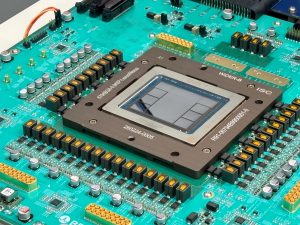
[News] Intel’s Advanced Packaging, Led by EMIB-T, Set to Hit Its Stride in 2029; DRAM Manufacturing Ruled Out

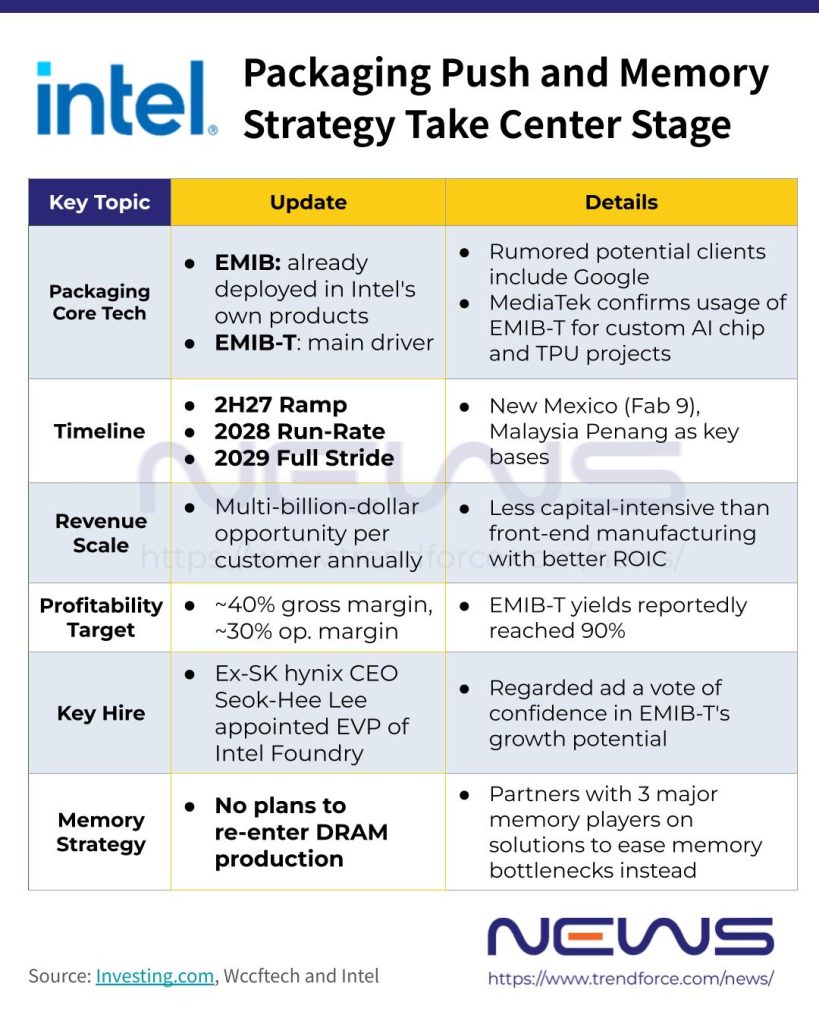
Intel is gaining momentum in advanced packaging, with tech giants such as Google reportedly showing interest in its EMIB (Embedded Multi-die Interconnect Bridge) technology amid ongoing CoWoS supply constraints. Citing CFO David Zinsner’s remarks at Deutsche Bank’s 2026 Technology Conference on August 26, Investing.com reports that Intel expects advanced packaging revenue, led primarily by EMIB-T, to ramp in 2H27, become a steady contributor in 2028 and hit its stride in 2029.
Memory was another key topic at the conference, as AI reshapes the strategic importance of memory. Tom’s Hardware previously reported that Intel CEO Lip-Bu Tan had hinted at a potential return to the memory market. Zinsner, however, clarified that Intel has no plans to re-enter DRAM manufacturing, according to Investing.com.
Advanced Packaging Eyes 40% Gross Margin
Notably, Zinsner highlighted the scale and profitability potential of Intel’s expanding advanced packaging business. According to Investing.com, the opportunity could be worth several billion dollars per customer annually, with the business targeting around 40% gross and 30% operating margins. Its relatively low capital intensity versus front-end manufacturing could also support strong ROIC, he added.
In Zinsner’s words, Intel is “already eating our own dog food” with EMIB, indicating that the company is already deploying the technology in its own products. Building on EMIB, EMIB-T eliminates the need for an interposer, further enhancing the technology’s appeal and potential for broader adoption, he said.
According to Wccftech, Intel’s Clearwater Forest, or Xeon 6+, CPU features twelve EMIB tiles using 2.5D packaging. The design integrates three active base tiles with two I/O tiles and twelve compute tiles. The I/O tiles are built on Intel 7, while the active base tiles use Intel 3 and the compute chiplets are manufactured on Intel 18A, the report explains.
SK hynix Veteran’s Appointment Signals Intel’s Packaging Push
Lip-Bu Tan’s appointment of former SK hynix CEO Seok-Hee Lee as Intel Foundry’s executive vice president could fuel speculation that Intel is considering a return to memory manufacturing. However, according to an Investing.com transcript, Intel CFO David Zinsner instead pointed to Lee’s appointment as a strong vote of confidence in the growth potential of EMIB-T.
Bringing in an executive of Lee’s caliber to lead the business underscores Intel’s confidence in the opportunity and its long-term prospects, he added.
Intel Stays Out of DRAM Manufacturing
Notably, while Intel is developing memory-related technologies such as XHBM and Z-angle Memory (ZAM), Zinsner pushed back on speculation that the chipmaker plans to return to memory manufacturing.
According to Investing.com, he said Intel has no plans to resume DRAM production. Instead, Intel is working with three major memory players on AI-focused products and architectures designed to ease memory bottlenecks. Management emphasized that the company’s focus will remain on system-level memory solutions rather than manufacturing memory itself, according to the Investing.com transcript.
Read more
- [News] Hot Chips 2026: Samsung’s zHBM Claims 70% Power-Efficiency Gain; SK hynix Evaluates Intel EMIBs
- [News] Intel and Memory: A History of Exits, and a New Bid to Return
(Photo credit: Intel)