[News] From Pricing War to Pricing Power: Behind Samsung Foundry’s Reported up to 15% Price Hikes
Samsung’s foundry revival has become a hot topic, as Reuters reported earlier that the company has raised 4nm-led advanced nodes prices by up to 15%, with Chinese clients seeing the largest degree of hikes. The interpretation behind this move, according to ijiwei, could signal a fundamental shift in foundry pricing: with leading-edge capacity now increasingly constrained, pricing is shifting toward supply-demand dynamics and capital intensity, which is less connected with higher yields and lower costs.
Samsung Raises Prices Across Multiple Nodes
The reported price increase takes place against the backdrop of Samsung’s tight capacity. According to an early August Chosun Biz report, Samsung Electronics’ foundry business is on track to reach full utilization in the second half of the year, with current capacity utilization estimated at 70%–80%.
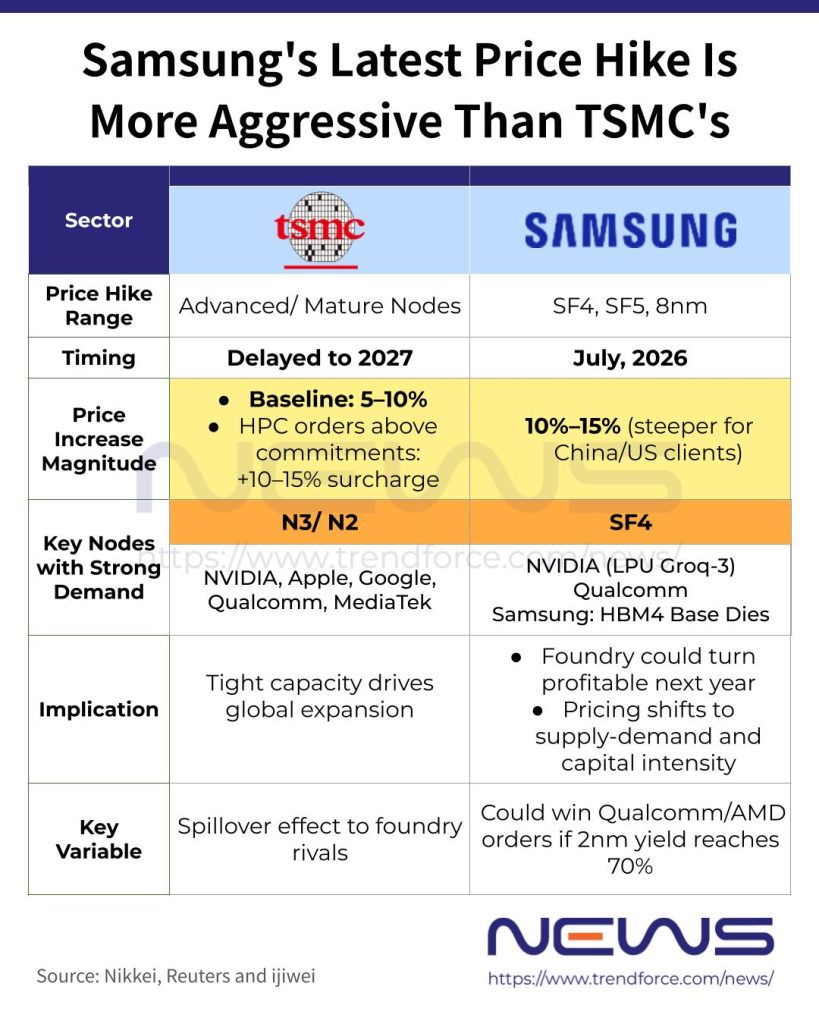
The capacity squeeze is already showing up in SF4 pricing. Reuters reports that Samsung raised prices for the 4nm node in July, with SF4 customers in China and the U.S. facing increases of 10%–15%, while customers in Taiwan, home to TSMC, saw more moderate hikes of 5%–10%.
Notably, Samsung’s SF4 capacity is also drawing strong demand from major tech companies. Reuters reports that Google is in talks to manufacture chips on SF4, while Qualcomm is already a customer.
Ijiwei adds that NVIDIA’s Groq-3 inference LPU is also seeing higher-than-expected production volumes, further lifting demand for 4nm. Samsung’s 4nm lines are meanwhile running at full utilization to produce base dies for its own HBM4 chips, putting additional pressure on supply.
The price increases extend beyond SF4, with more mature nodes also seeing higher pricing. Reuters adds prices for the SF5 process rose by 10%–15%, while those for the 8nm node climbed by nearly 10%.
Samsung’s Pricing Strategy Takes a Turn
However, just a year ago, Samsung was still relying on aggressive pricing to win orders. A 2025 DealSite report said the company was likely to offer Tesla a discounted price to secure its massive AI6 order on 2nm. Tom’s Hardware later put Samsung’s 2nm pricing at around $20,000 per wafer—about one-third below TSMC’s reported $30,000.
For Samsung, the yield gap made price its main competitive weapon. According to ijiwei, its 3nm GAA process once posted yields as low as 20%, pushing wafer costs to around $14,000 versus roughly $8,000 at TSMC.
That disadvantage left Samsung with little choice but to compete on price. Now, tightening leading-edge capacity is changing the equation, with supply scarcity and massive capital investment playing a bigger role in determining pricing power, ijiwei notes.
Notably, Samsung’s latest price increases have even outpaced those of foundry leader TSMC. A July Nikkei report said TSMC plans to defer its next round of price hikes until 2027, giving customers more time to prepare following negotiations. Its prices for both advanced and mature nodes could rise by up to 10% next year, according to Nikkei.
That puts Samsung’s current pricing move in sharper relief: its increases of up to 15% are arriving earlier and exceeding TSMC’s reported planned hikes, underscoring how quickly Samsung’s pricing position is changing as foundry capacity tightens.
Yields Remain Key
Still, 2nm yields remain a critical hurdle for Samsung Foundry’s recovery. According to Seoul Economy News, the industry is watching closely to see whether Samsung can lift 2nm yields from an estimated 60% to the 70% range—a level considered necessary to secure large-scale production from major customers such as Qualcomm and AMD.
The pace of Samsung’s foundry recovery will therefore depend on both yield improvements and rising fab utilization in the second half of the year. The report also notes that Samsung’s second-generation 2nm process, SF2P, is expected to enter mass production for mobile products in the second half of 2026, potentially adding another growth driver as the company works to expand its 2nm customer base.
Read more
- [News] Samsung Foundry Eyes 2H26 Full Utilization as HBM4 Base Dies and U.S. Orders Fuel Turnaround Hopes
- [News] Samsung Foundry Reportedly in Talks With Chinese Carmakers Like BYD for 2nm, 4nm Autonomous Driving SoCs
(Photo credit: Samsung)