[News] Intel May Tap TSMC N2X for Some Razor Lake Chips in 2027, Depending on 18A-P Performance
Competition between Intel and TSMC in advanced process is intensifying as both push ahead with their next-generation roadmaps. According to Commercial Times, Intel’s Razor Lake processors would reportedly adopt TSMC’s 2nm N2X process, potentially expanding Intel’s use of TSMC across the 2nm family. TechPowerUp notes that Intel may pursue a dual-sourcing strategy for Razor Lake, similar to its approach with the upcoming Nova Lake, depending on the performance of its own 18A-P node.
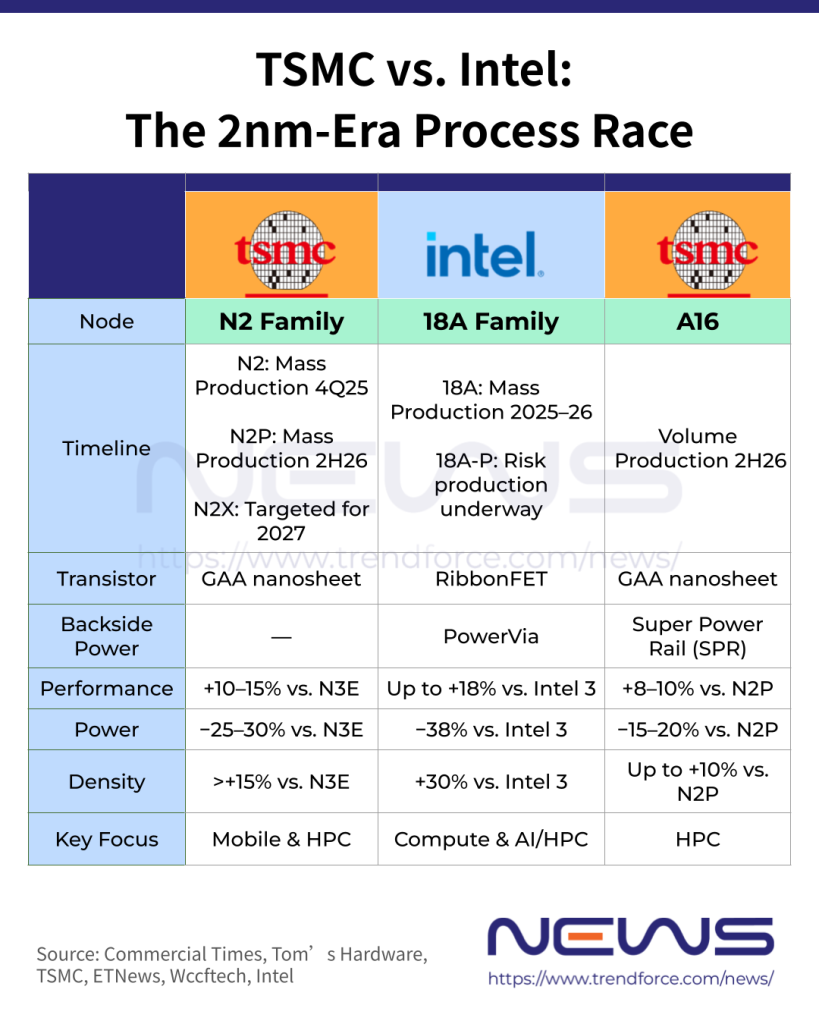
Such a strategy could give Intel greater flexibility as it continues to develop its own advanced nodes. The Commercial Times report notes that outsourcing some compute dies to TSMC could reduce risk as Intel balances launch schedules, performance, and capacity for high-end CPUs. The move could also intensify competition for TSMC capacity, with Wccftech noting that Intel’s strategy may complicate AMD’s efforts to secure additional supply, which is already severely constrained. Tom’s Hardware adds that TSMC’s process roadmap places N2X in 2027, aligning with the expected timeline for Razor Lake.
Intel continues to advance its own manufacturing roadmap. As noted by HotHardware, 18A-P has entered risk production. Unlike TSMC N2, Intel 18A already features PowerVia backside power delivery. Intel is also adopting High-NA EUV, while TSMC N2 continues to use conventional EUV. Intel is also moving ahead with its next-generation 14A process. Reuters and Wccftech, citing CEO Lip-Bu Tan, note that Intel now targets high-volume production in 2028, bringing 14A onto a similar production timeline as TSMC’s A14.
TSMC, however, is progressing with its own backside power implementation. According to ETNews, the company has successfully developed and validated A16 with its Super Power Rail (SPR) technology while retaining N2P’s gate density and NanoFlex design flexibility. Compared with N2P, A16 delivers 8–10% higher speed at the same power or 15–20% lower power at the same speed, along with an 8–10% increase in density. Mass production is scheduled to begin in 4Q26.
Beyond process technology, Intel is also advancing its CPU architecture strategy. Sources cited by Commercial Times note that its Nova Lake desktop processors will adopt bLLC (Big Last-Level Cache), increasing last-level cache capacity to reduce memory latency and positioning the technology as a response to AMD’s 3D V-Cache.
TSMC Pushes Advanced Node Roadmap
TSMC’s advanced process roadmap continues to move forward. As noted by Economic Daily News, Samsung has pushed back mass production of its 1.4nm process from 2027 to 2029, one year later than TSMC’s A14. Industry sources expect TSMC to continue benefiting from its technology lead, supporting further revenue and profit growth. Sources also say A16’s initial customer lineup includes Apple and NVIDIA, along with emerging AI players.
Looking further ahead, TSMC’s A14 is scheduled for mass production in 2028, followed by A13, an extension of the A14 family, in 2029. Economic Daily News notes that A12, featuring TSMC’s second-generation Backside Power Rail solution, is also planned for mass production in 2029.
Read more
- [News] Intel Might Build Up to 90% of Nova Lake Compute Tiles on 18A, Scaling Back TSMC’s Planned Role
- [News] Intel Pulls Forward 14A Timeline by One Year, Targeting 2028 Mass Production Near TSMC’s Roadmap
(Photo credit: Intel)