[News] Chip Equipment Crunch Reportedly Pushes Lead Times to 24 Months, Giving China’s Toolmakers a Boost
Memory and AI chips aren’t the only hot commodities in semiconductors. The bottleneck is shifting from “not enough chips” to “not enough equipment to make them,” ijiwei reports, adding that with critical component shortages stretching lead times for front-end and memory tools to 12–24 months, China’s domestic equipment makers could be poised for a new wave of opportunities.
Equipment Crunch Puts Pressure on Chipmakers
Citing SEMI, ijiwei says the latest semiconductor supercycle is being driven by sub-3nm logic, rising 3D NAND layer counts, and global mature-node capacity expansion. Against this backdrop, heavy investment in leading-edge logic, advanced memory, testing and packaging is expected to sustain equipment market growth over the next five years, the report adds.
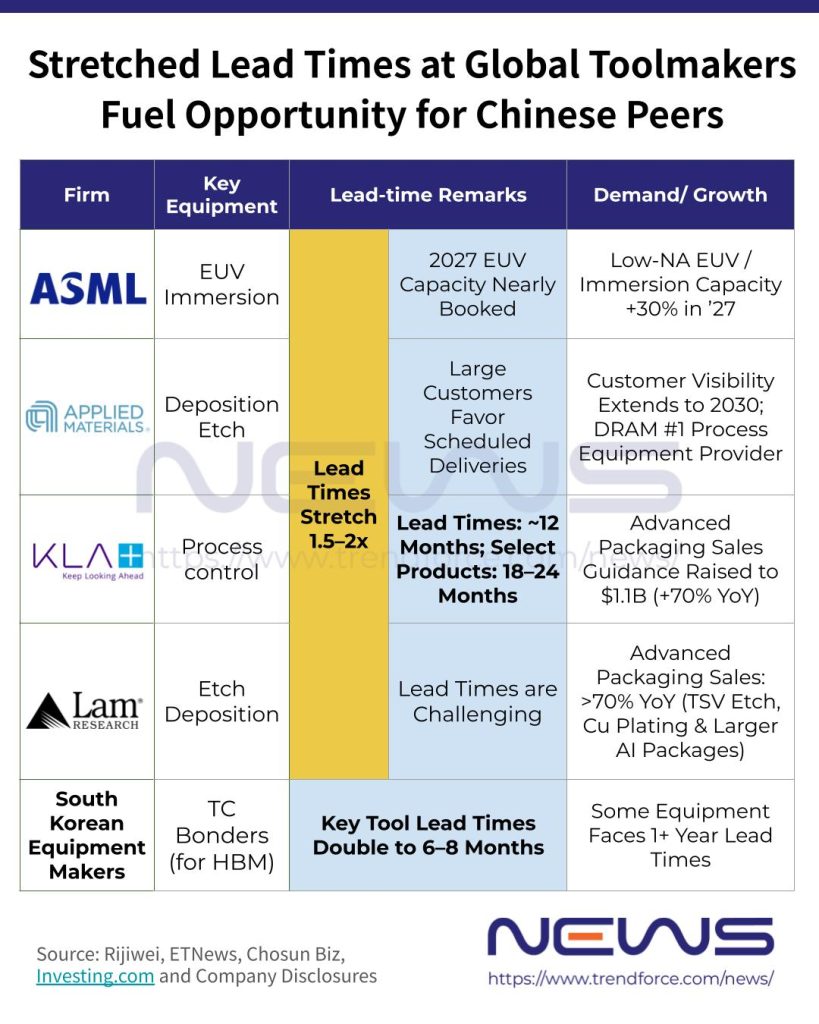
However, as demand surges, chipmakers are scrambling for equipment. As reported by ETNews, lead times for key equipment from the top five semiconductor equipment makers—Applied Materials, ASML, Lam Research, Tokyo Electron, and KLA, which collectively account for around 70% of the global market, have stretched by 1.5 to 2 times.
Ijiwei similarly reports that lead times for conventional etch and thin-film deposition tools have doubled to 12 months, while high-end packaging and testing equipment now faces lead times of more than 18 months. For imported RF power supply equipment, lead times can stretch to as long as 24 months, the report adds.
The equipment crunch is increasingly putting major semiconductor customers under pressure. According to ETNews, a South Korean supplier of front-end and back-end tools to TSMC and Micron has seen lead times for some equipment stretch from 3–4 months to 6–8 months. Meanwhile, Samsung and SK hynix are reportedly exploring earlier equipment orders to secure supply as they advance multiple fab projects.
ASML’s order book offers another clear sign of just how tight equipment demand has become. In an Investing.com transcript, CFO Roger Dassen said Low-NA EUV capacity is already nearly fully booked for 2027, prompting ASML to plan a roughly 30% capacity increase. For 2028, the company has already received a significant number of Low-NA EUV orders, with strong customer demand prompting it to explore another 30% capacity increase.
ASML is seeing similarly strong demand for immersion systems. The company plans to increase immersion capacity by 30% in 2027 and is evaluating a further 30% expansion in 2028, Dassen said.
China’s Equipment Makers Gain an Edge
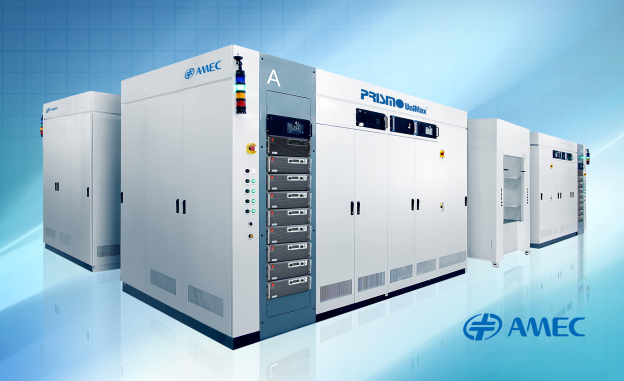
China’s semiconductor equipment makers could be poised to benefit from shorter lead times and rising demand for domestic alternatives. According to ijiwei, with global lead times for etch and thin-film deposition tools stretching to 12 months, domestic players are offering faster delivery: AMEC, China’s leading etch equipment maker, has a lead time of roughly nine months, while Piotech, a major thin-film deposition equipment (CVD) supplier, can deliver in around 10 months.
The opportunity is particularly significant given China’s scale in semiconductor equipment demand. Citing SEMI, ijiwei reports that China accounted for 36.51% of global equipment sales in 2025, making it the world’s largest buyer. Yet domestic suppliers served only around 23% of demand, leaving substantial room for local players to expand, the report notes.
That opportunity is being reinforced by aggressive capacity expansion among China’s leading chipmakers. As noted by ijiwei, SMIC is keeping equipment-related capex above $8 billion in 2026, while CXMT launched a new round of equipment tenders in Q2 and plans to add 50,000–60,000 wafers of monthly capacity this year, implying RMB35–43 billion in equipment purchases. YMTC is also advancing construction of its third-phase fab, adding to equipment demand, the report adds.
With demand rising, domestic penetration still low and overseas lead times stretched, China’s equipment makers are entering a rare window to accelerate growth and capture market share.
Read more
- [News] U.S. Export Curbs Backfire? Samsung, SK hynix Reportedly Mull AMEC’s Tools as China Fab Backup
- [News] China’s AMEC Reportedly Produces Some of the Most Advanced Etching Tools; SMIC Purchased 800+ Machines
(Photo credit: AMEC)