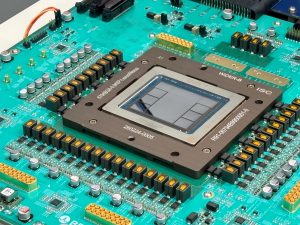
[News] Sandisk Reportedly Tapes Out First HBF Product, Targets 2027 Samples and 2028 Production
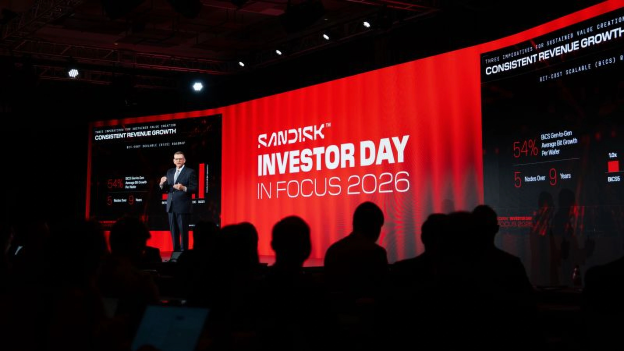
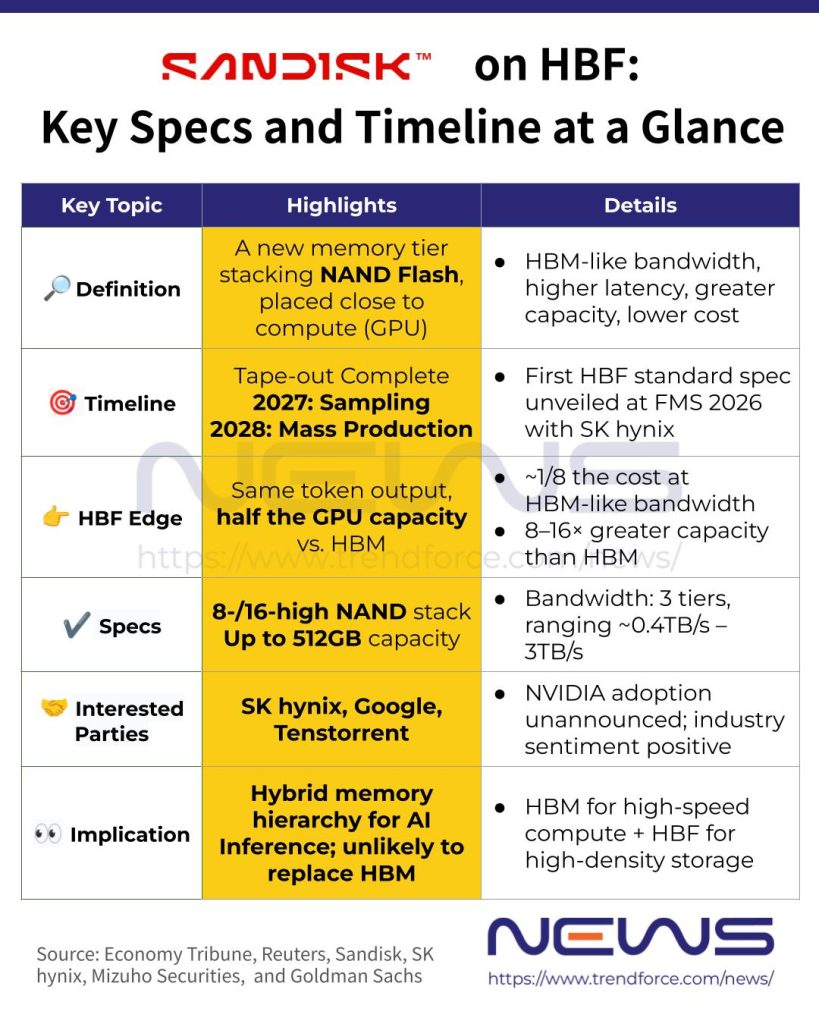
Just days after unveiling the first High Bandwidth Flash (HBF) standard specifications with SK hynix in early August, Sandisk offered further details at its August 13 Investor Day. According to notes from Mizuho Securities and Goldman Sachs, the company has already taped out its first HBF product, with initial samples slated for 2027 and mass production expected to begin in 2028.
A Goldman Sachs note, shared by Institutional TMT researcher Nicholas Mugalli on X, highlights HBF’s potential to tackle the AI “memory wall” by combining HBM-class read bandwidth with 8–16× greater capacity. Sandisk’s simulations also suggest that an HBF-only architecture could deliver the same token output with half the GPU capacity required by an HBM-only setup, according to Goldsman Sachs.
As noted by Economy Tribune, Sandisk’s analysis suggests four GPUs equipped with HBF delivered the same token output as eight HBM-based GPUs when running large AI models. The result suggests HBF could ease memory-capacity constraints, reduce the need for additional GPUs, and ultimately lower AI inference infrastructure costs, the report adds.
The report explains that HBF is a memory technology that stacks NAND flash instead of DRAM and places it close to computing devices such as GPUs. While targeting bandwidth close to HBM, HBF has higher latency as well as greater capacity at a lower cost.
Mizuho Securities, on the other hand, believes HBF is unlikely to replace HBM outright, but could enable disaggregated architectures for AI inference, while the HBF consortium, which includes Google, Meta, SK hynix, and Tenstorrent, is working to advance this approach.
This is in line with TrendForce’s observation, which notes that although NVIDIA has yet to announce any plans to adopt the technology, industry sentiment remains broadly positive. TrendForce believes the long-term architecture will likely combine HBM for ultra-high-speed computation with HBF for high-density data storage, creating a hybrid memory hierarchy that could become a key enabler of large-scale AI commercialization.
According to the HBF standardization details unveiled earlier by SK hynix at the opening of Future of Memory and Storage (FMS) 2026, the inaugural specification supports capacities of up to 512GB using 8-high and 16-high NAND stack configurations, with three bandwidth tiers (Grade 1–3) delivering roughly 0.4TB/s to 3.0TB/s.
Mid-to-High-Teens Growth, 80% Gross Margins Through FY2030
On the other hand, Reuters, citing Sandisk, reports that the company expects revenue to expand at a mid-to-high-teens rate from FY28 through FY30, supported by robust demand as AI infrastructure investment accelerates.
The outlook is reinforced by Sandisk’s New Business Model (NBM), which CFO Luis Visoso said will help sustain adjusted gross margins at around 80%, the report adds. The company has secured NBM agreements with eight customers, including three U.S. hyperscalers, covering roughly 50% of storage output in FY2027 and two-thirds in FY2028, providing greater visibility into future demand.
Read more
- [News] SanDisk Goes Beyond HBF: Patent Bonds Processor onto NAND Tile, with HBM Stacks on Shared Interposer
- [News] SK hynix, SanDisk Debut HBF Standard to Challenge AI Memory Bottlenecks with Google, Tenstorrent Support6
(Photo credit: Sandisk)