[News] U.S. Export Curbs Backfire? Samsung, SK hynix Reportedly Mull AMEC’s Tools as China Fab Backup
China’s leading etching equipment maker, Advanced Micro-Fabrication Equipment (AMEC), could emerge as an unexpected beneficiary of tightening U.S. export controls. According to Reuters, Samsung Electronics and SK hynix are evaluating AMEC’s semiconductor equipment for potential use at their China fabs, as the memory giants seek to reduce supply chain risks amid uncertainty over future U.S. restrictions.
AMEC’s tools are already deployed at major Chinese chipmakers, including NAND flash producer YMTC, giving Samsung and SK hynix greater confidence in the maturity and performance of the equipment, the report says.
Beyond the memory market, AMEC has also expanded its presence in foundry applications. Citing AMEC CEO Gerald Yin Zhiyao, the South China Morning Post reports that the company’s etching technology supports processes ranging from mature 65nm nodes to advanced 5nm and 3nm nodes, with some products already adopted by TSMC. Another TechNews report points out that SMIC has purchased at least 800 pieces of equipment from AMEC.
Samsung, SK hynix Eye Chinese Equipment Backup
Samsung Electronics told Reuters that it has not tested AMEC equipment for potential use at its China facilities and has not considered adopting the tools, while SK hynix declined to comment on whether it is evaluating the Chinese supplier’s equipment.
Nevertheless, the reported evaluations highlight how the memory giants are preparing for greater uncertainty around semiconductor export controls.
In 2023, the U.S. Commerce Department granted Samsung and SK hynix’s China fabs “validated end user” (VEU) status, allowing them to import certain controlled U.S. equipment without individual licenses. After Washington revoked the VEU authorization in 2025, the two companies received annual licenses in 2026 to continue importing chipmaking equipment into China.
Against this backdrop, Reuters reports that they are now keeping Chinese suppliers as a backup option to maintain and upgrade existing production lines, rather than using them to expand China manufacturing capacity.
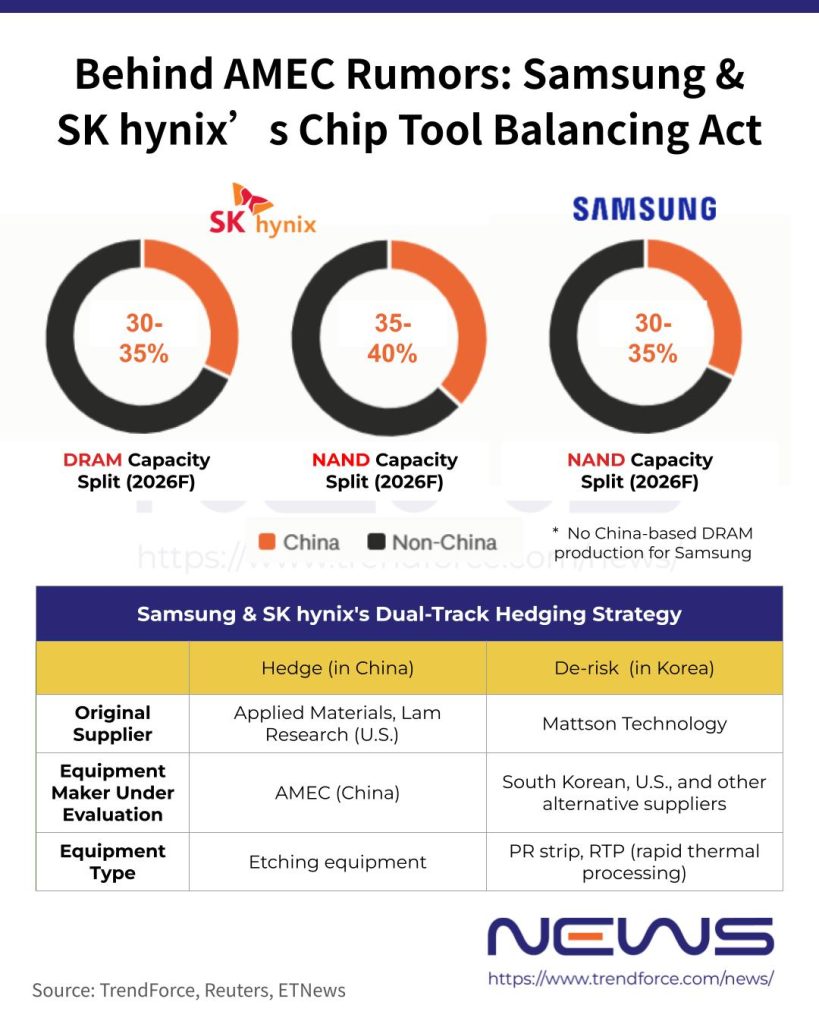
China continues to serve as a critical manufacturing base for both Samsung and SK hynix, although production there is primarily focused on more mature memory products. In 2026, an estimated 30%–35% of SK hynix’s global DRAM output is expected to come from its China operations, while China-based NAND production is projected to account for around 30%–35% of Samsung’s total NAND capacity and 35%–40% of SK hynix’s, according to TrendForce.
Samsung operates its NAND flash fab in Xi’an, while SK hynix runs NAND production in Dalian and a DRAM facility in Wuxi. These China operations rely heavily on etching equipment supplied by U.S. chipmaking toolmakers, including Applied Materials and Lam Research, Reuters reports.
A Dual Strategy: De-risking via Decoupling
Interestingly, while chip giants explore Chinese tools as a contingency plan for their China operations, they are simultaneously de-risking their broader supply chains by reducing reliance on Chinese equipment in sensitive or advanced nodes.
According to a July report by ETNews, Samsung and SK hynix—concerned that Washington could further tighten controls—are moving to replace select Chinese-made tools with alternatives from South Korea, the U.S., and other regions.
Among these efforts, the memory makers are reportedly scaling back their use of equipment from Mattson Technology, a U.S.-based company acquired by Chinese capital, ETNews reports, adding that tools under review include photoresist (PR) strip systems and rapid thermal processing (RTP) equipment.
This dual track mirrors earlier moves by TSMC. As the report noted, the foundry giant had already excluded equipment from both Mattson and AMEC from its cutting-edge 2nm manufacturing lines last year to comply with shifting geopolitical boundaries.
Read more
- [News] Samsung, SK hynix Reportedly Look Beyond Chinese Tool and Component Suppliers Amid Supply Chain Risks
- [News] TSMC Reportedly Eliminates Chinese Equipment Use in 2nm Production as U.S. Rules Loom
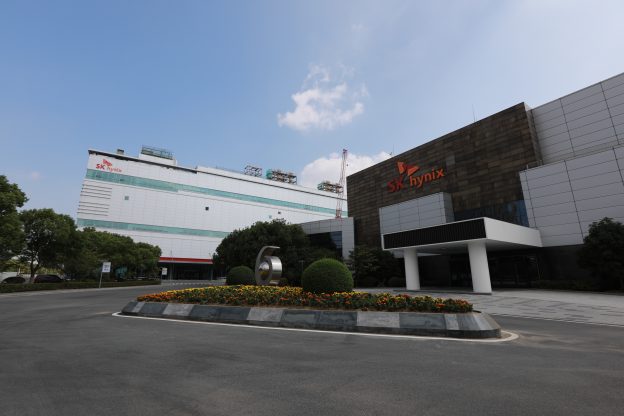
(Photo credit: SK hynix)