[News] AMD’s Helios AI Rack Challenges NVIDIA with HBM4 Memory Edge; Microsoft Joins as Latest Customer
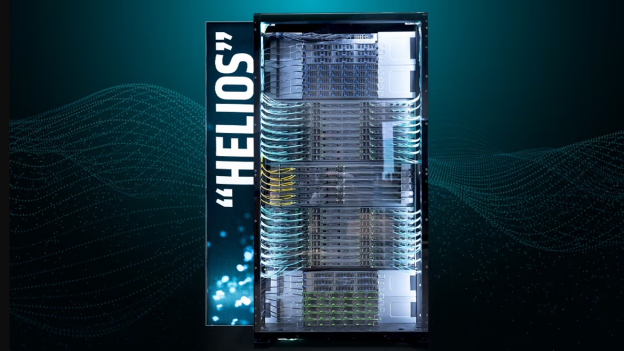
NVIDIA’s blockbuster Grace Blackwell and the upcoming Vera Rubin platforms are facing a direct challenger. As reported by CNBC, AMD is set to ship its first rack-scale AI system, Helios, later this year, with Microsoft becoming the latest customer to join Meta, OpenAI and Oracle.
Microsoft said it will deploy Helios in its data centers to power frontier AI model inference for its own services, AI customers, and Azure AI offerings. The company will also introduce two new compute instances powered by AMD’s latest Venice CPUs — one optimized for agentic AI and data pipelines, and the other targeting semiconductor design workloads, CNBC reports.
Microsoft is among a growing list of major companies turning to AMD for AI acceleration. According to CNBC, AMD said that eight of the top 10 AI companies are already running workloads on its Instinct GPUs, including OpenAI, Cohere, and xAI, Elon Musk’s AI venture backed by SpaceX. The report adds that AMD expects tens of billions of dollars in AI data center revenue starting in 2027, driven largely by Helios deployments.
Helios Bets on Memory Advantage, Comes at a Premium
Notably, citing AMD CEO Lisa Su, CNBC says Helios is positioned as a competitive alternative to NVIDIA’s rack-scale AI systems, offering “significant benefits” in AI inference, memory bandwidth, and memory capacity.
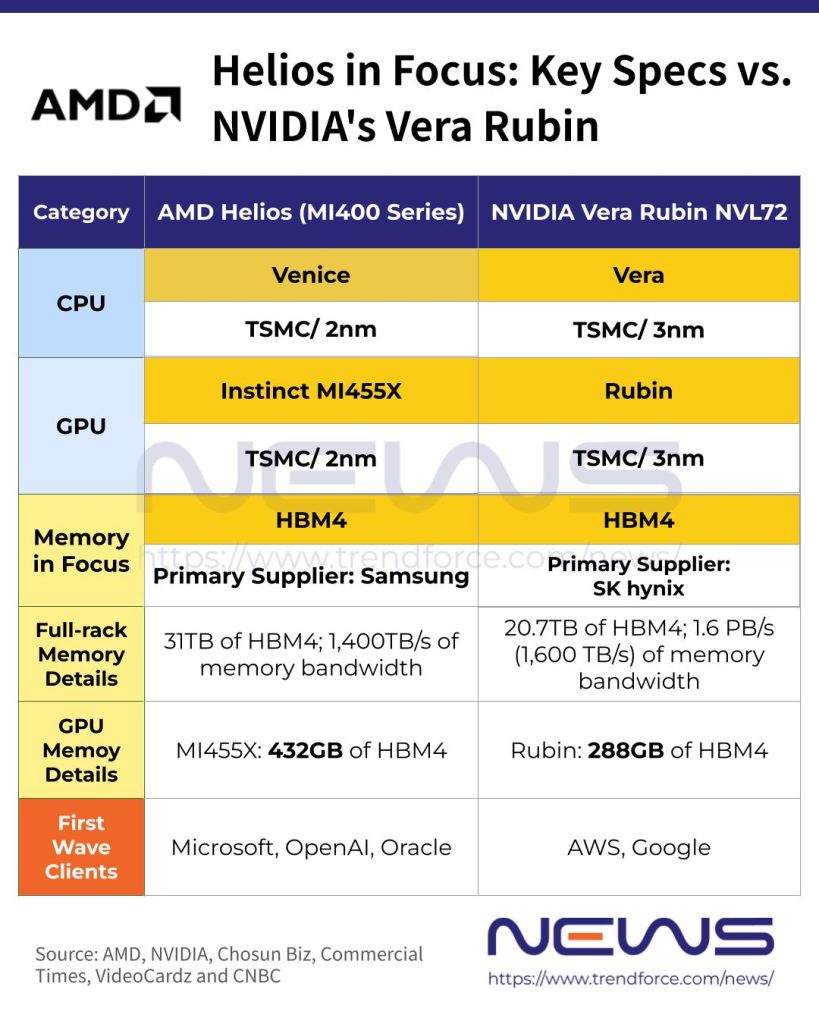
Those memory advantages are reflected in Helios’ architecture. A June report from Tom’s Hardware, which saw AMD’s Helios rack showcased at COMPUTEX, said the system will feature AMD’s 6th-generation EPYC Venice CPUs with up to 256 cores, paired with 72 Instinct MI455X AI accelerators. It will pack 31TB of HBM4 memory and deliver 1,400TB/s of memory bandwidth.
AMD, according to Tom’s Hardware, estimates Helios will deliver around 2,900 FP4 dense PFLOPS of compute performance. While the system may trail NVIDIA’s VR200 NVL72 in raw compute power, it is expected to hold an advantage in HBM4 memory capacity — a key factor for memory-intensive AI workloads such as large language model inference, per the report.
In addition to its compute and memory capabilities, Helios will also incorporate Pensando networking technology. Each tray will feature up to 12 Pensando-based networking chips, leveraging tech from AMD’s 2022 acquisition of Pensando. CNBC notes that Pensando has become a key component in AMD’s effort to build the hardware stack behind Helios.
Pricing, however, remains undisclosed. Citing Futurum Group, CNBC estimates Helios could cost $5 million–$5.5 million per rack, compared with $3.5 million–$4 million for NVIDIA’s next-generation Vera Rubin platform.
Memory, Foundry Partners in Focus
On the other hand, Chosun Biz highlights the shifting HBM competitive landscape among South Korea’s memory giants. With MI450 expected to require more HBM4 capacity than NVIDIA’s next-generation products, the report expects AMD to play a growing role in Samsung and SK hynix’s HBM supply chains.
According to Chosun Biz, AMD’s MI450 is reportedly set to feature 432GB of HBM4 memory per GPU, around 150GB more than NVIDIA’s Vera Rubin GPU, which is expected to carry 288GB.
Notably, the report adds Samsung has secured a key HBM4 supplier role for AMD’s next-generation accelerators, while also passing final quality validation for NVIDIA’s Rubin-based HBM4. Its HBM4 production yield is reportedly expected to improve from around 50% in the fourth quarter of last year to 60–70% in the second half of this year.
Meanwhile, SK hynix is believed to hold a larger share of NVIDIA Rubin-related HBM4 supply, while leaving room for potential expansion into AMD’s ecosystem, Chosun Biz suggests.
On the foundry front, Commercial Times reports that Venice will become one of the first enterprise CPUs built on TSMC’s 2nm process, while the Instinct MI450, MI455, and next-generation MI550 series are also expected to draw significant market attention.
AMD has also indicated that MI450 AI accelerators will adopt TSMC’s 2nm technology, according to a late 2025 TechPowerUp report. Further details from semiconductor leakers cited by the report suggest that the N2P node will be used for the accelerator core die (XCD). The MI450, therefore, is expected to compete directly with NVIDIA’s Rubin platform, which is built on TSMC’s 3nm (N3P) process.
Read more
- [News] Samsung Foundry Reportedly in Talks with AMD for 2028 CPU Production as BYD, Google Consider Its Services
- [News] AMD Zen 7 Reportedly Built on TSMC A14 Node as Powertech’s FOPLP Packaging Said to Be Under Evaluation
(Photo credit: AMD)