[Sponsored Content] Breaking AI Server Integration Barriers: How ARDGE and Advantech Make Enterprise On-Premises AI Deployment Practical
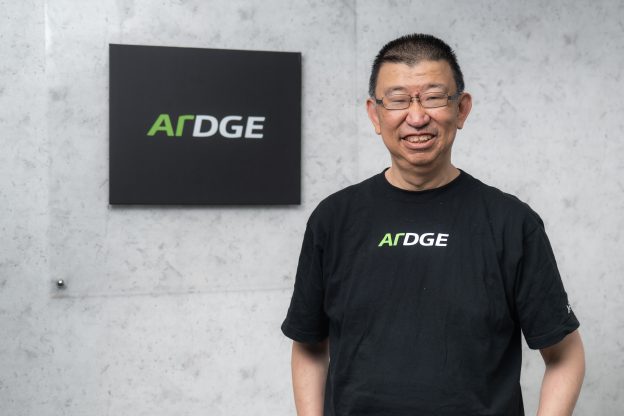
At GTC Taipei 2026 this June, NVIDIA founder and CEO Jensen Huang declared that “the era of useful AI has arrived,” signaling the industry’s transition from AI model training to inference and real-world deployment. Jensen Huang also reaffirmed his vision of the AI Factory. Under the AI Factory model, computing power is no longer merely a hardware expense but a revenue-generating asset. As tokens become measurable units of economic value, how can enterprises build AI factories of their own? Peter Chiu, CTO of ARDGE, a company specializing in on-premises enterprise AI deployment, draws on frontline implementation experience to explain the most common challenges organizations face when adopting AI—and how they can move beyond proof-of-concept (PoC) projects toward large-scale deployment and reliable operations.
From AI Inference to Real-World Deployment: Operations Become the Biggest Challenge
The rapid rise of AI agents is reshaping not only how individuals use AI, but also accelerating enterprise AI adoption. Peter Chiu observes that since early 2026—particularly following the viral success of the AI agent tool “OpenClaw”—enterprise inquiries about deploying AI workflows to on-premises servers have surged, with manufacturers and companies undergoing digital transformation being the most proactive. The reason is simple: agent tools like these need an enterprise on-premises environment to run on.
Yet when discussions begin, meetings often turn into a game of “passing the buck” between business units and IT teams. For departments such as sales, customer service, R&D, and manufacturing, AI agents represent digital employees capable of solving real operational challenges. For IT teams, however, the focus quickly shifts to long-term operational concerns, including system maintenance, software updates, access control, data security, and regulatory compliance.
Chiu identifies the core issue: “What enterprises need today is no longer just an AI model—they need an AI service that IT teams can easily manage and maintain, enabling every department to use AI with confidence.”
Traditionally, deploying on-premises AI required IT personnel to manually install operating systems, configure complex GPU drivers, and set up the underlying software environment. This not only increased deployment complexity but also forced enterprises to invest heavily in dedicated IT teams for ongoing maintenance, resulting in significant costs and a high barrier to adoption.
Simplifying AI Infrastructure Deployment and Operations
To simplify the complexity of AI infrastructure orchestration and software operations, ARDGE developed ARX OS, an AI platform operating system that streamlines the entire deployment lifecycle. From model deployment and application service management to software upgrades and daily operations, every step is presented through an intuitive graphical interface, allowing IT teams to manage networking, storage, and GPU drivers with just a few clicks.
Chiu emphasized that software platforms can only deliver their full value when built on a stable and flexible hardware foundation. This is why ARDGE has partnered closely with Advantech. While Advantech provides a diverse portfolio of industrial-grade, validated AI server hardware, ARDGE focuses on simplifying system operations. By optimizing hardware and software together from the ground up, the two companies enable a truly plug-and-play on-premises AI infrastructure that is easy to deploy and maintain.
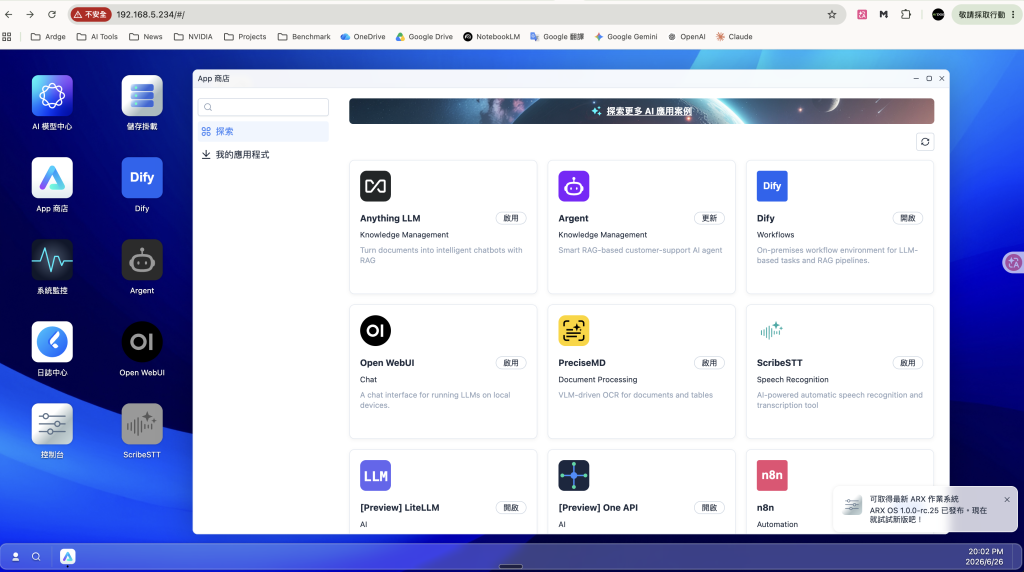
▲ ARX OS in action. At this year’s CES, ARDGE received the CES 2026 TechRadar Pro Picks Award for its ARX OS platform and ARX-100 AI server. (Source: ARDGE)
As enterprise data continues to grow in volume and sensitivity, making cloud deployment impractical, on-premises AI has become a pragmatic solution that balances performance with data security. Chiu cited the example of an organization with an extensive archive of long-form interview videos. Uploading the entire collection to the cloud for analysis would not only be time-consuming but could also raise concerns about data leakage. By connecting ARX OS to the organization’s existing NAS storage, the videos can be processed entirely on-premises to build a retrieval-augmented generation (RAG) knowledge management system. This enables staff to quickly locate relevant video segments while avoiding additional storage infrastructure costs.
However, not every AI workload is best suited for an entirely on-premises deployment. More compute-intensive tasks—such as complex reasoning, long-form content generation, or presentation creation—may still benefit from the capabilities of large cloud-based LLMs. According to Chiu, the ARX platform will support a hybrid AI workflow by applying de-identification policies before data is sent to the cloud, automatically masking sensitive information such as names and personally identifiable information (PII). This allows enterprises to leverage cloud LLM compute while maintaining compliance with data security requirements.
Accelerating Enterprise AI Deployment Through Hardware–Software Integration
“The arrival of the inference era is, in reality, the arrival of the deployment era,” said Chiu. As enterprise AI adoption continues to accelerate, he believes that hardware platforms and software operations are equally critical to successful deployment. This is why ARDGE chose to partner with Advantech, leveraging the company’s strong end-to-end ecosystem. Upstream, Advantech works closely with Intel, NVIDIA, and AMD, offering a comprehensive portfolio of server processors and AI accelerators that can be tailored to different workloads, deployment scenarios, and computing requirements. Downstream, Advantech has long served manufacturers and enterprise customers across diverse industries, giving it deep insight into real-world operational needs.
Building on Advantech’s AI server platforms—including the SKY-602E3—ARDGE integrates manufacturing software and workflow tools into ARX OS for industrial applications such as smart manufacturing and Automated Optical Inspection (AOI). The combination bridges the final gap in enterprise on-premises AI deployment by simplifying system deployment, software updates, and ongoing operations.
With ARDGE’s expertise in IT management and AI application deployment, combined with Advantech’s extensive server portfolio and ecosystem, the partnership enables enterprises to move beyond simply deploying AI hardware to establishing AI environments that are fully manageable and maintainable. Whether organizations are starting with a single system for a small-scale deployment or scaling AI infrastructure across a large enterprise, the two companies can design hardware configurations and management architectures tailored to each customer’s workloads, user scale, and computing requirements.

AI Factories Are Not an Arms Race—Success Depends on Deployment and Operations
This year, enterprise on-premises AI deployments have faced another reality: rapidly rising hardware costs, particularly for memory. Many organizations spend months evaluating AI adoption, only to discover that infrastructure prices have climbed significantly by the time they’re ready to invest. In response, Chiu advises, “Don’t start by buying the biggest GPUs. Start with a deployment that is easy to implement and simple enough for your own IT team to manage.”
Looking ahead to the inference era, Chiu remains optimistic. “During the AI training era, the ecosystem was highly fragmented, and developers were often locked into specific hardware platforms. Today, inference engines are rapidly converging toward standardized architectures.” This shift is creating new opportunities for AI development to move beyond fragmented experimentation toward scalable, enterprise-ready deployment, laying the foundation for the next generation of AI factories.
Advantech’s extensive server portfolio and application ecosystem, combined with ARDGE’s IT management and AI deployment platform, provide enterprises with a complete solution spanning hardware selection, deployment, and ongoing software operations. Ultimately, organizations that take the first step—building AI on a platform that is manageable, governed, and secure—will be best positioned to transform AI into real business productivity and gain a competitive advantage in the emerging AI era.
To learn more about Advantech AI solutions ▲ Edge AI Systems – Advantech
To consult with an Advantech expert ▲ Contact Us
(Photo credit: TechNews)