[News] SK hynix Chair Dismisses HBM Slowdown Talk, Reportedly Says Clients Want Memory Capacity Up 5-6x
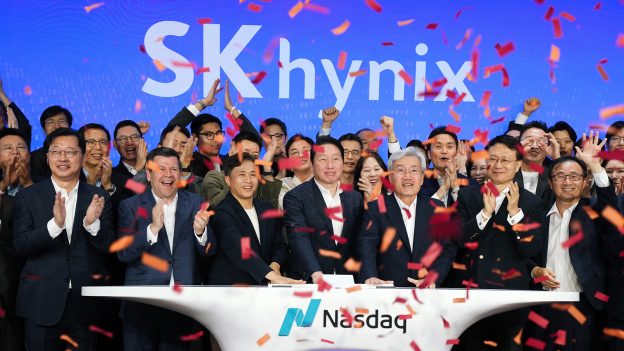
SK hynix has taken its first major step into global capital markets, with The Wall Street Journal reporting that its ADRs surged 13% last Friday following the memory chipmaker’s record $26.5 billion U.S. share offering—the largest ever by a foreign company. The stock, as noted by the report, closed its debut trading day at a $1.2 trillion market value, surpassing U.S. chip giants Micron and AMD.
Notably, in recent interviews with foreign media, SK hynix highlighted the looming memory supply crunch expected to peak in 2027, while also unveiling further details of its U.S. expansion strategy. Here are the key takeaways.
Supply Gap to Persist Beyond 2030
Hankyung, citing SK Group Chair Chey Tae-won, reports that customers are urging SK hynix to boost supply by “five to six times.” The remarks underscore the widening gap between surging AI-driven demand and available memory capacity, even as the company plans to aggressively expand production—with Chey previously telling Nikkei that SK hynix aims to triple wafer output by 2034.
The outlook also echoes SK hynix CEO Kwak Noh-jung’s assessment of the memory market. Citing Kwak, Reuters reports that the global memory industry is heading toward its most severe supply shortage ever in 2027.
Kwak, according to Reuters, added that SK hynix expects demand to remain above its supply capabilities even beyond 2030, but the company is continuing efforts to narrow the gap.
HBM Demand Shows No Signs of Slowing
Despite concerns that rising HBM costs and supply constraints could prompt tech giants, including NVIDIA and Google, to reduce HBM adoption, SK hynix pushed back against the narrative. Citing Chey, Hankyung reports that the company has seen no signs of weakening demand from major customers.
“We haven’t seen any signals that HBM demand is declining,” Chey said, adding that “our partners are actually asking us to further increase supply capacity for both this year and next.”
Still, as the AI industry seeks alternatives to ease reliance on HBM, new memory architectures are emerging. Qualcomm’s HBC (High-Bandwidth Compute) is one such approach, aiming to challenge NVIDIA’s dominance in AI accelerators.
According to Nikkei, HBC stacks low-power double data rate (LPDDR) memory chips directly on top of a logic die, reducing data movement to lower power consumption while boosting memory capacity. Qualcomm, per Nikkei, claims the technology can deliver up to six times higher bandwidth per watt than HBM, positioning it as a potential energy-efficient alternative.
U.S. Expansion Plans
As SK hynix and Samsung unveiled a combined KRW 800 trillion (US$532 billion) investment plan in Korea’s Honam region, the Trump administration is stepping up pressure on the two memory giants to expand manufacturing in the U.S., with Commerce Secretary Howard Lutnick urging them to build memory fabs on American soil, according to Bloomberg.
Against this backdrop, SK Group Chair Chey Tae-won signaled that SK hynix remains open to expanding its U.S. manufacturing footprint. In addition to its ongoing US$4 billion investment in an advanced packaging facility in Indiana, Chey, according to Hankyung, said further U.S. production expansion is possible—provided the right conditions are in place, including reliable power, clean water supplies, suitable sites, skilled talent, and a strong semiconductor ecosystem.
Meanwhile, Reuters suggests that SK hynix is also committing US$10 billion to establish an AI solutions business in the U.S., seeking new growth opportunities in the AI era.
Read more
- [News] New DRAM Price-Fixing Case Against Samsung, SK hynix, and Micron Tests Whether HBM Expansion Can Prove Collusion
- [News] SK hynix Reportedly Removes Price Cap in Memory Long-Term Agreements, Diverging from Micron
(Photo credit: SK hynix)