[News] New DRAM Price-Fixing Case Against Samsung, SK hynix, and Micron Tests Whether HBM Expansion Can Prove Collusion

In late June, Samsung, SK hynix, and Micron were sued in the U.S. by 14 consumers and three small PC assembly and distribution firms over allegations of coordinated supply cuts that pushed memory prices up nearly 700% in four years, drawing close industry attention to how the case will unfold.
Amid market speculations, Chosun Biz, citing legal experts, notes that parallel price hikes alone rarely prove collusion. To establish the claim, plaintiffs must show more concrete evidence that competitors coordinated behind the scenes—whether through sharing sensitive pricing or production data, or using industry meetings and associations as venues to align strategies, the report adds.
Notably, the case could unfold in two possible directions. Tom’s Hardware reports that the defendants have yet to respond in court and are expected to file motions to dismiss. Chosun Biz adds that if plaintiffs fail to provide sufficient evidence, the case could be dismissed before trial.
However, Tom’s Hardware points out that if the lawsuit survives, Samsung, SK hynix, and Micron — currently benefiting from the most profitable memory cycle on record — could be compelled to disclose internal communications related to HBM allocation and commodity DRAM reductions to plaintiffs’ attorneys for the first time.
Memory Giants Push Back on the Claims
Notably, Korea JoongAng Daily reports that both Samsung and SK hynix have responded to the allegations. Samsung dismissed the claims as unfounded, with a company spokesperson emphasizing that its business operations are conducted in full compliance with fair competition principles and all applicable laws and regulations.
On the other hand, SK hynix, according to the report, said it is currently reviewing the lawsuit, and will take appropriate action after completing the assessment.
HBM Shift at the Center of New Collusion Claims
Chosun Biz explains that the latest lawsuit centers on allegations that Samsung Electronics, SK hynix, and Micron — which collectively account for roughly 90% of the global DRAM market — coordinated to reduce production of legacy commodity DRAM, including DDR3 and DDR4, while using HBM expansion as justification.
Citing legal experts, the report compares the situation to village bakeries shifting their ovens toward more profitable wedding cakes, leaving basic bread in short supply and pushing prices higher. In this analogy, HBM represents the premium wedding cakes, while commodity DRAM represents everyday bread serving broader market demand.
According to Chosun Biz, the key difference from previous DRAM legal cases is the plaintiffs’ focus on the HBM transition and whether it can serve as direct evidence of coordinated supply reductions. However, a semiconductor attorney noted that a simple timing overlap between HBM expansion and DRAM production cuts may not be sufficient to prove collusion.
The memory makers, meanwhile, have their own defense. Chosun Biz notes that surging AI server demand provides a legitimate explanation for rising memory prices, allowing the companies to argue that market dynamics — rather than coordination — drove the increase. Recent capacity expansion plans by Micron in Hiroshima, SK hynix in Yongin, and Samsung further strengthen this argument, as companies intentionally restricting supply would have little reason to invest heavily in expanding production, the report adds.
A Look Back at the Legal Precedent
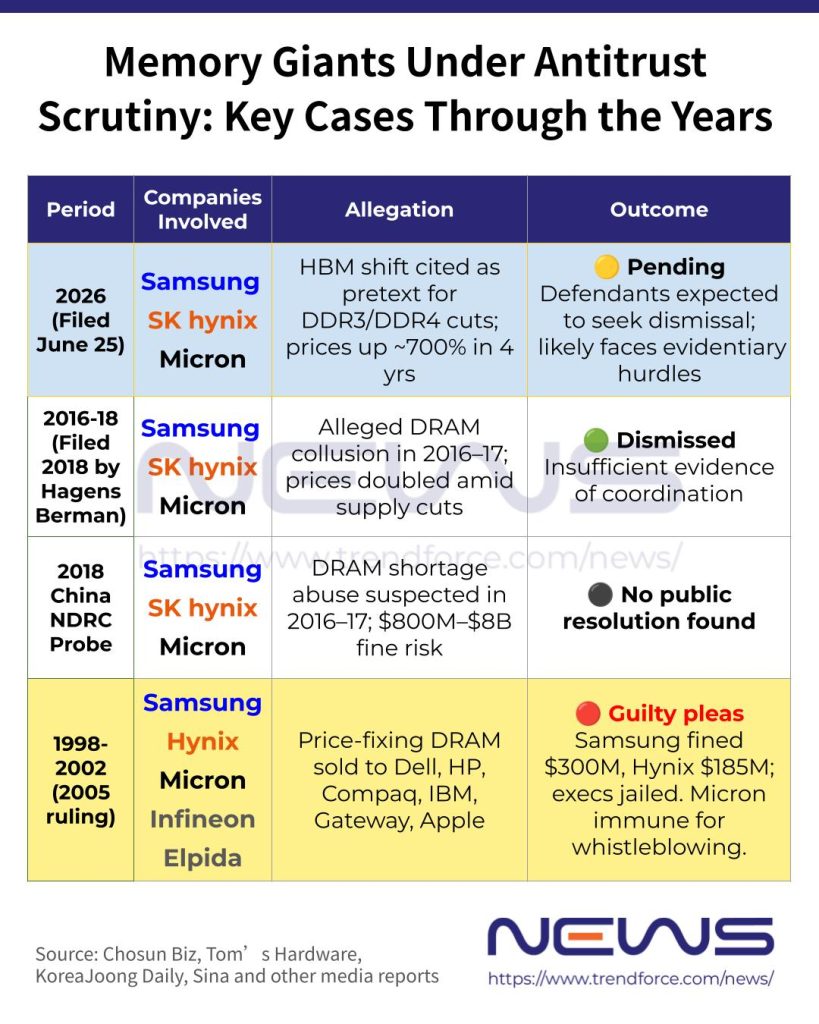
It is also worth revisiting past legal battles involving the memory industry. According to Tom’s Hardware, DRAM suppliers were found to have fixed memory prices sold to major PC makers, including Dell, HP, Compaq, IBM, Gateway, and Apple, between 1998 and 2002.
The case became a landmark antitrust action, with Samsung receiving a $300 million criminal fine in 2005 — the second-largest antitrust penalty in U.S. history at the time — followed by fines of $185 million for Hynix, $160 million for Infineon, and $84 million for Elpida, the report says.
Meanwhile, Korea JoongAng Daily notes that a closer precedent for the latest lawsuit can be found in a 2018 class-action case, which alleged that Samsung Electronics, SK hynix, and Micron coordinated to curb DRAM supply and push up prices during the 2016–2018 period.
The lawsuit, however, was ultimately dismissed by a federal district court in 2022, after judges concluded that the plaintiffs had not provided enough evidence to substantiate an agreement or coordinated effort among the three memory makers, the report adds.
Read more
(Photo credit: SK hynix)