[News] SK hynix Reportedly Removes Price Cap in Memory Long-Term Agreements, Diverging from Micron
As Micron announced another major Strategic Customer Agreement (SCA) with General Motors, the structure of global memory makers’ long-term supply agreements (LTAs) has come into focus. According to Green Economy News, SK hynix is now adopting contracts that eliminate the industry-standard price cap, marking a departure from Micron’s approach.
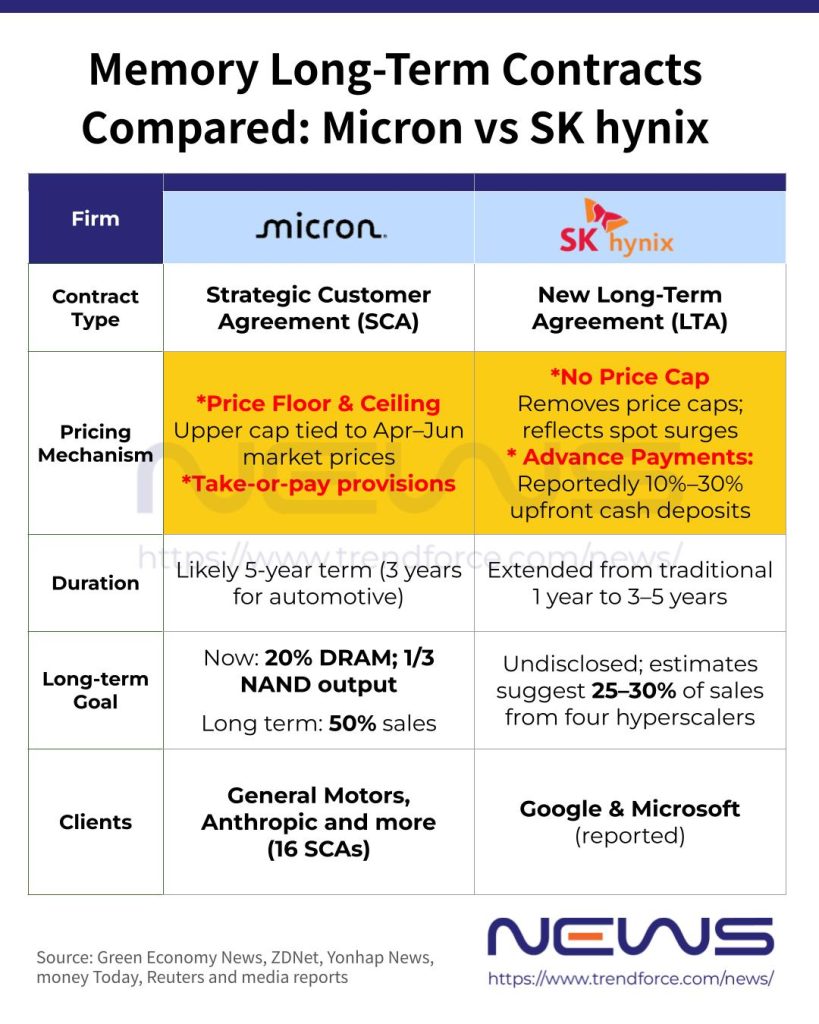
Citing industry sources, the report says that unlike traditional memory contracts, where price ceilings are used to limit volatility, SK hynix’s new structure allows spot market price increases to be fully reflected in contract pricing when supply shortages push market prices higher. The shift, according to the report, effectively reworks its long-term contract framework to better capture profitability during upcycle conditions.
Notably, Global Economy News adds that SK hynix may now be the only major memory supplier not applying a price cap in its long-term agreements.
Meanwhile, long-term contract durations are also lengthening. According to the report, both SK hynix and Samsung are extending their long-term supply agreements from the traditional one-year term to three to five years.
In a related development, Busan Ilbo reports that Samsung Electronics addressed supply strategies for HBM3E as well as next-generation HBM4 and HBM4E tailored to individual customers during its DS Division global strategy meeting. The company’s LTA strategy with major cloud and big tech clients—already underway since earlier this year—was also discussed as a key agenda item, the report adds.
As noted by the report, Samsung Electronics stated during its Q1 earnings conference call that it was pursuing long-term supply agreements for memory products in response to customer requests, and that it had already signed contracts with some clients.
Inside Micron’s SCA Model
Unlike SK hynix, Micron, in its SCA disclosed last month, reportedly set the price cap for existing products at the second-quarter 2026 market price, according to Green Economy News.
ZDNet explains that Micron’s SCAs include binding volume commitments, while also setting an upper price cap tied to prevailing market levels from April to June, alongside a contractual price floor applied over the full term of the agreements. However, next-generation products such as high-bandwidth memory (HBM), DDR6, and LPDDR6 are said to be priced separately through negotiated terms.
In a recent post on X, Micron CEO Sanjay Mehrotra said the latest Strategic Customer Agreement ensures GM a long-term supply of LPDRAM, NOR, and UFS NAND. He added that Micron’s US$2 billion modernization of its Manassas, Virginia fabrication facility has already begun production this year, providing GM with a U.S.-based, long-cycle supply foundation aligned with automotive platform requirements.
According to Reuters, the U.S. memory giant also noted that GM’s agreement is part of 16 strategic customer contracts disclosed during its third-quarter results.
Read more
- [News] Decoding Micron’s SCAs: Reportedly 20% of DRAM Output, Toward 50% of Long-Term Memory Revenue
- [News] Samsung Reportedly Eyes Long-Term Memory Deals with Google, Microsoft; May Include $10B+ Prepayments
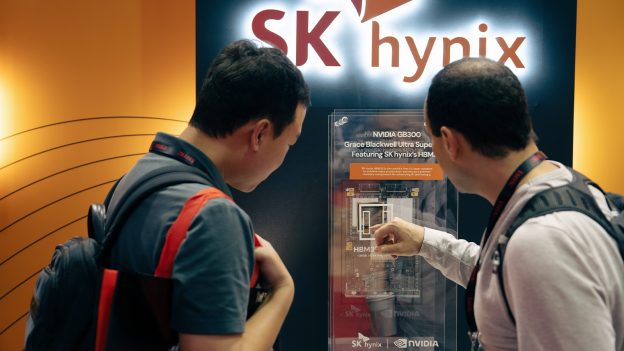
(Photo credit: SK hynix)