[News] Decoding Micron’s SCAs: Reportedly 20% of DRAM Output, Toward 50% of Long-Term Memory Revenue

Shortly after announcing a strategic agreement with Anthropic covering AI memory and storage architecture design—part of its broader push into Strategic Customer Agreements (SCAs)—Micron expanded on its long-term deal pipeline during its latest earnings call.
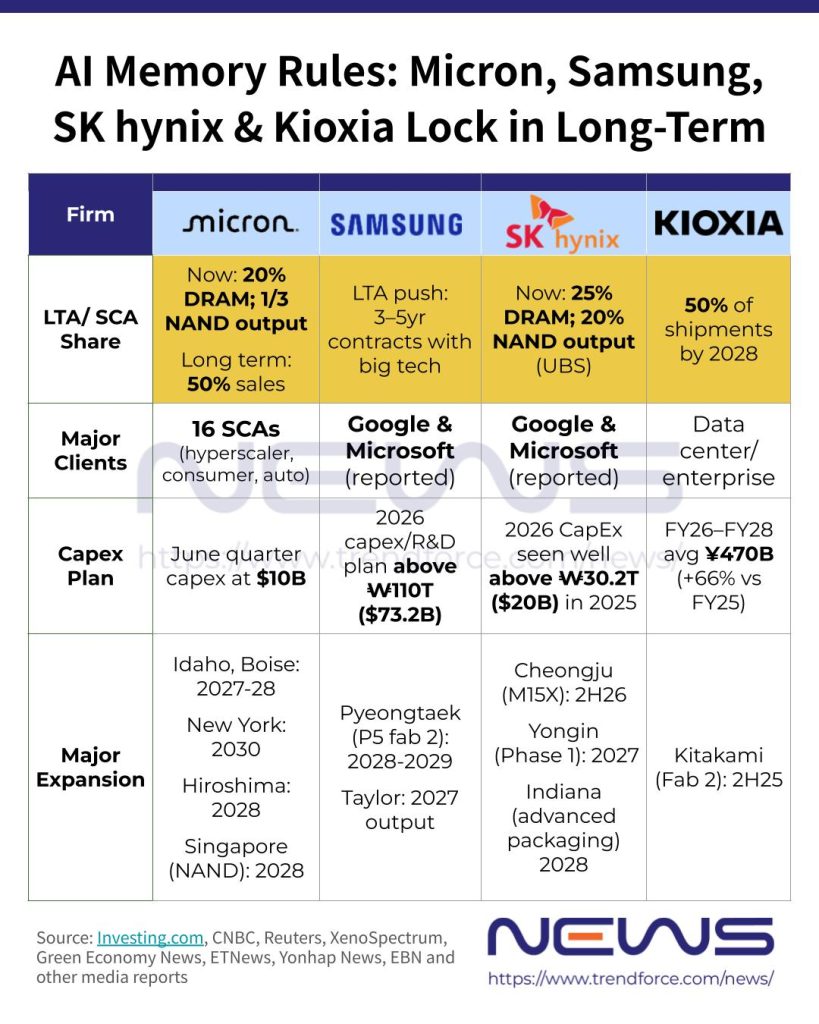
According to Investing.com, the company has signed 16 SCAs, spanning roughly 20% of its DRAM output and about one-third of its NAND volumes over the contract period. CNBC, citing CEO Sanjay Mehrotra, notes that these strategic customer agreements are expected to account for roughly half — or even more — of Micron’s total revenue once fully in place.
SCA Deal Structure and Size
Micron’s SCAs provide a broad customer base and secure upfront payment commitments prior to delivery. According to Reuters, the US$22 billion in commitments stems from strategic customer agreements spanning data center, consumer, and automotive markets. The contracts include take-or-pay provisions, cash deposits, and pricing floors aimed at securing supply and supporting margin stability, the report adds.
In detail, ZDNet explains that Micron’s SCAs include binding volume commitments, while also setting an upper price cap tied to prevailing market levels from April to June, alongside a contractual price floor applied over the full term of the agreements. Meanwhile, next-generation products such as high-bandwidth memory (HBM), DDR6, and LPDDR6 are priced separately through negotiated terms, leaving room for additional upside, the report says.
Notably, the overall scale of the agreements could be significantly larger than the US$22 billion figure. Citing Micron, Reuters reports that remaining performance obligations (RPOs)—a key indicator of contracted future revenue—across its current agreements stand at approximately US$100 billion.
Implications for the LTA Model
Citing CFO Mark Murphy, CNBC points out that the move is good for Micron, as it gives the company visibility into demand and locked-in volumes, allowing it to invest with greater confidence.
As explained by Yonhap News, unlike traditional annual long-term supply agreements (LTAs), SCAs lock in both volume and pricing over a five-year term (or three years in the automotive segment), effectively pre-agreeing key commercial terms over the contract duration.
From a broader industry perspective, TrendForce observes that these LTAs, featuring both floor and ceiling pricing mechanisms, could incentivize suppliers to accelerate capacity expansion during 2027–2030 in order to fulfill committed demand, potentially creating additional upside for industry-wide supply growth.
Micron’s memory peers are also expected to follow suit. ZDNet notes that South Korean players such as Samsung Electronics and SK hynix stand to benefit from these agreements over the medium to long term.
This trend is already reflected in recent deals. An April report from Green Economy News suggests SK hynix is structuring its long-term DRAM agreements with Microsoft and Google to include advance payments of around 10%–30% of total contract value. At the core of the Microsoft deal is a three-year DDR5 supply agreement starting this year, while discussions with Google reportedly involve a long-term DRAM contract of up to five years, with a possible two-year extension tied to next-generation HBM supply.
Read more
- [News] Micron Profit Surges 15-Fold as Margin Nears 85%; HBM4 Revenue Exceeds $1B
- [News] Samsung, SK hynix Deepen LTAs as Buyers Pay Premiums to Secure Supply, May Drive Memory Prices Higher
(Photo credit: Micron)