[News] Intel Reportedly to Adopt Silicon Capacitors in 2027 to Improve EMIB Power Stability for Google’s v8e
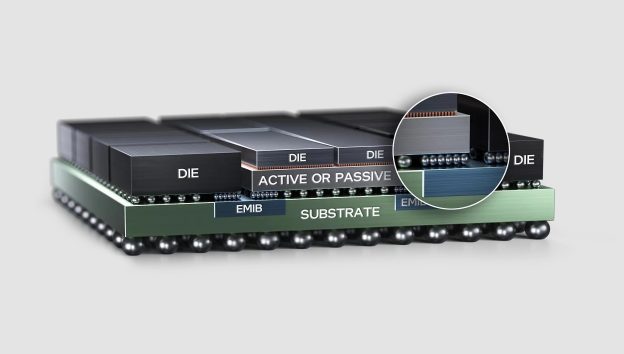
With TSMC’s CoWoS capacity remaining constrained, Intel’s EMIB (Embedded Multi-die Interconnect Bridge) advanced packaging technology is increasingly gaining traction as an alternative, fueling expectations for stronger demand across related components. Notably, ZDNet reports that Intel plans to begin mass adoption of silicon capacitors in 2027 to further strengthen EMIB performance.
As previously reported by Wccftech, Intel’s EMIB has reached 90% yield levels, with Google and Meta emerging as potential adopters. Google’s TPU v8e, scheduled for 2H27, as well as Meta’s in-house CPU planned for 2H28, are both expected to leverage EMIB, according to the report.
Against this backdrop, ZDNet reports that Google’s v8e AI chip is expected to adopt EMIB substrates integrated with silicon capacitors. With other hyperscalers, such as Amazon, also leveraging Intel’s EMIB technology, industry expectations are growing for a broader ramp-up in silicon capacitor demand going forward, as per the report.
Inside Intel’s Silicon Capacitor Shift
ZDNet notes that while EMIB is widely seen as a more cost-efficient advanced packaging solution, it is increasingly encountering limitations in providing stable power delivery for AI chips with rapidly rising power demands. To address this challenge, silicon capacitors and through-silicon vias (TSVs) are expected to be introduced for Google’s v8e, according to the report.
ZDNet further explains that a capacitor is a key circuit component that stores and releases electrical energy. Silicon capacitors, in particular, offer ultra-low equivalent series inductance (ESL) and equivalent series resistance (ESR)—reportedly more than 100 times lower than traditional multilayer ceramic capacitors (MLCCs)—helping significantly reduce signal loss in high-performance semiconductors. Meanwhile, they are also built on a silicon wafer-based ultra-thin structure, enabling higher-density integration, the report suggests.
Citing an industry source, the report adds that voltage droop in high-frequency AI workloads is difficult to fully address with MLCCs alone, which is why Intel is increasingly turning to silicon capacitors as a potential solution. Meanwhile, the supply chain for related components is already taking shape, with mass production expected to begin next year, as per ZDNet.
Silicon Capacitor Supply Chain Strengthens on Rising Demand
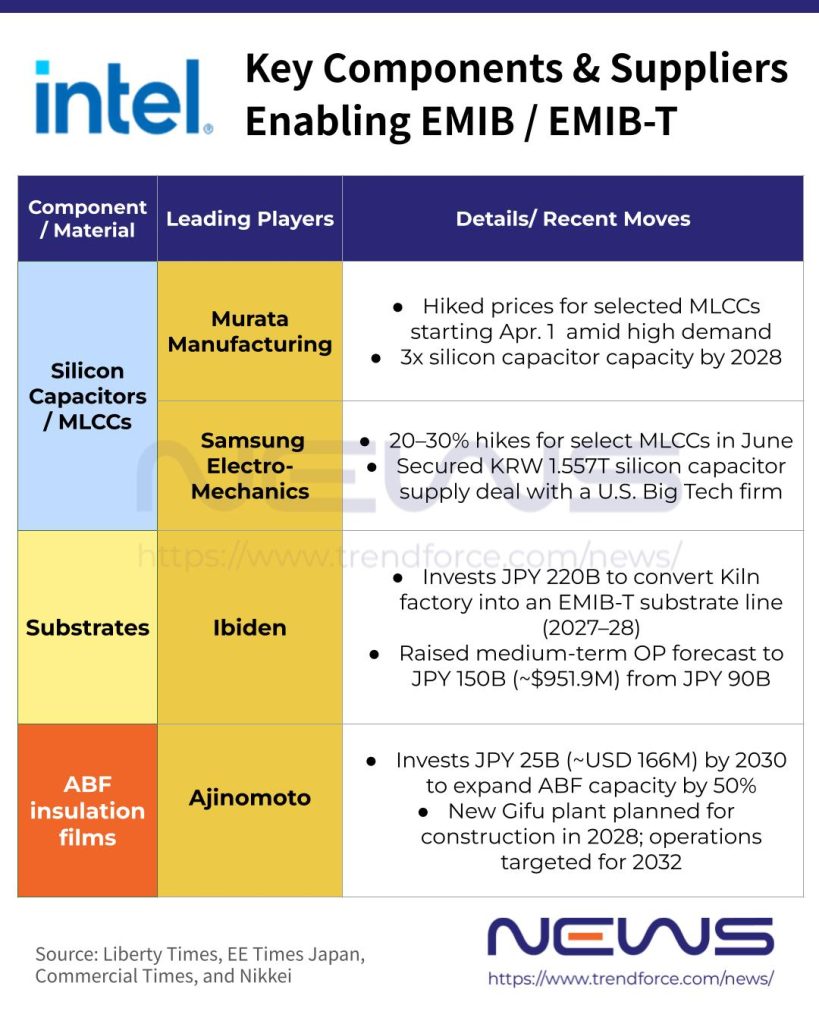
The growing demand for silicon capacitors also aligns with Samsung Electro-Mechanics’ announcement on May 20. Chosun Biz, citing a press release, reported that the firm has secured a silicon capacitor supply deal worth roughly 1.557 trillion won with a major global customer, covering the period from January next year through December 2028.
While the customer remains undisclosed, industry sources cited by the report believe the contract involves a U.S. Big Tech company. According to Chosun Biz, Samsung Electro-Mechanics’ major customers include NVIDIA, AMD, Amazon, and Marvell.
It is also worth noting that Murata Manufacturing, the market leader, has steadily scaled up its presence in the segment over the past few years. According to EE Times Japan, the company entered the silicon capacitor market in 2016 through its acquisition of French manufacturer IPDiA.
After the move, Murata further expanded its footprint in 2023 by announcing a new 200mm wafer production line at its France site, which began operations in 2024, as per the report. The company is also reportedly planning to invest around 10 billion yen by 2028 across its facilities in Hakusan, Sendai, and its Finnish subsidiary, aiming to lift total production capacity to roughly three times the current level.
Read more
- [News] Intel Says EMIB Customers Back Substrate Prepayments; 4 Taiwan, 2 Japan Suppliers Seek Commitments
- [News] Intel Reportedly Scales EMIB Expansion in U.S., Vietnam, with Taiwanese Tool Orders Set for 2H26 Delivery
(Photo credit: Intel)