[News] Japan’s Adhesive Tape Firm Lintec Targets EUV Pellicles, Reportedly Plans ¥7B Investment and 2026 Production
Another traditional Japanese industrial player may be stepping deeper into advanced semiconductor manufacturing. According to Nikkei, adhesive tape company Lintec plans to begin mass production of a dust-proof film used in cutting-edge chip production as early as 2026. The company is expected to invest roughly ¥7 billion in the project, with annual output planned at around 10,000 sheets, the report adds.
As noted by Nikkei, Lintec is advancing work on EUV-related materials, saying it is conducting joint research with the National Institute of Advanced Industrial Science and Technology (AIST) in Tsukuba, Ibaraki Prefecture, to develop mass-production technology for carbon nanotube (CNT)-based EUV lithography pellicles, a key material for next-generation semiconductor patterning.
In a February press release, Lintec provided additional details on its technological progress. As explained by Lintec, a pellicle is a dust-proof film attached to a photomask to prevent particle contamination, and EUV applications require high transmittance along with strong heat resistance and durability.
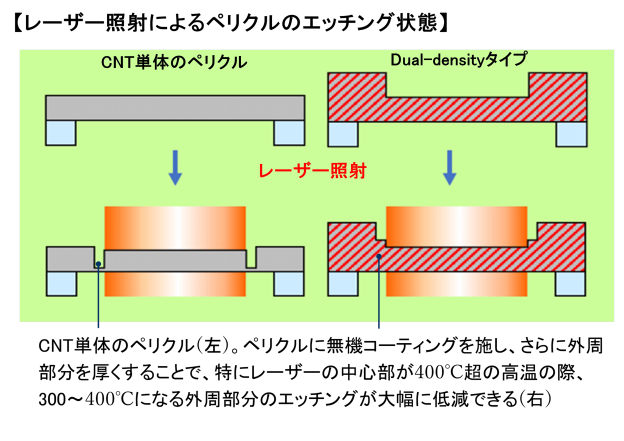
The company noted that hydrogen plasma–induced etching of CNT pellicles rises with temperature, peaking at around 300–400°C, while becoming negligible above 900°C. Based on this temperature behavior, Lintec is developing coating solutions to suppress etching and has also created a “dual-density” CNT pellicle, reinforcing the outer region to improve durability under higher future EUV power conditions.
Legacy Players Move Into Semiconductor Niches
Notably, Lintec is not the only traditional industrial player pivoting toward advanced semiconductors. As highlighted by The Economist, several established companies have already secured near-monopoly positions in highly specialized chip-related segments.
For instance, Ajinomoto has long been known for producing monosodium glutamate (MSG), a flavor enhancer responsible for the signature umami taste in food for over a century.
However, its Ajinomoto Build-up Film (ABF)—originally derived from MSG production by-products—has become a critical insulating material for semiconductor substrates used in advanced AI processors, the report notes, adding that Ajinomoto now controls more than 95% of the global ABF market.
Meanwhile, another long-established Japanese manufacturer, TOTO, has also found unexpected momentum from the semiconductor boom. As noted by the report, Bbest known globally as a leading toilet maker, the company has become a key supplier of electrostatic chucks—ceramic components that securely hold silicon wafers in place during chip fabrication.
Read more
- [News] Japan’s Toilet Maker TOTO Reportedly Sees Ceramics Margins Exceed 40% as It Rides NAND and AI Chip Demand
- [News] Ajinomoto Boosts Chip Materials Business With ¥1.2B Land Buy for 2032 Plant; ABF Margins Top 50% on AI Boom
(Photo credit: Lintec)