[News] Japan’s Toilet Maker TOTO Reportedly Sees Ceramics Margins Exceed 40% as It Rides NAND and AI Chip Demand
Japan’s TOTO, long associated with its toilet business, is emerging as an increasingly important supplier of key semiconductor components. According to Nikkei, the company’s earnings are now being driven by high-precision ceramic parts used in chipmaking equipment essential to the AI boom. Notably, this advanced ceramics segment is expected to contribute well over half of the group’s operating profit for the fiscal year ended in March.
TOTO expects operating profit from its advanced ceramics division to surge 32% to a record ¥27 billion ($169 million) for the fiscal year ended March 2026. The segment is once again set to outpace the company’s core businesses, with Japan housing equipment projected to generate ¥18 billion and overseas housing equipment ¥7 billion, leaving ceramics with a dominant 55% share of total operating profit, as the report points out.
The report highlights that the segment’s operating margin is expected to surpass 40% for the fiscal year ended in March, a sharp rise from just under 9% five years ago.
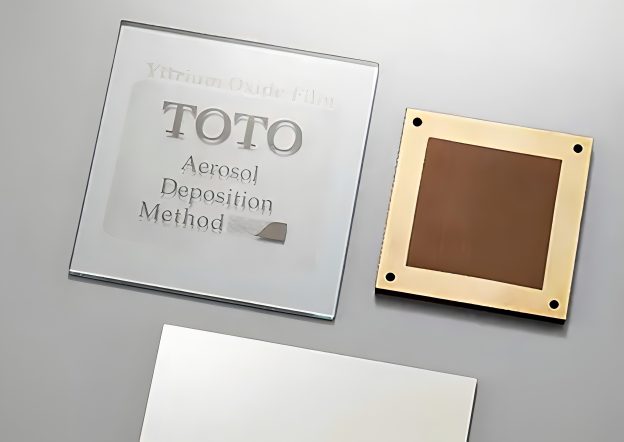
Its product lineup for chipmaking has gradually consolidated around three core offerings. As the report notes, these include: first, electrostatic chucks (e-chucks) used in etching tools to form circuits on silicon wafers for NAND flash memory, where they hold wafers in place using electrostatic force. Second, aerosol deposition components that shield chamber walls in etching systems for logic semiconductors. Third, highly durable structural parts designed for manufacturing equipment used in large LCD panel production.
Analysts cited by Bloomberg note that tight supply-demand conditions in the memory market, along with ongoing AI data center buildouts, are expected to continue driving demand for the company.
The company is also looking to deepen its footprint in semiconductors. According to Nikkei, one key area of opportunity is chiplet integration, a technology that enhances performance by linking multiple chips. TOTO sees its structural components as a strong fit for chiplet fixture materials, with development efforts already underway.
Like TOTO, Bloomberg notes that Japan’s long-standing semiconductor industry has led a wide range of companies, even those outside traditional tech sectors, to develop chip-related businesses. For example, Ajinomoto, best known for MSG seasoning, leverages its expertise in amino acids to produce insulating films for semiconductors, while Kao has also expanded into wafer cleaning alongside its core personal care products.
Read more
(Photo credit: TOTO)