[News] SK hynix Introduces iHBM Solution, Targets HBM5 Adoption with 30% Thermal Resistance Reduction
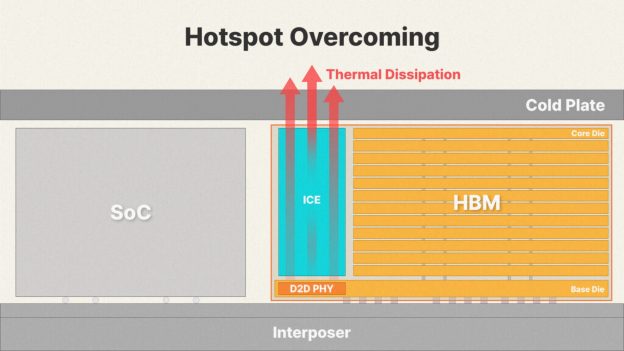
As thermal management emerges as a key challenge for HBM, SK hynix has unveiled its iHBM solution, which integrates cooling elements (ICEs) directly into the HBM package. The company plans to adopt the technology in next-generation products, including HBM5, according to its press release.
According to SK hynix, unlike conventional HBM designs that dissipate heat through the core die, iHBM integrates cooling elements (ICEs), made of thermally conductive, electrically non-conductive silicon-based materials, directly into the D2D PHY between HBM and GPUs, where heat is most concentrated. The company said the technology reduces thermal resistance by 30% and improves operating stability.
As highlighted by SK hynix, the iHBM solution adopts a structural approach to thermal management by creating an additional heat dissipation path within the package. It also leverages the company’s wafer-level packaging (WLP) process and proven MR-MUF technology to enable stable high-volume manufacturing.
In addition, its compatibility with existing System-in-Package (SiP) architectures allows customers to adopt the thermal solution with minimal design modifications, SK hynix adds.
In terms of future roadmap, SK hynix plans to incorporate the iHBM solution into next-generation HBM products, including HBM5, with the goal of improving the stability and efficiency of HPC systems and AI data centers.
Another Key Technology beyond Hybrid Bonding
Alongside SK hynix’s latest iHBM solution, hybrid bonding is widely seen as a key approach to addressing heat dissipation challenges in 20-stack HBM, which, as previously reported by The Elec, are expected to become increasingly difficult.
As explained in the report, hybrid bonding differs from conventional thermo-compression (TC) bonding, which connects chips through soldered micro-bumps. Instead, it bonds dielectric materials such as silicon dioxide (SiO₂) and copper through an annealing process at temperatures of roughly 200°C to 400°C.
By heating and gradually cooling copper sealed within dielectric layers, thermal expansion and vertical pressure enable direct copper-to-copper diffusion bonding without reaching copper’s melting point, the report notes, adding this approach helps reduce thermal damage to semiconductor circuits while delivering improved thermal and electrical performance.
Read more
- [News] SK hynix Reportedly Tests Intel EMIB 2.5D Packaging With HBM Amid TSMC CoWoS Tightness
- [News] HBM4 Strategies Diverge: Samsung Reportedly Chases 80% 1c DRAM Yield While SK hynix Trims Shipments by 30%
(Photo credit: SK hynix)