[News] Memory 1Q26 Price Surge: Samsung Flags 146% ASP Jump, SK hynix Sees Mid-60% DRAM Gains
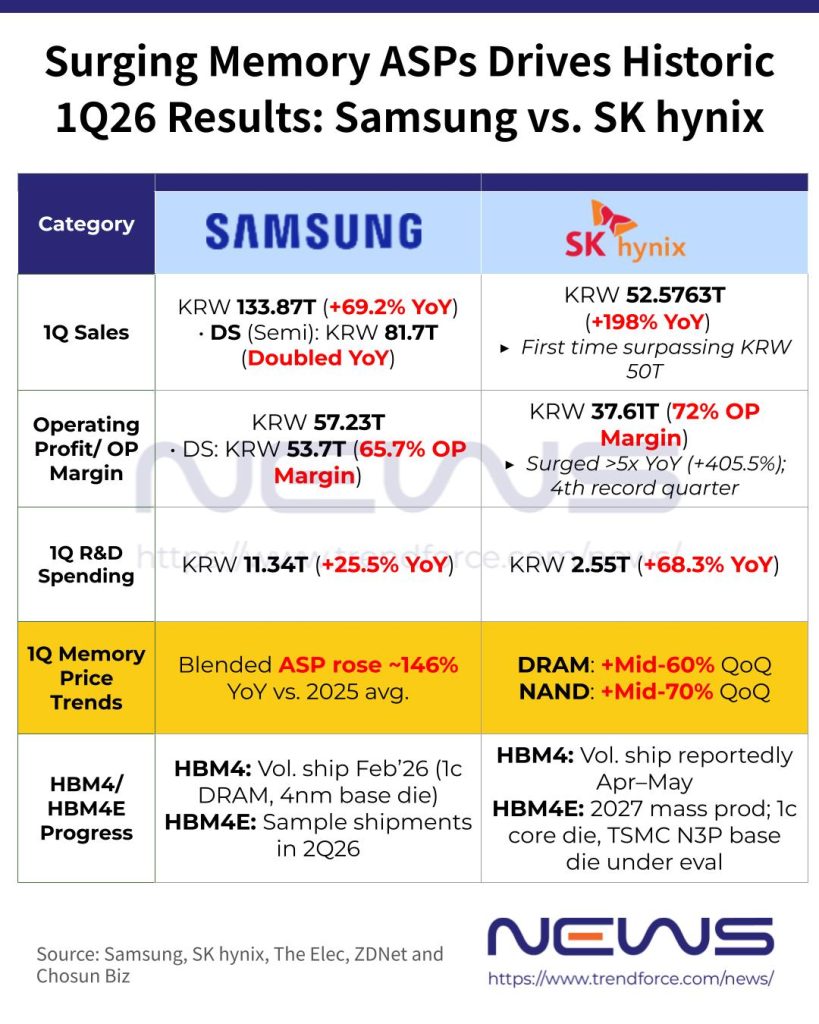
As Samsung Electronics and SK hynix reported strong revenue and profit growth in Q1 2026 amid surging memory prices, both companies highlighted notable pricing trends for the period. According to Samsung’s full earnings report released on May 15, average memory selling prices—including DRAM and NAND—surged about 146% from the 2025 full-year average.
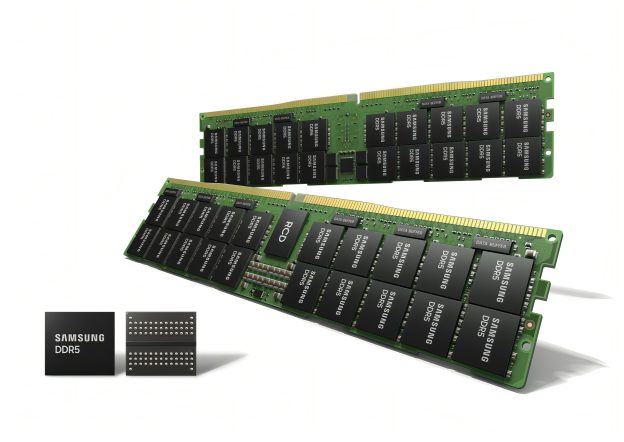
While Samsung Electronics did not separately disclose pricing trends for DRAM and NAND, it highlighted key momentum drivers, noting that its DS division’s memory business continued to see strong demand for high-performance DRAM such as HBM4 and DDR5, as well as NAND flash for high-capacity SSDs.
Meanwhile, SK hynix’s Q1 financial disclosure, also released the same day, showed DRAM bit shipments remained broadly in line with the previous quarter, while ASP rose by the mid-60% range, driven by strengthening momentum in mainstream DRAM pricing.
NAND flash saw a more pronounced price increase. The company said NAND bit shipments fell by around 10% quarter-on-quarter, while ASP climbed by the mid-70% range, supported by broad-based price gains across products.
Soaring Memory Costs Reshape Samsung DX Procurement
However, soaring memory prices have become a double-edged sword for Samsung Electronics, with mobile memory costs for its DX division—used in finished products—rising by about 107% compared with the previous year’s full-year average, the company said in its earnings report.
Against this backdrop, ZDNet reports that Samsung Electronics’s DX division has, for the first time, added “mobile memory” to its raw material procurement list. Mobile memory accounted for 9.4% of the DX division’s procurement mix in the first quarter, slightly above camera modules at 8.9%, but below mobile APs at 19.9% and display panels at 10.2%.
ZDNet further notes that DX division purchases totaled KRW 1.993 trillion, with U.S. memory chipmaker Micron listed as a key supplier.
R&D Costs on Rise, Featuring HBM4 and HBM4E Progress
On the other hand, The Elec reports that Samsung Electronics and SK hynix saw their R&D spending surge by as much as 68% during the period, reflecting intensifying competition in AI memory development.
According to its quarterly report, Samsung’s R&D spending in Q1 totaled KRW 11.34 trillion, up 25.5% year-on-year. Its capital expenditure reached KRW 11.23 trillion, with KRW 10.19 trillion, or 90.7%, allocated to the Device Solutions (DS) division. According to The Elec, Samsung plans to spend more than KRW 110 trillion this year on capital expenditure and R&D, aimed at advancing AI semiconductor technologies and expanding into new businesses such as robotics through acquisitions.
Notably, Samsung also highlighted its HBM progress in the earnings report, saying it began HBM4 volume shipments in February based on its 10nm-class 1c DRAM process, with the base die manufactured on Samsung Foundry’s 4nm node. The company is also advancing HBM4E development, with first sample shipments slated for Q2, according to The Elec.
Meanwhile, SK hynix’s Q1 R&D spending totaled KRW 2.55 trillion, up 68.3% from KRW 1.52 trillion a year earlier, accounting for 4.9% of its quarterly revenue of KRW 52.58 trillion. As noted by The Elec, its quarterly R&D spending first surpassed the KRW 2 trillion mark in Q4 2025. Between 2022 and 2024, average quarterly R&D spending stood at roughly KRW 1.11 trillion, the report adds.
According to The Elec, SK hynix is also preparing its HBM4E lineup, targeting sample shipments in the second half of 2026 and mass production in 2027. The company is developing the base die on process technology tailored to customers’ performance requirements, while the core die is set to adopt its 1c DRAM node, the report suggests.
Read more
[News] Samsung SSD Prices Reportedly Surge Up to 300% in Japan, Kioxia Also Posts Gains as Market Divergence Widens- [News] Samsung, SK hynix Deepen LTAs as Buyers Pay Premiums to Secure Supply, May Drive Memory Prices Higher
(Photo credit: Samsung)