[News] MLC NAND Spot Prices Reportedly Triple Since Late 2025 as Samsung, Kioxia Exit Supply
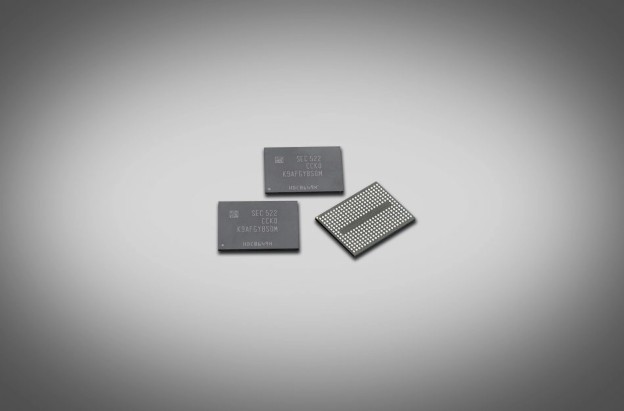
As global memory makers pivot toward high-capacity solutions and steadily phase out legacy 2D NAND, supply of low-capacity, general-purpose NAND chips is tightening sharply, sending spot prices soaring. According to Chosun Ilbo, 64Gb MLC NAND spot prices have surged more than 300% from end-2025 levels, recently trading in the $20–28 range.
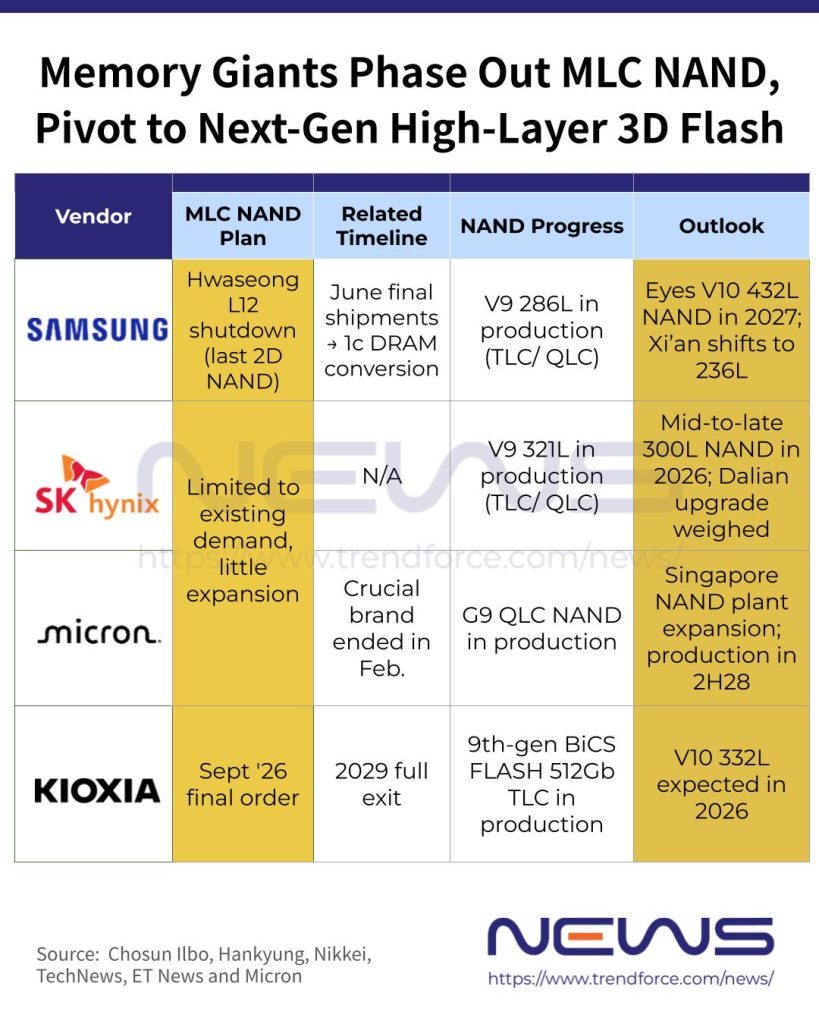
Major NAND suppliers are aggressively shifting capacity from 2D NAND to HBM and advanced 3D NAND, fueling the broader price uptrend. Chosun Ilbo reports Samsung began gradually shutting down 2D NAND production at its Hwaseong Line 12 in March, converting the site into an end fab for 1c DRAM. The company is set to end shipments after next month’s final deliveries, effectively closing its last 2D NAND stronghold with a monthly wafer capacity of 80,000–100,000 units, the report adds.
Kioxia, SK hynix, and Micron are also keeping MLC production largely limited to existing customer demand, with little incentive to expand capacity, TrendForce notes. Thus, global MLC NAND Flash capacity is projected to fall 41.7% YoY in 2026, further deepening the supply-demand imbalance.
Kioxia China, as previously reported by TechNews, issued an end-of-life notice on March 31, saying certain floating-gate and third-generation BiCS FLASH products will be phased out in 2028. Chosun Ilbo adds that the company plans to take final orders by end-September this year, complete last shipments by December 2028, and fully exit 2D NAND and 3rd-gen BiCS FLASH from 2029 onward.
Micron, meanwhile, is maintaining MLC NAND production only at levels sufficient to meet existing customer demand, while also announcing the end of its consumer brand Crucial, Chosun Ilbo reports.
MLC Exits as Memory Giants Push 3D NAND Layers Higher
MLC, which stores 2 bits per cell, delivers stronger data retention and durability despite lower capacity compared with 3-bit TLC and 4-bit QLC designs, Chosun Ilbo explains. However, weak profitability has reportedly pushed it out of the market.
Meanwhile, memory giants are pivoting capacity toward higher-layer 3D NAND amid soaring AI demand. ET News reports NAND has emerged as a key focus of Samsung’s next strategic push, centered on 400-layer-class (V10) devices. Samsung began mass production of its 9th-gen 286-layer NAND (V9) in April 2024, which remains its most advanced commercial NAND product to date, the report adds.
As noted by the report, SK hynix is already mass producing 321-layer NAND and supplying customers, putting Samsung slightly behind in the layer-count race.
On the other hand, as previously reported by Nikkei, Kioxia plans to begin mass production of its 10th-generation NAND flash memory (332-layer) around 2026, targeting surging demand for high-speed, low-power storage driven by generative AI. The company aims to expand its business with hyperscalers such as Amazon Web Services (AWS) and Microsoft, as cloud giants increasingly seek advanced storage solutions to support AI workloads, according to Nikkei.
Read more
- [News] Macronix NAND Sales Jump 382% YoY on Samsung’s MLC Exit, Shifts to Monthly Pricing Amid Deepening Crunch
- [News] Samsung, Micron Rumored to Exit MLC, Driving Price Hikes and Order Surge for Taiwanese Suppliers
(Photo credit: Samsung)