[News] Samsung’s DS Division Tops NVIDIA With 65.7% Operating Margin, Driving 93.8% of 1Q26 Profit
Riding an AI-driven semiconductor supercycle, Samsung’s Device Solutions (DS) division delivered a historic first quarter, with operating profit surpassing KRW 50 trillion for the first time, according to The Chosun Daily. The report highlights the unit’s overwhelming dominance, accounting for 93.8% of Samsung’s total operating profit.
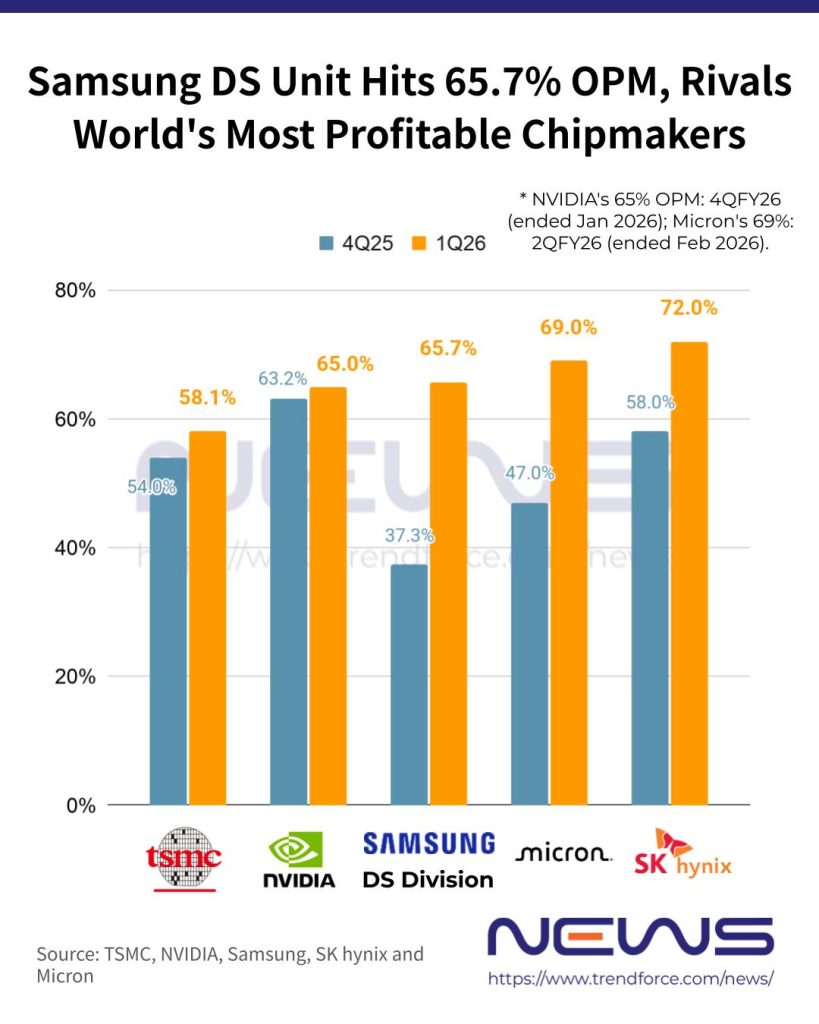
Samsung’s DS unit recorded a 65.7% operating margin in 1Q26, slightly above NVIDIA’s 65%, placing it among the most profitable semiconductor businesses globally, the report notes, adding that the surge was fueled by a sharp pricing upswing, with DRAM and NAND flash prices jumping nearly 90% quarter-over-quarter.
In comparison, SK hynix reported an even higher 72% operating margin in 1Q26, outpacing TSMC at 58%, as reported by ZDNet.
On April 30, the company reported that the DS division generated KRW 81.7 trillion in revenue and KRW 53.7 trillion in operating profit for the first quarter, according to its press release. Compared with a year earlier, sales nearly doubled while profit surged more than threefold within just 12 months, according to The Chosun Daily.
On a consolidated basis, Samsung reported revenue of KRW 133.87 trillion and operating profit of KRW 57.23 trillion in 1Q26, marking a dramatic expansion. Revenue jumped 69.2% year-over-year, while operating profit skyrocketed 756%, translating into a robust operating margin of 42.8%.
Looking ahead, SeDaily reports that Samsung plans to begin supplying HBM4E samples in the second quarter, followed by mass production of NVIDIA’s new language processing units (LPUs) on 4nm in the second half of 2026.
Memory Boom: A Double-Edged Sword of Over-Reliance
However, The Chosun Daily notes that Samsung’s surge was overwhelmingly powered by memory, which generated KRW 74.8 trillion—accounting for 91.6% of DS revenue and 55.9% of the company’s total first-quarter sales.
According to The Chosun Daily, within the semiconductor segment, both the LSI and foundry businesses remain in the red. Samsung did not disclose exact figures, but industry estimates cited by the report still point to losses in the trillion-won range, though the gap has narrowed from a year earlier, helped in part by HBM base die production.
Looking ahead, the company expects a recovery in the second half, supported by expanding 2nm orders and the full-scale ramp-up of 4nm AI-focused chips entering mass production, the report adds.
Meanwhile, Samsung’s non-memory businesses are increasingly being squeezed by the very memory boom powering its profits, as rising semiconductor prices begin to erode margins elsewhere.
In the first quarter, Samsung’s mobile and network division posted KRW 38.1 trillion in revenue and KRW 2.8 trillion in operating profit, with smartphones (MX) contributing KRW 37.5 trillion. The launch of the Galaxy S26 series provided a near-term boost, helping offset higher component costs, including chips, as per the Chosun Daily, though analysts warn that as the new product effect tapers in the second quarter.
As previously reported by Money Today, Roh Tae-moon, head of Samsung Electronics’ DX (Device eXperience) Division and MX (Mobile eXperience) unit, has raised internal concerns over the risk of the MX business slipping into an annual loss. If realized, it would mark the first full-year deficit since the MX division was established, the report added.
Strike Risk Looms
On the other hand, as global memory supply remains extremely tight amid the AI boom, Samsung’s looming large-scale strike is seen as further intensifying the strain. According to South Korean media outlets News1 and The Dong-A Ilbo, citing analysts, disruptions could reach 3–4% for DRAM and 2–3% for NAND, based on the production weight of Samsung’s Pyeongtaek and Hwaseong fabs.
Beyond the numerical impact, Joseilbo warns that the consequences could be far broader if the strike materializes. A halt in chip operations could delay shipments, weaken global customer confidence, and sharply reduce revenues for key partners, while cascading disruptions across the supply chain could also strain liquidity among smaller suppliers.
Separately, the Samsung Electronics branch of the company-wide labor union reaffirmed on the 23rd that it will proceed with an 18-day general strike starting May 21 and lasting through June 7.
Read more
- [News] Samsung’s May Strike Seen Disrupting Up to 4% of DRAM Output, With Weeks-Long Recovery Risk
- [News] Samsung, Kingston Reportedly Lift SSD Prices by Over 10%, More Hikes Likely in Coming Weeks
(Photo credit: Samsung)