[News] Middle East Energy Turmoil Raises Chip Risks, Spotlight on TSMC Power Use and Bromine for DRAM
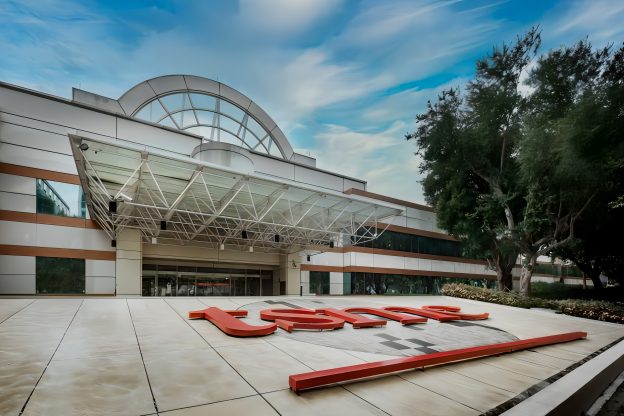
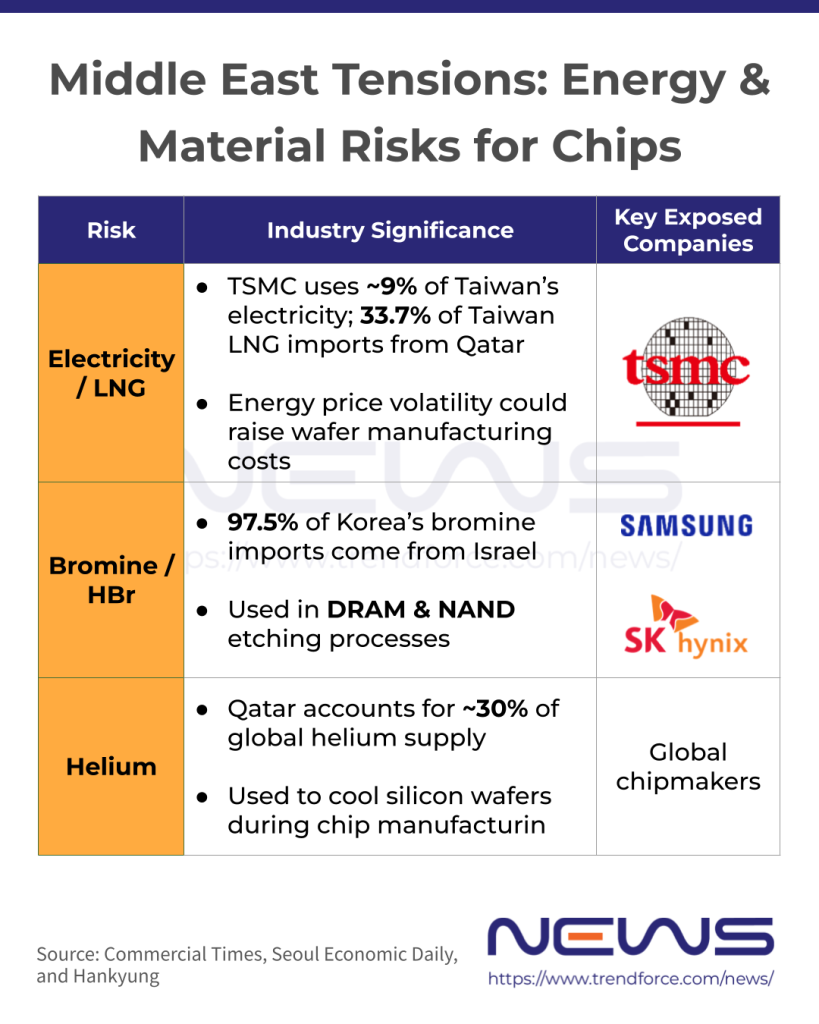
Conflict in the Middle East triggered by tensions between the U.S. and Iran is rattling energy markets, raising concerns for the semiconductor industry. According to Commercial Times, as demand for AI chips surges, the industry’s reliance on stable power supplies continues to grow. For example, TSMC alone accounts for about 9% of Taiwan’s total electricity consumption, prompting concerns over whether fluctuations in energy prices could affect wafer manufacturing.
Institutional investors cited by the report say that while foundries typically have pricing power that allows some cost pass-through when energy prices rise, unstable energy supply during peak AI chip demand could still affect production efficiency and capacity planning.
As the report indicates, TSMC said supply chain disruptions are not expected to significantly impact operations for now. Still, the report notes that TSMC previously warned in its annual reports that rising electricity prices could increase manufacturing costs.
Regarding electricity usage, the report notes that TSMC’s 2024 Sustainability Report states the company’s total electricity consumption reached 27.456 billion kWh. Of this, 93% came from purchased electricity, while natural gas accounted for 6.9%. The semiconductor industry is highly sensitive to electricity supply. As the report states, Qatar has suspended natural gas exports, while about 33.7% of Taiwan’s liquefied natural gas (LNG) imports come from Qatar.
Helium and Bromine Supply Risks Draw Semiconductor Industry Attention
Aside from power supply, the industry is also closely watching potential disruptions to other chip materials. According to Seoul Economic Daily, citing Nikkei, QatarEnergy said production of urea, polymers, methanol, aluminum, and other natural gas-derived products has been halted. Helium, a byproduct produced during the pre-liquefaction processing of natural gas, has also likely stopped alongside LNG production.
Helium is particularly critical for the semiconductor industry because it is used to cool silicon wafers during manufacturing processes. Seoul Economic Daily notes that QatarEnergy accounts for about 30% of global helium production, making it a key supplier to the industry. Meanwhile, Hankyung indicates that companies may be able to withstand potential disruptions through pre-secured inventories and diversified supply chains. Hankyung, citing sources, adds that SK hynix has secured helium inventory as well as additional supply lines, helping it avoid short-term impacts.
Beyond helium, concerns are also emerging around bromine, another material used in chip manufacturing. According to Hankyung, although bromine’s impact has not been as significant as helium’s, the situation remains concerning. Bromine is used in semiconductor etching processes to remove unnecessary materials, while high-purity hydrogen bromine (HBr) is specifically used for polysilicon etching in DRAM and NAND flash production. Hankyung also notes that South Korea relies heavily on the Middle East for bromine supplies, with 97.5% of its imports coming from Israel.
Read more
- [News] Middle East Escalation Hits Tech: NVIDIA Shuts Dubai Office, AWS Data Center Strike Raises Concerns
- [News] TSMC Speeds up Expansion in Taiwan: up to 10 Fabs Reportedly under Construction or Starting in 2026
(Photo credit: TSMC)
Please note that this article cites information from Commercial Times, Seoul Economic Daily, Nikkei, and Hankyung.