[News] Intel Rumored to Build Tesla Chips on 18A; Gaudi 3 Sees Early Momentum in Dell Servers

With Washington at Intel’s back with a 10% stake backup, Team Blue might be bracing for orders from more big techs. According to TweakTown, citing sources online, Intel may soon join forces with Tesla to build custom chips on its 18A process.
As noted by TweakTown, the leak originated from Wccftech reporter Muhammad Zuhair, who posted on X that an Intel–Tesla partnership on the 18A node “wouldn’t be far-fetched.” He pointed out that with Elon Musk’s preference for surrounding himself with strategic partners, Intel appears to be a logical fit.
Adding fuel to the speculation, Zuhair also shared a screenshot showing Intel CEO Lip-Bu Tan following Elon Musk on X, noting that observers might want to start connecting the dots.
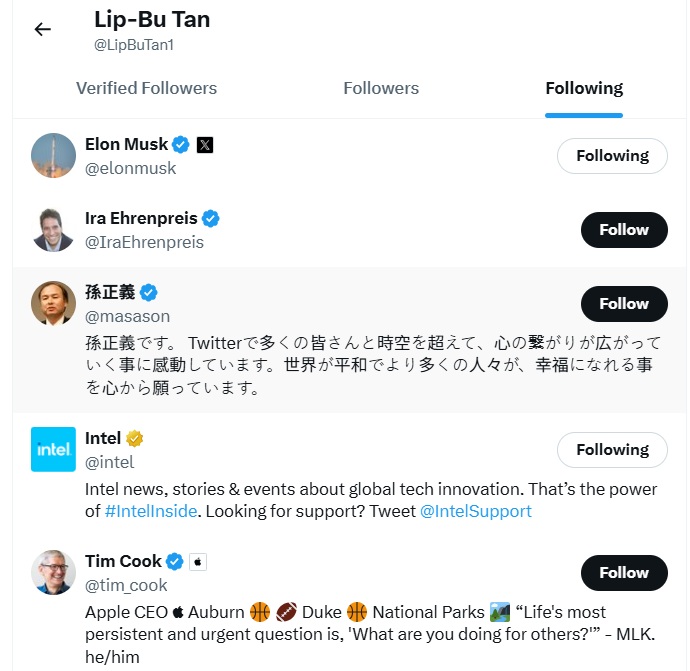
(Photo credit: Lip-Bu Tan’s X)
The report, citing Zuhair, indicates that the potential collaboration could go beyond simple foundry work, possibly including advanced packaging technologies such as Intel’s Foveros. If Intel does team up with Tesla on foundry and advanced packaging services, it could pose a notable challenge to Samsung, as Calian News points out.
It is worth noting that after sealing a $16.5 billion deal with Tesla for its AI6 chips, Samsung is eyeing further expansion at its Taylor, Texas plant, adding an advanced packaging line alongside existing foundry and R&D facilities, according to the Korea Economic Daily.
ZDNet reports that Samsung plans to finish the cleanroom by early Q4 and begin installing equipment by year-end. If the timeline holds, 2nm mass production could kick off at Taylor in the second half of 2026, the report suggests.
Gaudi 3 Shows Early Momentum
On the other hand, Intel’s struggling AI chip business seems to be seeing the light at the end of the tunnel as well. According to Wccftech, Dell has brought Intel’s Gaudi 3 AI chips into the spotlight, integrating them into its PowerEdge XE7740 servers. Positioned as cost-efficient and scalable, the move marks one of the first major adoptions of Gaudi 3 in mainstream AI server offerings, the report notes.
The configuration, designed to be cost-efficient and scalable, reportedly supports up to 8x Gaudi 3 chips with eight PCIe accelerators and a 1:1 networking interface for flexible integration. The servers are compatible with leading AI models, including Llama4, Llama3, DeepSeek, Phi4, Qwen3, and Falcon3, the report reveals.
Despite this progress, Intel still faces a steep climb after shelving Falcon Shores, and whether its upcoming Jaguar Shores rack-scale solution can help the company catch up with NVIDIA and AMD remains to be seen, the report notes.
Read more
- [News] Samsung Reportedly Weighs Intel Packaging Investment, Glass Substrate Tie-Up to Challenge TSMC
- [News] Intel’s Clearwater Forest Unveils 18A Backside Power at Hot Chips; TSMC’s Super Power Rail to Follow
(Photo credit: Intel)
Please note that this article cites information from TweakTown, Muhammad Zuhair’s X, Calian News, Korea Economic Daily, ZDNet, and Wccftech.