[News] China’s Big Fund Phase III Pivot: From Fab-Building to Advanced Packaging, Equipment, and AI Chips
With memory champions CXMT and YMTC tapping capital markets, investment strategies of their key backer, China’s National Integrated Circuit Industry Investment Fund (the “Big Fund”), are once again in the spotlight.
According to ijiwei, however, the Big Fund’s Phase III, launched in 2024, marks a notable shift from its earlier phases, with investments increasingly focused on advanced packaging, semiconductor equipment and materials, and computing chips.
Phase I & II: Building China’s Semiconductor Foundation
As ijiwei points out, the Big Fund’s first two phases adopted a broad-based investment strategy, spanning wafer manufacturing, IC design, packaging, equipment, and materials. The primary goal was to rapidly expand domestic semiconductor capabilities and address gaps across the industry value chain.
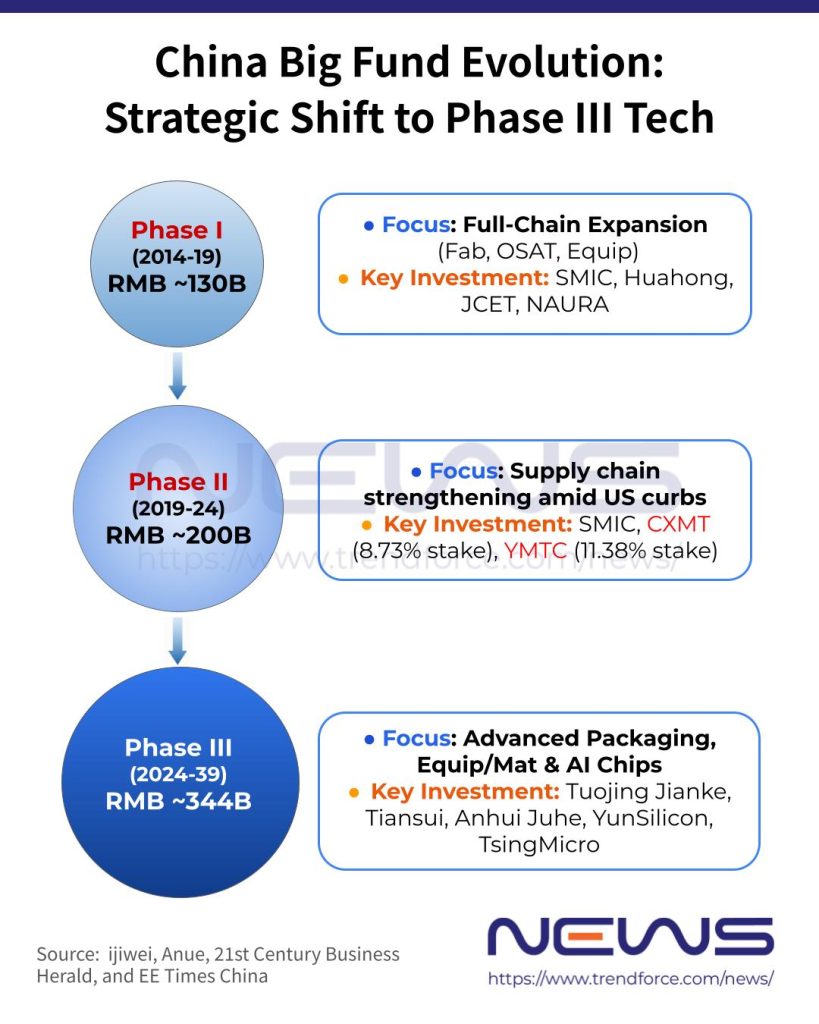
According to Beifengchuang’s analysis on Anue, the Big Fund Phase I, launched in 2014 with around RMB 130 billion in capital, invested in 23 companies across 75 projects.
Investments included major foundry projects such as SMIC and Huahong, leading OSAT players including JCET and Tongfu Microelectronics, as well as critical suppliers such as semiconductor equipment maker NAURA Technology, EDA provider Empyrean Technology, and memory chip manufacturer YMTC, the report notes.
Notably, Anue suggests that compared with Phase I, the Big Fund Phase II, launched in 2019 with around RMB 200 billion in funding, placed greater emphasis on strengthening the semiconductor supply chain amid rising U.S. restrictions on China’s chip industry. The Fund expanded its focus beyond capacity building to include upstream and downstream ecosystem development, while continuing to prioritize wafer fabrication. Its largest single investment was a US$1.5 billion (approximately RMB 10.7 billion) injection into SMIC, according to Anue.
Beyond wafer fabrication, Phase II also stepped up support for China’s memory ambitions. As reported by 21st Century Business Herald, 2016 marked a turning point in China’s push for memory self-sufficiency, with CXMT established in Hefei and YMTC founded in Wuhan. The Big Fund Phase II, per 21st Century, directly holds around 8.73% of CXMT, while EE Times China reports that the Big Fund Phase I and Phase II hold 11.97% and 11.38% stakes in YMTC, respectively.
Phase III: From Fab Expansion to Strategic Technologies
However, as ijiwei notes, the Big Fund Phase III marks a clear departure from its predecessors. Rather than funding mature wafer fabs, the fund has shifted its focus to reinforcing the semiconductor industry’s foundation by investing in critical upstream technologies.
According to ijiwei, Phase III’s investment strategy has now taken shape around three key pillars: advanced packaging and IP integration, semiconductor equipment and materials, and AI computing chips.
Key Phase III Investments in Focus
Among them, the advanced packaging and IP integration track, led by Huaxin Dingxin, has progressed at a relatively slower pace. To date, only two investments have been disclosed, ijiwei reports. One is Tiansui Xinyuan Technology, in which Huaxin Dingxin acquired a 31.58% stake through a RMB 300 million investment. The company’s core assets originate from the automotive-grade vision ISP and display processing IP business of Zhudian Semiconductor, a unit controlled by VeriSilicon.
The second investment, according to ijiwei, is Anhui Juhe Microelectronics, in which Huaxin Dingxin acquired an 18% stake. Based in Hefei, the company specializes in Chiplet packaging substrates and heterogeneous integration packaging, and is one of the few independent packaging platforms in China capable of supporting high-volume Chiplet production, the report notes.
The equipment and materials track, led by Guotou Jixin, has been Phase III’s most active investment area. Among its flagship deals is a RMB 450 million investment in Tuojing Jianke, a spin-off from PECVD equipment leader Tuojing Technology that develops HBM hybrid bonding and chip-stacking equipment, ijiwei notes.
Third, ijiwei points that the Big Fund Phase III’s AI computing power investment arm is targeting both cloud-scale general-purpose computing and edge-side processing-in-memory (PIM) technologies, using multiple technical approaches to diversify development risks.
Key investments include YunSilicon, which develops high-speed interconnect and compute-network switching chips; TsingMicro, focused on compute-in-memory AI chips and processors for on-device large language models; and Beijing Aijieko Xin, which develops general-purpose AI accelerators and generative AI chips, according to ijiwei.
Read more
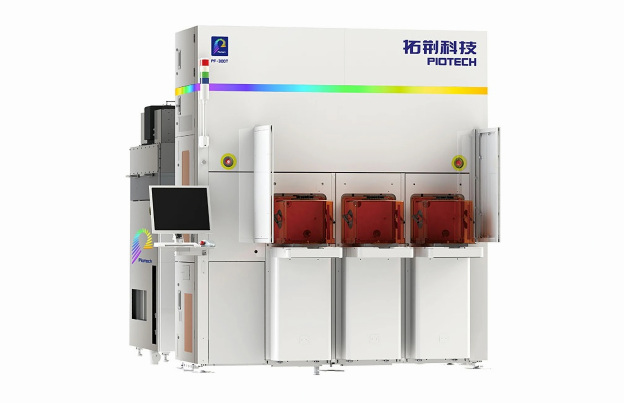
(Photo credit: Piotech)