[News] Kioxia Steps Up AI NAND Competition With South Korean Rivals, Eyes PCIe 6.0 and UFS 5.0 Mass Production
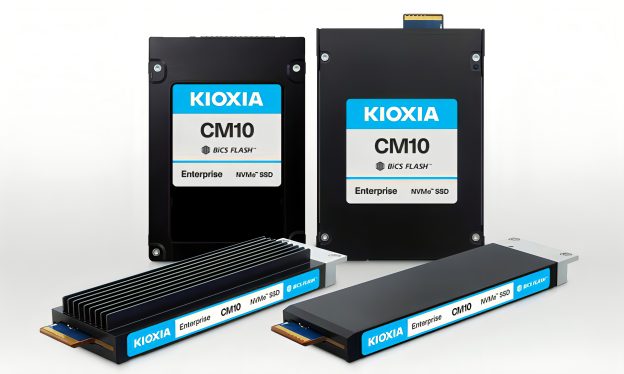
Kioxia, the world’s third-largest NAND flash supplier, is stepping up its push into the next-generation AI NAND market. According to ZDNet, the company recently began mass production of its 10th-generation (BiCS 10) 3D NAND and plans to begin mass production of PCI Express (PCIe) 6.0 and Universal Flash Storage (UFS) 5.0 solutions later this year for AI data centers and on-device AI.
According to TrendForce, Kioxia held a 13.9% share of the global NAND flash market in the first quarter of 2026, ranking third behind Samsung Electronics (31.6%) and SK hynix (17.6%).
BiCS 10 Drives Kioxia’s AI Storage Roadmap
Kioxia’s 10th-generation NAND features 332-layer stacking, the report notes. Building on its latest NAND technology, Kioxia has commercialized the CM10 enterprise SSD (eSSD) for data centers, supporting the PCIe 6.0 interface, the latest SSD interface standard. The company says the CM10 delivers up to 92% higher sequential read performance and approximately 85% higher random read performance than its predecessor.
Kioxia also plans to begin mass production of UFS 5.0 memory for the on-device AI market by the end of 2026, the report notes. As the latest embedded storage standard entering commercialization this year, UFS 5.0 is primarily designed for mobile NAND applications. It offers approximately twice the data processing speed of UFS 4.1 and integrates Kioxia’s in-house controller with its eighth-generation NAND.
Samsung Advances Its Next-Generation NAND Roadmap
Meanwhile, South Korea’s memory makers, led by Samsung Electronics, are stepping up development of next-generation NAND solutions. According to ZDNet, Samsung began mass production of its PM1763 PCIe 6.0 enterprise SSD earlier last month, featuring its ninth-generation V-NAND and a new 4nm-based controller. Samsung also completed development of its UFS 5.0 memory in June and plans to begin mass production in the fourth quarter of this year.
In addition, according to Seoul Economic Daily, Samsung is increasing shipments of its flagship ninth-generation V-NAND (V9) to NVIDIA while simultaneously beginning mass production and deliveries of its 10th-generation (V10) NAND. The company is also accelerating development of its 500-layer, 11th-generation (V11) NAND.
SK hynix is likewise advancing its next-generation NAND roadmap. According to The Elec, the company plans to begin mass production of its 375-layer 3D NAND by the end of this year following production validation. Rather than building new capacity, SK hynix is converting existing production lines at its M15 fab in Cheongju from lower-layer NAND to the new 375-layer process. The report also notes that the company plans to introduce molybdenum (Mo) into part of its word-line metal gate electrodes, replacing selected tungsten layers to reduce resistance, improve signal transmission, and enable higher-density NAND.
Read more
- NAND Flash Supply Growth to Outpace Demand in 2027, Easing Supply Constraints in 2H27, Says TrendForce
- [News] Kioxia 1QFY26 Gross Margin Hits 80%; Reaffirms 50% LTA Target for 2028
(Photo credit: Kioxia)