[News] Across-the-Board 30% Price Hike: MLCC Price Surge Intensifies
With a single AI server cabinet consuming up to 440,000 high-end MLCCs, Samsung Electro-Mechanics reporting a profit surge exceeding 100%, and Japanese and South Korean giants pushing a comprehensive 30% price increase, the passive component industry is now facing a tight-supply dynamic where even if buyers accept higher prices, delivery schedules remain difficult to guarantee.
Japanese and South Korean Leaders Lead Price Hikes: Full Portfolio Adjusted Up to 30%
As per recent supply chain sources cited by South Korea’s Chosun Ilbo, leading Japanese and South Korean MLCC manufacturers have officially issued written price adjustment notices to downstream distributors and channel partners, initiating broad price increases for the second half of the year.
- Samsung Electro-Mechanics: Effective August 1, 2026, shipment prices across its entire MLCC product portfolio will be uniformly raised by 30% from current levels. This adjustment spans all product categories—including consumer electronics, industrial control, automotive, and AI servers—with no specifications exempted.
- Taiyo Yuden: Citing sharp recent price increases in raw materials such as barium titanate powder, nickel powder, and rare earth additives, Taiyo Yuden confirmed new MLCC shipment prices effective September 1, 2026.
A look back at H1 2026 shows that this wave of price hikes had already triggered a chain reaction:
- Taiyo Yuden: Implemented a interim price adjustment in April, raising high-capacitance automotive-grade items by 10%–30% and consumer-grade specifications by 6%–13%.
- Yageo & Walsin Technology: Yageo initiated broad capacitor price increases on July 1, with industry sources reporting an overall hike of approximately 50%. Walsin Technology simultaneously raised consumer MLCC prices by 5%–15%.
Field visits by Shanghai Securities News to electronic component vendors in Huaqiangbei, Shenzhen revealed that spot market quotes for common low-capacitance MLCCs (such as 0402 and 0603) are fluctuating wildly following multiple adjustments by original manufacturers. Popular in-demand part numbers frequently see “daily quote expirations and sharp spikes within two weeks,” with spot prices for certain high-capacitance, AI-dedicated specifications surging exceptionally fast.
Samsung Electro-Mechanics Profits Double; AI Long-Term Agreements Lock In Capacity
The pricing power of original equipment manufacturers (OEMs) is reflected in Samsung Electro-Mechanics’ latest financial results.
In Q2 2026, Samsung Electro-Mechanics posted revenue of 3.4572 trillion KRW, up 24.2% YoY and an operating profit of 440.4 billion KRW, representing a 106.7% YoY surge. The Component Unit generated 1.6494 trillion KRW in revenue (up 29% YoY), driven primarily by AI data center servers and automotive MLCCs.
Concurrently, MLCC procurement strategies are shifting rapidly from quarterly quotes to Long-Term Agreements (LTAs) for locked volume and price. By late July, Samsung Electro-Mechanics’ AI MLCC LTA customer base expanded to over 10 accounts, covering global hyperscalers and top fabless chip makers. In July alone, the company disclosed two AI server MLCC LTAs worth approximately 745 billion KRW, with delivery timelines locked through 2027.
AI servers demand vastly more MLCCs than traditional hardware. A single AI rack cabinet requires up to 440,000 units—8 to 10 times that of a standard server. Meanwhile, high-end MLCC manufacturing requires dielectric film thicknesses under 1 micron, entailing high manufacturing complexity and lower yields; effective capacity per line is only about one-tenth that of standard products. As Japanese and South Korean manufacturers prioritize LTA clients, freely floating market supply has tightened further.
Cost Pressures and Capacity Crowding Drive Rates Higher
Taiyo Yuden’s latest price adjustment stems not only from robust demand but also from escalating upstream material costs.
Prices for core dielectric materials—including barium titanate powder, ultra-fine nickel powder, release films, and glass powder—have risen consistently over the past year, pushing manufacturing costs higher. High-purity ultra-fine barium titanate powder remains supplied primarily by Japanese vendors, reflecting high supply chain concentration.
Global capacity expansion for high-end MLCCs requires 18 to 24 months. With short-term expansion limited, Murata, Samsung Electro-Mechanics, and Taiyo Yuden have reallocated production lines toward AI server orders. This crowds out supply for consumer electronics and industrial controls, extending high-end lead times and tightening mid-tier general-purpose availability.
Japanese and South Korean Shipments Hit Highs; Spot Prices Surge
According to TrendForce, driven by AI platforms such as Google TPU and AWS Trainium, monthly MLCC shipments from Murata, Samsung Electro-Mechanics, and Taiyo Yuden hit five-year highs in June.
However, shipment growth has flowed predominantly into the AI sector. To meet cloud customer demand, Japanese and South Korean vendors continue converting consumer-grade X5R capacity toward high-end specifications like X6S and X7R required for AI. This has constrained supply for general-purpose MLCCs (1μF to 22μF), pushing channel inventory below the 30-day warning threshold.
This supply crunch quickly transmitted down the value chain. Distributors continue to hike quotes, with spot prices for select short-supply models jumping 2 to 3 times above previous levels. Orders from small-to-midsize customers are re-routing toward Taiwanese and Mainland Chinese vendors, spurring a broader industry-wide price reaction.
Ultimately, this wave of MLCC price hikes is not driven by a broad recovery in consumer electronics demand. Instead, it is a structural market adjustment propelled by concentrated AI compute orders, long-term capacity lock-ins, and production line reallocations.
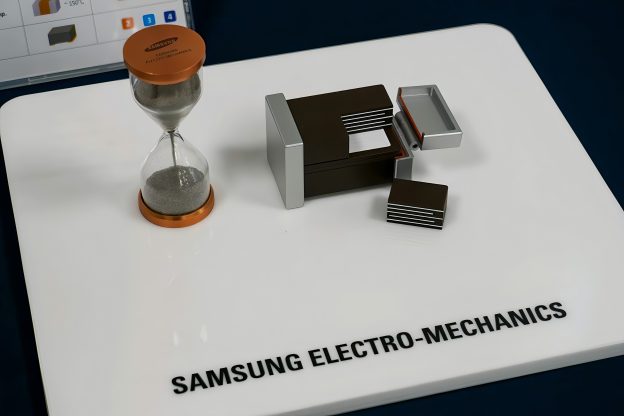
(Photo credit: Samsung Electro-Mechanics)