[News] Intel Pulls Forward 14A Timeline by One Year, Targeting 2028 Mass Production Near TSMC’s Roadmap

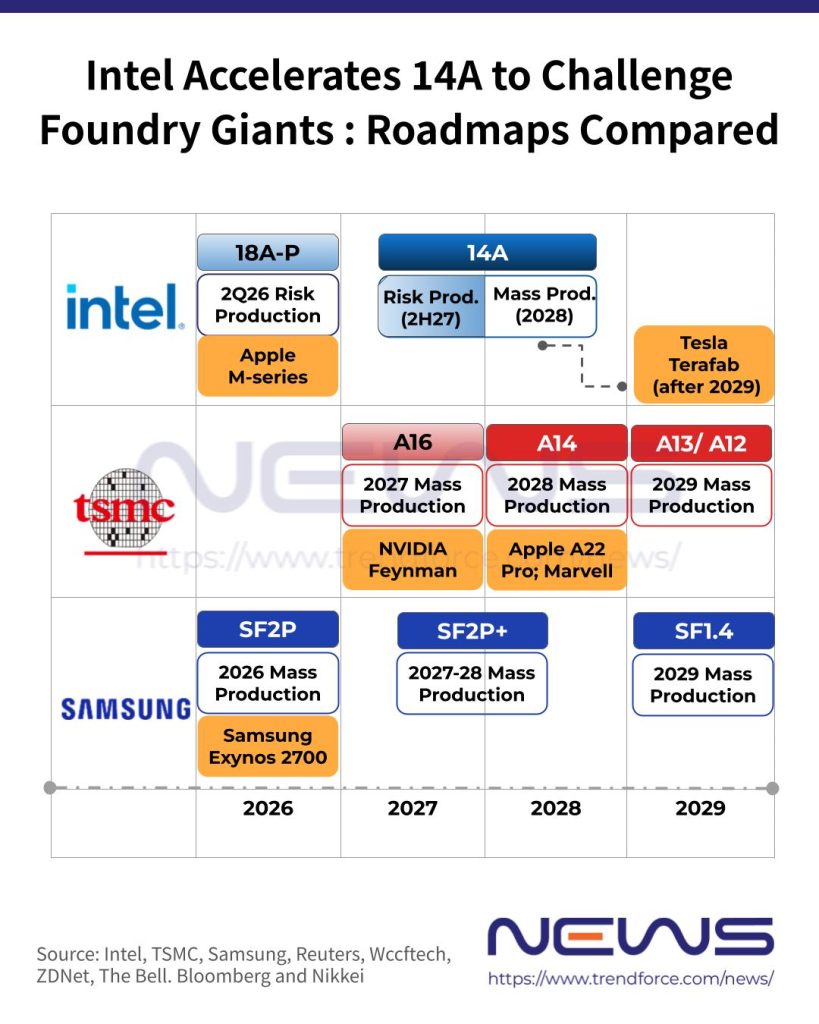
As Intel delivered stronger-than-expected second-quarter results, reportedly posting its fastest quarterly revenue growth since 2011 and hiked its 2026 CapEx target to more than US$20 billion from US$18 billion, one of the earnings call highlights would be its 14A progress. Reuters and Wccftech, citing CEO Lip-Bu Tan, note that the chip giant now eyes the node to enter high-volume production in 2028, matching TSMC’s advanced-node production timeline.
The latest development marks a notable turnaround from last year, when Intel warned it could abandon 14A if it failed to secure a major external customer. “I’m pleased to see the increasing momentum on customer engagements for Intel 14A, and I’m increasingly confident that 14A will be a highly competitive process,” Tan said, cited by Reuters.
As noted by Wccftech, Intel now expects 14A to enter risk production for internal products in the second half of 2027, a year earlier than previously planned, while high-volume manufacturing remains on track for 2028—also ahead of its original 2029 roadmap.
Tan also shared further updates on 14A, saying the node is progressing ahead of 18A in both defect density and transistor performance. “I see the yield for 256 SRAM and the defect density, the performance, ahead of the schedule that I put a very tough schedule for my team,” Tan said, according to a Yahoo! Finance earnings call transcript. 14A PDK (Process Design Kit) 0.5 is already complete, while PDK 0.9 is on track for October.
Team Blue has already secured its first 14A customer. Reuters, citing Elon Musk, reported in April that Tesla plans to use Intel’s next-generation 14A process for chips in its Terafab AI complex in Austin.
18A Progress on Track
Intel also highlighted continued progress on 18A, which entered mass production in late 2025. According to Wccftech, Intel’s Intel 7, Intel 3 and Intel 18A process technologies all exceeded internal production targets in the second quarter, driven by higher utilization, shorter cycle times and increased wafer inventory.
Among them, Intel 18A achieved the strongest ramp, with rising output supporting upcoming products such as Panther Lake (Core Ultra Series 3) and Wildcat Lake (Core Series 3). CEO Lip-Bu Tan further noted that 18A output increased meaningfully in the second quarter, with factory production continuing to grow sequentially each month. The company has also started risk production of its enhanced 18A-P process.
Beyond production momentum, CFO David Zinsner highlighted improving cost efficiency and margin potential as 18A matures. According to a Yahoo Finance earnings call transcript, Intel Foundry has reduced the cost of its primary Panther Lake SKU by roughly 50% year-to-date and expects a further 20% reduction this year, with additional meaningful savings planned for 2027.
As 18A yields continue to improve, Intel also expects Panther Lake margins to rise above the company average, Zinsner said.
Financial Highlights
Intel reported adjusted earnings per share of 42 cents on revenue of US$16.1 billion in the second quarter, beating LSEG consensus estimates of 21 cents and US$14.42 billion, respectively, CNBC reports. Intel Foundry also generated US$5.77 billion in quarterly revenue, exceeding analysts’ estimate of US$5.55 billion, Reuters notes.
For the third quarter, Intel expects revenue of US$15.8 billion to US$16.8 billion, above analysts’ forecast of US$15.1 billion, according to Reuters.
Read more
- [News] SK hynix Reportedly Eyed as Potential Partner to Operate Intel’s Ohio Fab After Denying Acquisition Plans
- [News] Intel Might Build Up to 90% of Nova Lake Compute Tiles on 18A, Scaling Back TSMC’s Planned Role
(Photo credit: Intel)