[News] Japan–U.S. NAND Alliance Steps Up Investment as Kioxia–SanDisk Capex Reportedly Rises 40% YoY
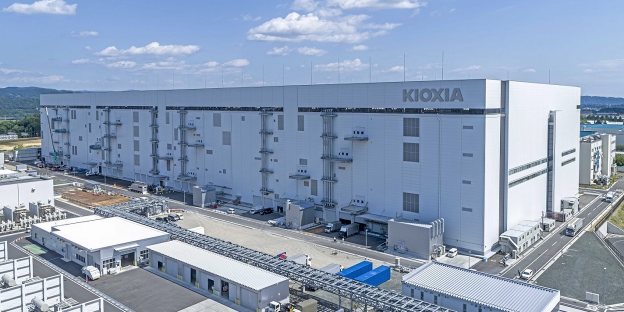
As South Korea’s memory giants shift focus toward 1c DRAM capacity expansion amid surging demand, Global Economic, citing German tech outlet ComputerBase, reports that the Kioxia–SanDisk alliance is moving fast to reassert its position in the NAND market, capitalizing on an investment gap as Samsung Electronics and SK hynix divert resources toward HBM.
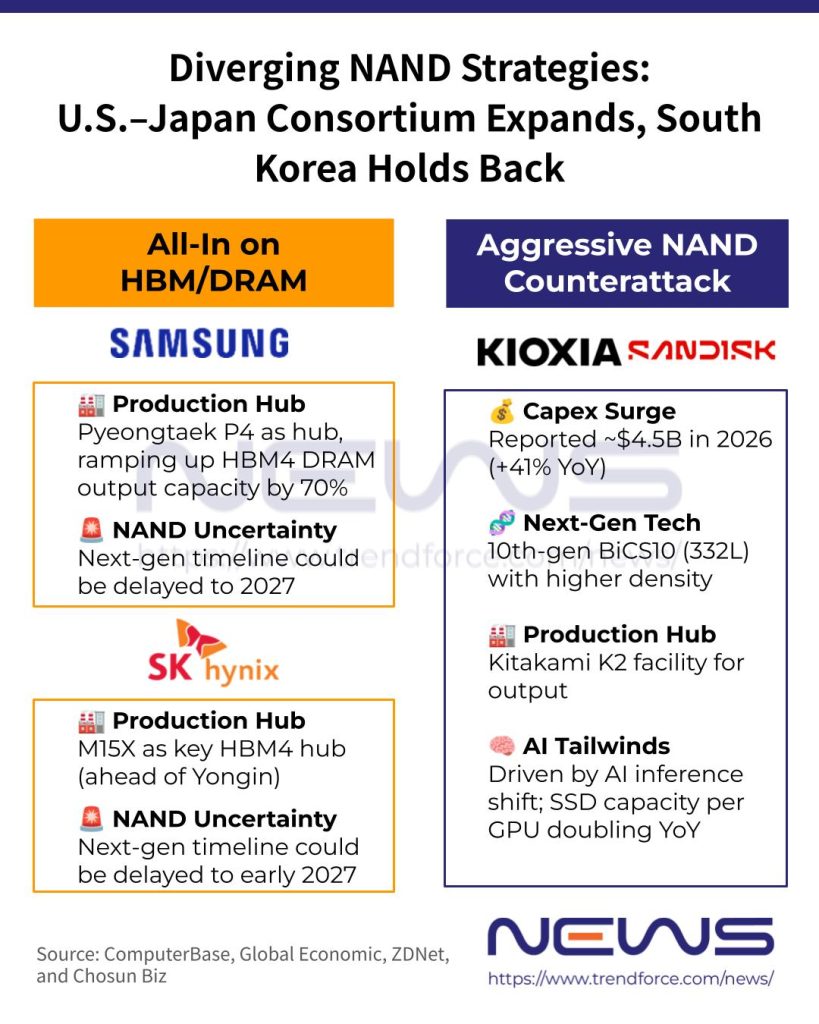
According to the reports, the U.S.–Japan NAND consortium is expected to execute total capital expenditure of $4.5 billion (about KRW 6.75 trillion) in the current fiscal year, marking a 41% year-on-year increase.
Notably, a key focus of the alliance would likely be the 10th-generation NAND. Nikkei previously reported that Kioxia plans to begin mass production at its Kitakami site in Iwate Prefecture in 2026. However, given the jump to a 332-layer architecture—up from 218 layers in its 8th-generation devices—the company is expected to repurpose its newly operational Kitakami K2 facility, which began production in September, to support output, according to Nikkei.
ComputerBase, cited by Global Economic, attributes the strong NAND demand supporting Kioxia–SanDisk’s investment to a structural shift in AI workloads: As AI moves from the training-heavy infrastructure build-out phase to large-scale inference deployment, demand is rising for high-performance, ultra-high-capacity storage.
At the same time, storage is accounting for a growing share of hyperscaler data center capex, while SSD capacity per GPU is more than doubling year over year, the report notes. As a result, next-gen AI servers are increasingly being designed with tens of terabytes of storage per GPU, driving a sustained surge in NAND demand, the report adds.
Fewer Layers, Comparable Density
ZDNet also reports that in its recent earnings briefing, Kioxia identified the launch of 10th-generation BiCS NAND as a key priority for fiscal 2026 (April 2026–March 2027). The report adds that the company applies its proprietary BiCS (Bit Cost Scalable) architecture to its scaling roadmap, with the 10th-generation device delivering 59% higher storage density per unit area and a 33% improvement in data transfer speed compared with the 218-layer generation.
According to ComputerBase, Kioxia’s stacking approach enables comparable density with fewer layers, translating into meaningful cost advantages. A lower stack height also simplifies vertical etching, reduces high-cost equipment runtime, and helps mitigate wafer warpage defects.
Based on 3D NAND density estimates cited by Global Economic from ComputerBase, Kioxia / SanDisk BiCS10 is projected to reach 37.6Gb per square millimeter in QLC configuration, which would surpass Samsung Electronics’ upcoming 430-layer V10 TLC architecture at around 28.0Gb.
Samsung, SK hynix Hold Back
However, TrendForce indicates that major NAND Flash suppliers will add virtually no new production capacity in 2026, and it seems that South Korean memory players are taking a different approach with Kioxia and SanDisk.
As highlighted by Global Economic, Samsung Electronics and SK hynix have both adjusted their 10th-generation NAND ramp-up schedules: Samsung has reportedly pushed back its V10 production timeline from the second half of 2025 to 2026, while SK hynix is targeting early 2027 for full-scale production.
ZDNet also reports that Samsung Electronics had initially planned to begin mass production of its 430-layer 10th-generation NAND this year, but the timeline has been delayed to at least 2027, citing technical complexity and softer demand conditions. The report adds that Samsung is still reviewing investment timing, with no concrete equipment orders confirmed, and that SK hynix faces a similar situation.
Global Economic notes that if the U.S.–Japan NAND alliance succeeds in lowering cost per terabyte and accelerating QLC enterprise SSD adoption, demand could shift more rapidly toward AI data center storage. Even so, Samsung and SK hynix remain competitive, supported by stable 9th-generation yields and strong enterprise SSD customer bases, the report adds.
Read more
- [News] MLC NAND Spot Prices Reportedly Triple Since Late 2025 as Samsung, Kioxia Exit Supply
- [News] Kioxia, SanDisk to Demonstrate QLC NAND Using Multi-Stacked Cell Architecture, Targeting 1,000+ Layers
(Photo credit: Kioxia)