[News] ADATA Sees Samsung Strike Boosting Memory Prices; China Expansion Impact Seen No Earlier Than 2028
With Samsung Electronics set to begin its strike on May 21, the industry is closely monitoring potential impacts on global memory supply and pricing trends. ADATA Technology noted, citing TechNews, that while the strike may have limited direct impact on Samsung’s full-year output, it has already fueled expectations of higher DRAM and NAND prices amid an increasingly tight supply backdrop.
Separately, Liberty Times, citing ADATA chairman Simon Chen, reports that Samsung’s leadership in DRAM and NAND means the strike is likely to weigh on market confidence and lift memory prices, with the magnitude of increases depending on the duration of the labor action.
Chen, cited by Liberty Times, also said in early March that NAND flash prices were set for another upcycle, potentially outpacing DRAM — a trend he said has now materialized, with DRAM likely to follow. He expects NAND to post stronger gains over the next three months, the report suggests.
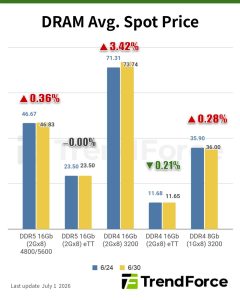
On DRAM pricing, Chen, cited by TechNews and Liberty Times, pointed to a rotating cycle between DDR4 and DDR5, where one segment advances while the other pauses before both resume their upward trend. He said the pattern is set to support ADATA Technology performance, with 2Q results expected to be “significantly better” than 1Q.
Due to the high level of automation in front-end facilities, from a broader industry perspective, TrendForce expects Samsung Electronics’s DRAM and NAND Flash production to remain largely at full capacity. Any potential impact from the strike is therefore likely to be confined mainly to non-memory business segments.
Views Split on China Memory Ramp-Up Impact
Notably, a recent report from SeDaily has drawn strong market attention, citing former Samsung Electronics semiconductor chief Kyung Kye-hyun, who said that as Chinese memory makers aggressively expand capacity, the market could begin to shift as early as the second half of next year, when a surge in supply starts to materialize. He added that beyond 2028, both memory prices and demand could come under pressure.
However, Simon Chen, cited by TechNews, argued that Chinese suppliers still account for less than 10% of global DRAM and NAND supply, with some segments below 5%. As a result, even rapid capacity growth would have only limited near-term impact due to the small base, with meaningful market influence unlikely before 2028, the report notes, suggesting he expects supply-demand conditions in 2026 and 2027 to remain largely unchanged.
Read more
(Photo credit: Samsung)