[News] Intel Says AI Inference Pushes CPU Ratio From 1:8 Toward 1:1; 18A Yield Target Advanced to Mid-Year
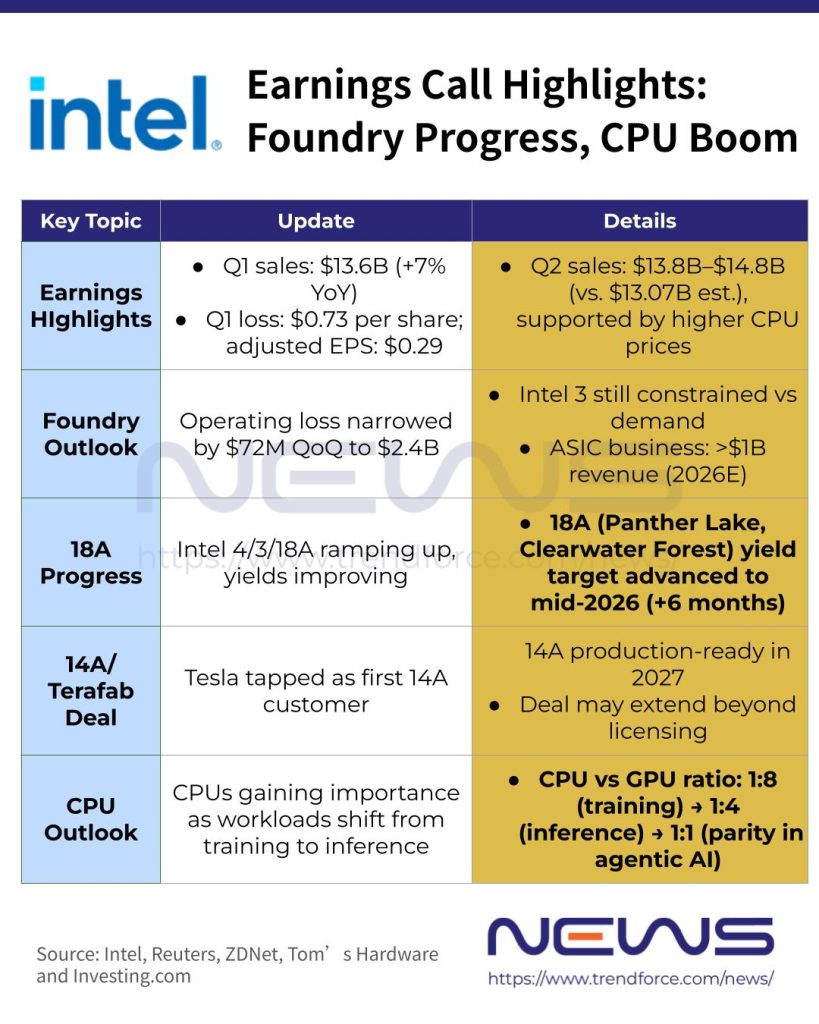
The recent CPU surge is steering Intel toward a long-awaited turnaround. The company projects second-quarter revenue of $13.8 billion to $14.8 billion, above the $13.07 billion consensus, according to Reuters. Market attention, however, centered on CEO Lip-Bu Tan’s comments that the CPU-to-GPU mix—once around 1:8—could eventually move toward parity at 1:1, or even tilt further toward CPUs.
Tan, according to an earnings call transcript cited by Investing.com, said customer feedback underscores the growing importance of CPUs as workloads shift from training to inference. He added that on the inference side—particularly in orchestration, control-plane functions, and managing multiple AI agents and data—CPUs are proving significantly more efficient.
According to Tan, the CPU-to-GPU mix, which previously stood at roughly 1:8, has already tightened to about 1:4, and could ultimately converge to parity at 1:1—or potentially shift further toward CPUs.
CFO David Zinsner further broke down the shift in compute mix, noting that training workloads typically run on a ratio of about 7–8 GPUs per CPU, as per the transcript. As the industry moves into inference, that balance tightens to roughly 3–4 GPUs per CPU. He added that in more advanced agentic and multi-agent scenarios, the ratio could compress further—potentially even flipping in favor of CPUs.
Intel’s view echoes broader industry expectations. As highlighted by TrendForce’s Substack, Arm estimates that while traditional AI data centers require around 30 million CPU cores per GW, demand could surge to 120 million cores per GW in the AI agent era—a fourfold jump. Against this shift, the CPU-to-GPU ratio is projected to move toward roughly 1:1 to 1:2, underscoring a significant upside in CPU demand, according to TrendForce.
Against this backdrop, Intel reported that first-quarter revenue from its Data Center and AI (DCAI) group—responsible for server-grade Xeon 6 processors—rose 22% year over year to $5.1 billion, according to a press release cited by Reuters. Overall quarterly sales reached $13.58 billion, though Reuters, citing CFO David Zinsner, noted that part of the figure came from older inventory—including previously shelved chips that were shipped amid stronger demand despite age or underperformance.
Intel Foundry Eyes Turnaround as 14A, 18A Ramp Advances
Notably, Intel is still working to push its foundry business toward profitability. The company posted a first-quarter loss of 73 cents per share, weighed down by more than $4 billion in restructuring charges, according to Reuters. On an adjusted basis, however, it swung to a profit of 29 cents per share, comfortably beating expectations of 1 cent.
As highlighted by Nikkei, Intel Foundry revenue rose 16% year over year to $5.4 billion in the January–March quarter, while the unit still recorded a $2.4 billion operating loss, weighed by heavy fab ramp-up costs. The report notes that this includes expansion of assembly and test capacity in Penang, Malaysia during the quarter.
The report, citing CFO David Zinsner, added that the expansion is aimed at supporting committed demand, which is expected to gradually convert into revenue starting in 2027.
It is worth noting that Team Blue’s advanced nodes are showing steady progress. Citing CFO David Zinsner, ZDNet reports that wafer starts are being ramped across Intel 7, Intel 3, and Intel 18A. Meanwhile, according to an Investing.com transcript, citing Zinsner, Intel Foundry’s operating loss narrowed by $72 million quarter over quarter in Q1, as improving yields across Intel 4, Intel 3, and Intel 18A lifted gross margins.
On Intel 18A—set to power Core Ultra Series 3 (Panther Lake) and Xeon 6+ (Clearwater Forest)—the company declined to disclose specific yield figures, but said it remains on track to hit year-end targets by mid-year, ZDNet adds.
On Intel’s 14A collaboration with Tesla’s Terafab, Tom’s Hardware reports that CEO Lip-Bu Tan said he “could think of no better partner than Elon Musk,” though details remain limited.
While market speculation points to a possible licensing model for Intel’s 14A technology, Tan suggested the partnership could go further, saying both sides share the view that global semiconductor supply is lagging behind surging AI demand, the report notes. He added that the two are “excited to explore innovative approaches” to silicon process development, including unconventional methods aimed at improving manufacturing efficiency and reshaping semiconductor economics.
Citing CEO Lip-Bu Tan, Tom’s Hardware previously noted that Intel’s 14A process is expected to reach production readiness in 2027, with early versions of its process design kit (PDK) already rolling out to external customers beginning this year.
Read more
- [News] Intel Tapped as Tesla Wins First 14A Customer Spot in Terafab Push
- [News] Server CPU Prices Up as Much as 20% Since March; Intel May Raise Prices Another 8%–10% in 2H26
(Photo credit: Intel)