Popular Keywords



About TrendForce News
TrendForce News operates independently from our research team, curating key semiconductor and tech updates to support timely, informed decisions.
[News] Expert Says HBF May Be Deployed in NVIDIA GPUs by 2027–28; Market Could Surpass HBM by 2038
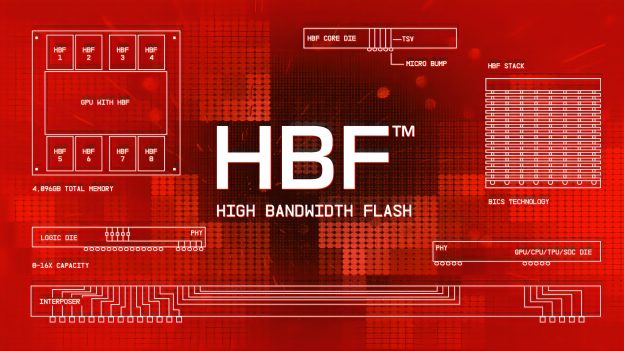
As AI workloads continue to grow, high-bandwidth flash (HBF) is gaining momentum, with experts forecasting earlier-than-expected commercialization. According to Sisa Journal, KAIST professor Joungho Kim—widely regarded as the “father of HBM”—indicates that Samsung Electronics and SanDisk plan to integrate HBF into products from NVIDIA, AMD, and Google by late 2027 or early 2028. As the report notes, Kim adds that while HBM takes over a decade to develop, HBF could reach commercialization much faster, as companies are already leveraging the process and design expertise accumulated from HBM to begin HBF development.
In addition, Kim also predicts that HBF will see broader adoption around the time HBM6 is introduced, and even suggests the HBF market could surpass HBM by around 2038. He explains that HBM6 will not consist of a single memory stack—instead, multiple stacks will be interconnected like a housing complex. As DRAM-based HBM faces capacity limits, he believes NAND-stacked HBF will emerge to fill the gap.
HBF’s Role in AI Inference and System Architecture
Commenting on HBF’s role in AI workloads, Kim explains that GPUs, during inference, first retrieve variable data from HBM, process it, and then generate output. He believes HBF will take on this role in the future, providing significantly larger capacity to support the task. While HBM is faster, HBF offers around 10 times the capacity. As the report notes, Kim highlights that HBF supports unlimited read cycles but is limited to approximately 100,000 write cycles, requiring software from companies like OpenAI or Google to be optimized for read-intensive operations.
Kim adds that today’s process of feeding data to GPUs involves long transmission paths through storage networks, data processors, and GPU pipelines. In the future, he envisions a more streamlined architecture, where data could be processed directly behind HBM. This structure, expected to emerge with HBM7, is being referred to by some as a “memory factory.”
Samsung and SK hynix Advance HBF Development
As the report highlights, SK hynix is expected to unveil a trial version of HBF for demonstration later this month. The report also notes that Samsung Electronics and SK hynix have signed memorandums of understanding (MOUs) with SanDisk to advance HBF standardization, and are now pursuing those efforts through a joint consortium. Both companies are actively developing HBF products, aiming to bring them to market by 2027.
Industry sources cited by the report estimate that HBF could achieve bandwidths exceeding 1,638 GB/s, a major jump compared to standard SSDs, which typically offer around 7,000 MB/s via NVMe PCIe 4.0. In terms of capacity, HBF is also expected to reach up to 512 GB, significantly outpacing the 64 GB provided by HBM4.
Read more
- [News] SLC-Based AI SSDs Gain Traction as SK hynix and Kioxia Accelerate Development With NVIDIA
- [News] SK hynix Reportedly Explores High-Bandwidth Storage Stacking NAND and DRAM
(Photo credit: SanDisk)
Please note that this article cites information from Sisa Journal.