Popular Keywords



About TrendForce News
TrendForce News operates independently from our research team, curating key semiconductor and tech updates to support timely, informed decisions.
[News] Smartphone Memory Inventories Reportedly Fall Below 4 Weeks, Low-End Devices in the Crosshairs
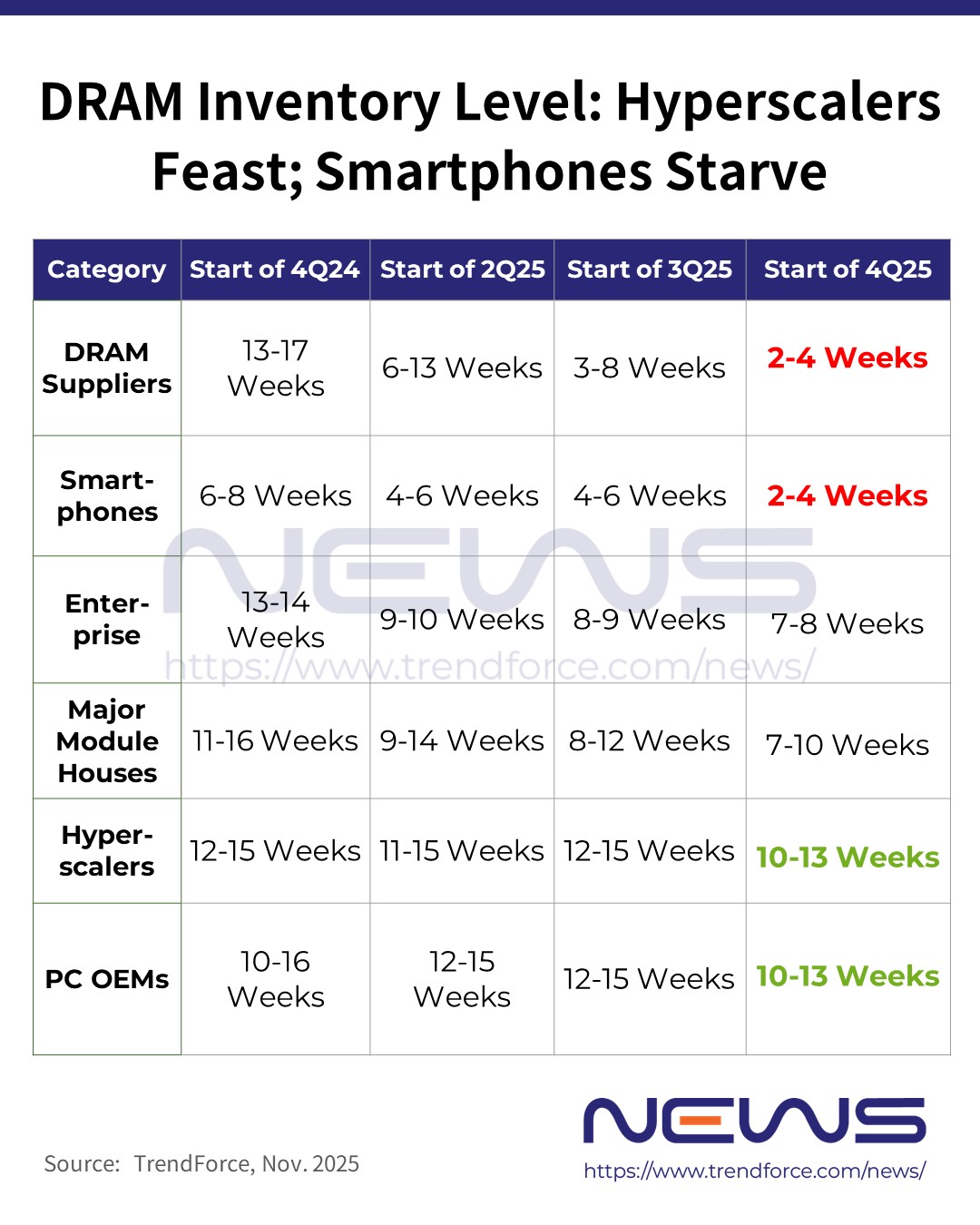
Amid recent headlines—Micron exiting the Crucial consumer memory business and Samsung and SanDisk reportedly delaying NAND deliveries—strong memory demand from hyperscalers is putting consumer products, especially smartphones, under pressure. According to Calian Press, citing TrendForce Senior Research VP Avril Wu, healthy smartphone memory inventories usually cover 8–10 weeks, but current stocks have dropped below four weeks.
Calian Press, citing Wu, notes that with inventories at critically low levels, manufacturers have no choice but to buy even at high prices, or production lines cannot continue operating. Notably, the report highlights that low-priced inventory may only last into the first quarter of 2026; after that, companies will have to accept the new price increases to replenish stocks.
A spokesperson for Coosea Group, the China-based maker of koobee smartphones, told Cailian that mid- to low-end smartphone chips—covering some 4G and 5G models—still rely on DDR4x or lower, with DDR5 unsupported. The report adds that DDR4 is expected to remain the mainstream for this segment over the next three years.
However, these products face the tightest supply-demand squeeze, driving the steepest price increases. Strong AI server (CSP) demand is consuming wafer capacity for HBM and enterprise DDR5, and with overall memory production tight, manufacturers are prioritizing high-margin HBM, squeezing supply for other memory types.
Notably, Calian reports that DRAM prices have soared over fourfold this year, with Flash nearly tripling. Coosea, cited by Calian, says 4GB DDR4x chips climbed from $7 at the start of the year to more than $30 by mid-November, a 4–5× surge. 64GB eMMC also jumped from $3.2 to over $8 during the same period.
For now, Samsung and SK hynix will only extend DDR4 production into next year, before planned discontinuation, according to South Korea’s Maeil Business Newspaper.
Rising DRAM Costs Set to Hit Budget Smartphones First
As TrendForce notes, this wave of DRAM price surge will hit entry-level smartphones first. According to TrendForce, the surge in smartphone memory costs in 2025 is mainly due to increases in DRAM prices. Contract prices for DRAM in the fourth quarter are expected to grow by more than 75% YoY, and given that memory usually makes up 10–15% of the total BOM cost, this has led to an overall unit cost increase of about 8–10% in 2025.
At present, TrendForce predicts a 1.6% YoY increase in global smartphone production for 2025, but cautions that ongoing memory supply issues could lead to a further downward revision.
Coosea, cited by Calian, notes that he company is adjusting memory configurations to prioritize the core smartphone experience. For example, mainstream configurations of 12GB + 512GB may shift toward more cost-efficient 8GB + 256GB versions, which suggests that the trend of rapidly doubling smartphone storage over recent years could reverse next year, Calian adds.
Beyond downsizing, price increases are also inevitable. Xiaomi President Lu Weibing told analysts earlier that the company has secured full-year memory supply for 2026, but warned that shortages could push smartphone prices higher, with product costs reflecting the rise in components, according to the Economic Daily News.
Amid this trend, Chinese memory manufacturers are accelerating R&D and production. The Economic Daily News suggests that GigaDevice plans to mass-produce LPDDR4X and is developing LPDDR5X, while Montage Technology is increasing penetration of its DDR5 memory interface chips (RAM), and TWSC has announced a private placement plan to expand SSD and memory production.
Read more
- [Exclusive] Memory Crunch Hits PCs: Dell Hikes Prices 15-20% Mid-December, Lenovo from January 2026
- [News] SanDisk, Samsung Reportedly Delay NAND Delivery, Hitting Transcend with 50–100% Price Spike
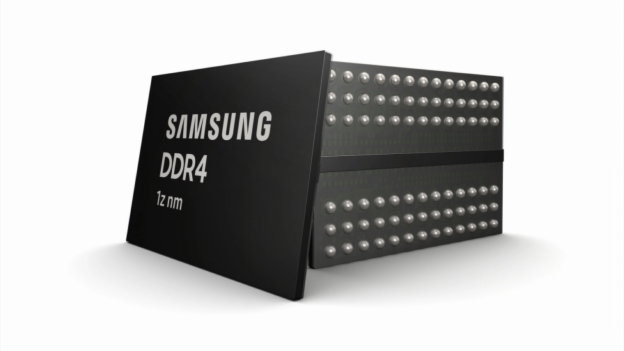
(Photo credit: Samsung)
Please note that this article cites information from Calian Press, Maeil Business Newspaper and Economic Daily News.