[News] Inside iPhone 18 Pro and Duo: A20 Pro Debuts as Apple’s 1st 2nm Chip in iPhone, Duo Trades RAM for Storage

John Ternus took the stage for his first iPhone launch as CEO following Tim Cook’s departure, putting the iPhone Duo, and the new iPhone 18 Pro and Pro Max in the spotlight. Among the key announcements was Apple’s A20 Pro, which powers both the iPhone 18 Pro and Duo and marks the first 2nm chip in an iPhone, according to Tom’s Hardware.
Notably, CNBC adds that while the chip is built on TSMC’s 2nm process, with production currently limited to Taiwan, Apple has also committed to manufacturing some iPhone chips at TSMC’s new Arizona fabs.
But the A20 Pro is only part of the hardware story. Here are the key takeaways on the silicon powering Apple’s latest iPhones, spanning the A20 Pro, C2 modem and memory.
A20 Pro: Packaging Tech also in Focus
According to NoteBookCheck, though Apple stopped short of specifying the exact node, A20 Pro has long been rumored to use TSMC’s base N2 process, while competing offerings such as Qualcomm’s Snapdragon 8 Elite Extreme Gen 6 and MediaTek’s Dimensity 9600 Pro are expected to adopt the more advanced N2P node.
Tom’s Hardware further explains that Apple’s first 2nm chip overall is the M6, unveiled in August. Sharing some of the M6’s architecture, the A20 Pro reportedly features dual neural engines as well as new CPU and GPU cores.
The report adds that A20 Pro packs a six-core CPU with two performance cores that are 20% faster than the previous generation, plus four efficiency cores with neural accelerators, as the Cupertino firm calls it a “desktop-class” processor and the fastest smartphone CPU.
According to Tom’s Hardware, its seven-core GPU delivers a 40% generational performance boost, with higher bandwidth and new neural accelerators that enable up to 2x faster FP8 compute. The two neural engines pack 32 cores in total, while memory bandwidth reportedly jumps 50% to what Apple calls the widest memory interface in an iPhone.
Beyond the chip itself, Apple has also revamped the A20 Pro’s packaging. The new approach places the silicon and memory dies side by side, keeping memory out of the SoC’s thermal path and allowing the dies to connect directly to the vapor chamber.
The redesigned chamber has three times the surface area of the iPhone 17 Pro, helping Apple achieve up to 40% higher sustained performance than the 17 Pro and twice that of the 16 Pro, according to MacRumors.
On the other hand, while Apple has unveiled its C2 modem to reduce the company’s reliance on Qualcomm, MacRumors points out that the iPhone 18 Pro and iPhone 18 Pro Max may use different modems, at least in the U.S.
Apple’s technical specifications page lists its C2 modem for the iPhone 18 Pro, but does not specify a modem for the U.S. version of the iPhone 18 Pro Max, the report notes, adding that pre-launch reports suggested that some iPhones could continue to use Qualcomm modems. With the C2 also powering the iPhone Duo, supply constraints could be one possible explanation, according to the report.
Memory Costs and Duo’s Memory Trade-Offs
According to Reuters, rising memory costs are hitting Apple’s latest iPhones, pushing the starting prices of the iPhone 18 Pro and Pro Max up by $100 to $1,199 and $1,299.
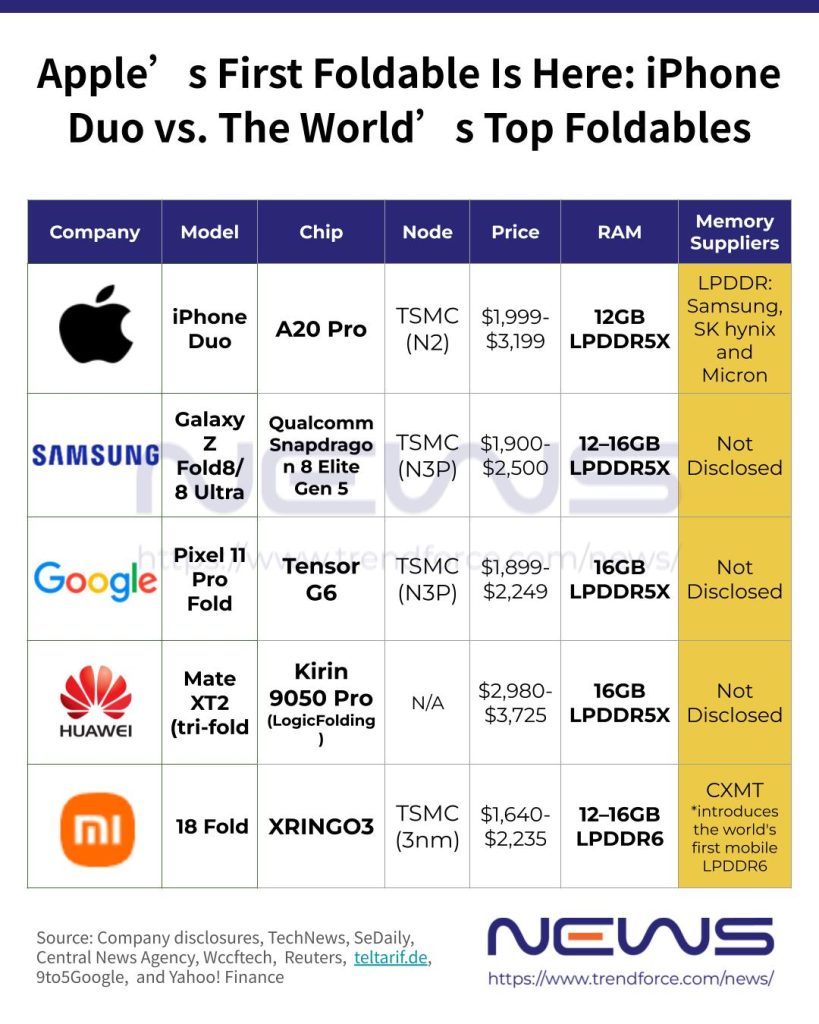
Yet Apple’s first foldable iPhone brings a storage advantage of its own. Starting at $1,999, roughly $100 above Samsung’s Galaxy Z Fold8 and Google’s Pixel 11 Pro Fold at comparable base capacities, Duo offers up to 2TB of storage—twice the 1TB maximum offered by either rival, according to Reuters.
Duo, meanwhile, does not lead across every memory specification, SeDaily highlights that Apple has not officially disclosed the iPhone Duo’s memory capacity, but it is reportedly equipped with 12GB of RAM, which is less than the up to 16GB supported by Samsung’s Galaxy Z Fold and Galaxy Z Fold8 Ultra.
Against the backdrop, Apple has diversified its memory supply chain beyond its previous reliance on Samsung Electronics to include SK hynix and Kioxia, according to Financial News. However, as memory makers allocate more capacity to HBM for data centers, LPDDR supplies are tightening, with 12GB LPDDR5X module prices rising from $30 in early last year to the $70 range early this year, the report adds.
The squeeze is also driving up Apple’s memory costs. TrendForce expects memory prices to remain in a major upcycle that began in the second half of 2025, with memory costs for the 256GB Pro model projected to be nearly 400% higher in 3Q26 than a year earlier.
Read more
(Photo credit: Apple)