[News] Sandisk’s Gross Margin Guidance Flatlines at 83-85%: What’s Inside Its New Business Model Contracts?
As Sandisk posted a blockbuster 4QFY26, with sales surging 372% YoY to $8.97 billion and gross margin reaching 84.6%, attention is shifting to its current-quarter outlook. Although revenue is projected to rise to $10.30 billion–$10.80 billion, gross margin is expected to level off at 83%–85%, reinforcing the importance of the company’s New Business Model (NBM) in supporting long-term earnings.
Notably, Sandisk offered a rare glimpse into the profitability profile of its NBM strategy, with CFO Luis Visoso saying the company is signing NBM contracts at around an 80% margin level, according to a Yahoo! Finance earnings call transcript. He added that further upside remains if market prices continue to rise, as the model’s pricing structure allows Sandisk to capture part of the additional gains.
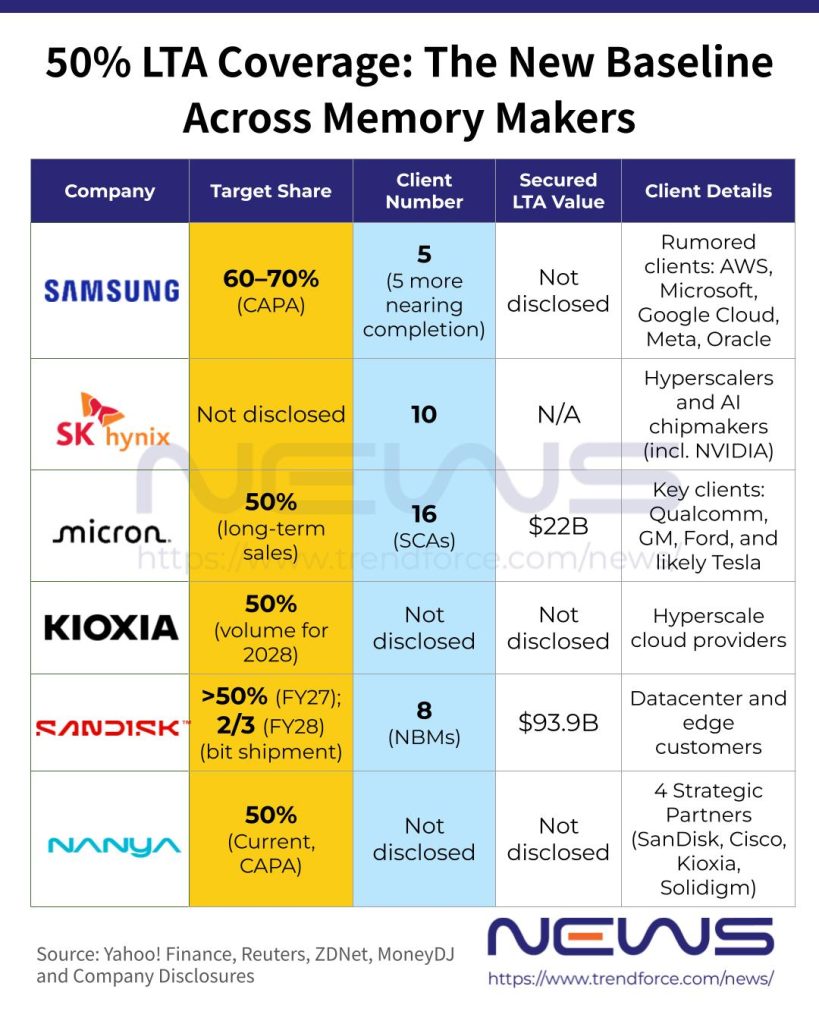
Against this backdrop, the company expects NBM agreements to become a major growth driver in the coming years. The contracts extend up to five years, with a weighted average duration of more than four years, and are projected to account for over half of bit shipments in FY2027 and roughly two-thirds in FY2028, Sandisk said.
Since April, Sandisk has signed five additional NBM agreements, including three with new customers and two expansions with existing partners, bringing its total NBM customer base to eight datacenter and edge customers. Together, these agreements represent $93.9 billion in minimum contracted revenue based on floor pricing, Reuters reports.
According to Sandisk, under the model, pricing combines fixed and variable components, with the variable portion structured with floor and ceiling mechanisms, allowing it to maintain attractive margins even at the minimum pricing level. Supply and demand commitments are defined on both annual and quarterly bases, giving Sandisk clearer operational visibility and greater financial protection.
Following Memory Giants’ LTA Playbook
Sandisk’s NBM strategy, which locks in long-term profitability while limiting exposure to price volatility, closely mirrors the broader shift among global memory leaders toward greater reliance on long-term agreements.
Micron expects its Strategic Customer Agreements (SCAs) to account for around 50% of long-term memory sales, while Samsung is pursuing an even more aggressive approach, targeting 60%–70% of total production capacity (CAPA) for long-term contract volumes, according to ZDNet. Meanwhile, SK hynix also offered limited details on its long-term agreements, disclosing that it has completed 10 such deals.
To match these long-term supply commitments, Sandisk is scaling up investment and inventory accordingly. The company expects capital expenditure to increase year over year as it ramps production of BiCS8 and BiCS10.
In addition, the company also plans to maintain elevated inventory levels, broadly in line with current levels, to support its NBM commitments and offset rising component costs. As a result, sellable bit supply is expected to remain in the mid-teens growth range for fiscal 2027.
Read more
- [News] Samsung Targets 60–70% Capacity Under LTAs; Five Key Customers Reportedly Include AWS, Microsoft, Google
- [News] SK hynix Posts Record 2Q Results but Misses Estimates Reportedly Due to Conservative Pricing; Completes 10 LTAs
(Photo credit: Sandisk)