[News] TSMC After Earnings Call: Foreign Brokerages See EUV-Driven CapEx Surge and 2027 Price Hikes

At TSMC’s earnings call yesterday, the foundry giant surprised the market by raising both its 2026 CapEx and full-year revenue growth outlook, even as it warned that the 2nm ramp-up and overseas expansion would weigh on gross margins. Following the updated guidance, foreign brokerages released fresh assessments of TSMC’s outlook, with the most bullish projecting TSMC’s 2028 CapEx could climb to US$90 billion. Below are the key takeaways.
EUV Expansion Emerges as Key Driver of Rising CapEx
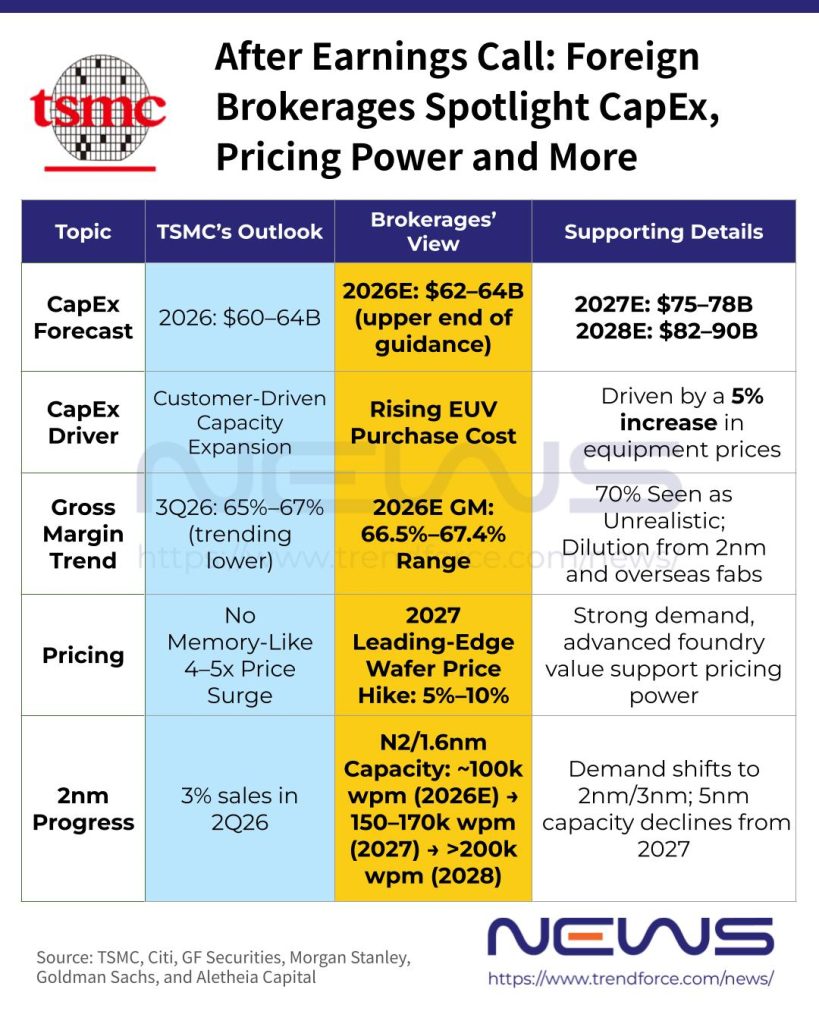
While TSMC has raised its 2026 CapEx guidance to US$60–64 billion from the previous US$52–56 billion, foreign brokerages largely expect spending to land near the upper end of the range, at around US$62–64 billion. Looking further ahead, CapEx is widely expected to keep climbing, with Citi forecasting US$77 billion in 2027 and US$86 billion in 2028. GF Securities takes an even more bullish view, projecting TSMC’s CapEx could surge to US$90 billion by 2028.
A surge in EUV-related spending is emerging as a key driver. Aletheia Capital links the increase to ASML’s upgraded FY26 revenue guidance of €43–45 billion, arguing that the boost is partly driven by installation-related revenue. The brokerage also expects TSMC to continue upgrading its installed EUV scanners to increase throughput. Morgan Stanley also highlights that ASML’s capacity allocation is expected to keep TSMC as its largest EUV customer.
However, beyond capacity expansion, rising equipment costs are also adding pressure to TSMC’s CapEx. Morgan Stanley estimates that TSMC may need to spend roughly US$3 billion to reflect a 5% increase in equipment prices, while another US$8 billion could be allocated toward equipment prepayments.
Notably, Reuters, citing The Information, reported earlier that ASML is seeking higher prices for its chipmaking equipment, a move TSMC is said to be 10% price hike for ASML’s mature DUV systems.
Advanced Node Demand Bolsters TSMC’s Pricing Power
As 2nm ramped up to contribute 3% of TSMC’s 2Q26 revenue, strong customer demand continued to support growth in the foundry leader’s advanced nodes. Against this backdrop, TSMC is expanding capacity while strengthening its pricing power, paving the way for further price increases.
According to Citi, TSMC’s N2-family capacity is expected to grow at a CAGR of more than 70% from 2026 to 2028, while N3 capacity is also expanding rapidly to support demand for advanced AI chips.
Against the backdrop, Morgan Stanley expects TSMC to raise leading-edge wafer prices by another 5%–10% in 2027, as strong demand and the value of its advanced foundry services continue to bolster its pricing power. On the other hand, Goldman Sachs is modeling a low- to mid-single-digit price increase for TSMC in 2027.
TSMC’s U.S. Fab Plans and 2nm Ramp-up
A key highlight of TSMC’s earnings call was its surprise announcement of an additional US$100 billion investment in the U.S. Aletheia Capital estimates that the move would bring TSMC’s total U.S. investment plan to US$265 billion, including four new fabs — likely comprising two front-end fabs and two advanced packaging facilities.
Notably, TSMC’s newly announced U.S. investment further reinforces its commitment to expanding leading-edge capacity overseas, as the future fabs are set to feature 2nm and more advanced processes. While the move may weigh on margins in the short term, it also signals a potential reshaping of TSMC’s advanced-node manufacturing footprint.
Morgan Stanley also highlights a shift in TSMC’s advanced-node mix: while 2nm and 3nm capacity continue to expand, 5nm capacity is expected to decline from 2027 as demand gradually migrates. The brokerage expects the transition to accelerate as NVIDIA moves from Blackwell to Rubin, with Rubin shifting to a 3nm process.
Read more
- [News] TSMC Lifts 2026 Capex 15% to $60-64B, Hikes Sales Outlook to Over 40% Despite Q3 Margin Dip
- [News] TSMC Boosts Arizona Investment by US$100B, Plans 4 More Fabs for 2nm and Advanced Packaging
(Photo credit: TSMC)