[News] WAIC 2026 Highlights China’s SuperNode Push Led by Huawei; MiniMax M3, Unitree Robots in Focus
The 2026 World Artificial Intelligence Conference (WAIC) opened in Shanghai on July 17. According to Yicai, this year’s exhibition shows AI moving into real industrial deployment. Supernodes have replaced individual chips as the new focus of computing power competition, AI agents are evolving into productivity tools, humanoid robots are entering factory environments, and consumer AI devices are moving toward everyday use.
One of the key themes is the rapid development of China’s domestic AI chips and GPUs. As the report notes, Dongfang Suanxin unveiled its first high-performance AI chip, the DF1000, ahead of the conference. Built on 14nm process, the chip is claimed to deliver performance comparable to 4nm-class chips. The company is also showcasing a 512-GPU cluster.
Other domestic GPU vendors are also introducing new products. MetaX is showcasing its Xijing S-series SuperNode and new Xisuo X-series products, while Moore Threads is demonstrating domestic chips completing ultra-large-scale AI training, including the full training of the MoE-236B foundation model from scratch and the world’s first native full-stack training of Peking University EvoPhys-World, a 5D world model.
SuperNodes Take Center Stage
As the report highlights, SuperNode products are a major focus across Chinese AI chip vendors. Huawei is debuting the industry’s largest Atlas 950 SuperPoD, featuring 1,024 Ascend AI accelerators, while its Atlas 950 SuperCluster can scale to 500,000 accelerators, which the company describes as the world’s most powerful AI computing cluster. Alibaba is also showcasing its Zhenwu M890 × Panjiu AL128 SuperNode, marking the first public demonstration of the platform following the launch of its Zhenwu 810E AI chip earlier this year. Supporting infrastructure is also on display. Huawei, Sugon, and MetaX will showcase 10,000-accelerator liquid-cooled clusters using both full-immersion and cold-plate commercial cooling technologies, the report adds.
AI Agents and Humanoid Robots Take the Spotlight
Another key highlight is the evolution of AI agents. According to the report, AI agents are no longer chatbots, but “digital employees” capable of independently completing complex tasks. Baidu’s DuMate stood out in a live demonstration, showcasing personalized habit learning and memory through continuous collaboration while enabling closed-loop task execution across apps and files.
MiniMax, one of China’s leading AI foundation model developers, will showcase its flagship MiniMax M3 model, as noted by Shanghai Securities News. The company will also introduce H3, which represents a shift from task-specific models toward general multimodal intelligence. The report adds that MiniMax will also demonstrate real-world AI applications, including Vbot’s robotic dog Datou BoBo, powered by the MiniMax M3 model.
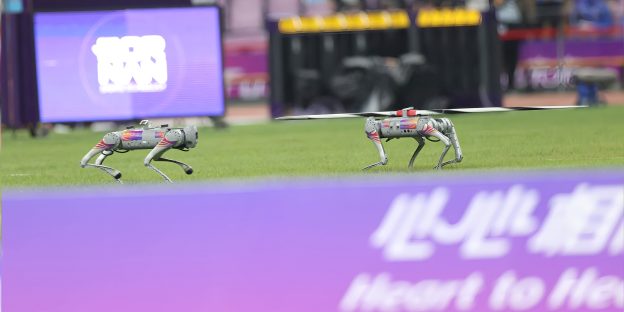
The exhibition also highlights advances in humanoid robotics. The Yicai report notes that Unitree is showcasing the world’s first rideable transforming mech, the GD01, which can switch between humanoid and quadruped modes. Meanwhile, Fourier is debuting the GR Nano, a desktop robot and the latest addition to its GR series designed for personal companionship.
Read more
- [News] China’s Dongfang Suanxin Unveils HBM-Free 14nm AI Chip, Claims Higher Memory Bandwidth Than NVIDIA H200
- Rising Demand for Caregiving and Emotional Support to Drive Humanoid Companion Robot Market to US$1.1 Billion by 2030, Says TrendForce
(Photo credit: Unitree)