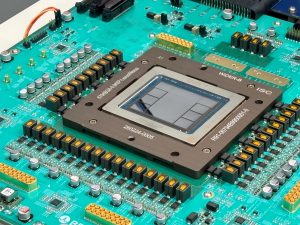
[News] China Unveils First GaN Magnetic Encoder Chip for Humanoid Robot Joints
Recently, CT-Unite released its CT-21X gallium nitride (GaN) magnetic encoder chip, marking the debut of China’s first GaN-based encoder specifically designed for humanoid robot joints. The launch represents a key breakthrough in the country’s development of high-end, application-specific chips for robotics.
According to the company, the CT-21X leverages the intrinsic advantages of GaN two-dimensional electron gas (2DEG) materials to address long-standing challenges in humanoid robot joints, including high-temperature failure, limited space, insufficient lightweight design, and the difficulty of balancing precision with reliability. The solution is positioned to support domestic applications across industrial robotics, embodied AI, aerospace, and specialized equipment with a new generation of highly reliable, miniaturized position-sensing technology.
In terms of performance, the chip adopts a GaN and AlScN-based architecture, enabling stable operation without degradation at extreme temperatures of up to 180°C, while withstanding peak temperatures ranging from 250°C to 400°C. It delivers angular accuracy of 30–100 arcseconds and ultra-low thermal drift of 0.01–0.03°/°C. The chip can be mounted directly near motor coils, eliminating the need for complex thermal management and enabling high-density integration.
The CT-21X also integrates a 21-bit ultra-high-resolution, low-noise ADC with programmable calibration. It achieves angular error of just ±0.1°, response latency below 2μs, and bandwidth of 1–5 MHz, supporting rotational speeds of up to 300,000 rpm. These capabilities can improve robotic trajectory control accuracy from ±0.2 mm to ±0.05 mm, meeting the requirements of high-dynamic and high-precision tasks such as running, jumping, grasping, and precision assembly.
The company highlights six core advantages of the chip: high-temperature reliability, miniaturization and lightweight design, ultra-high precision, low power consumption, high integration, and radiation resistance. Its single-chip multi-sensor fusion design reduces size by 40%–50% compared to conventional solutions, making it suitable for ultra-thin, compact, and hollow joint structures, while also meeting the radiation tolerance requirements of aerospace and specialized applications.
CT-Unite has long focused on GaN integrated circuits and robotic motion control chips. Mass production is expected to begin in Q3 2026, with samples and customization services already available.
(Photo credit: FREEPIK)