[News] Intel Foundry Gains Momentum: Apple Reportedly Eyes 18A-P as Google Explores Advanced Packaging
At last week’s earnings call, Intel CEO Lip-Bu Tan flagged that the CPU-to-GPU ratio—once around 1:8—is now trending toward 1:1 as inference and agentic AI scale, signaling a rebound in server CPU demand and renewed interest in Intel’s foundry business. Notably, according to Commercial Times, major tech players, including Google and Apple, are now weighing a shift to Intel’s foundry platform, with initial products potentially landing as early as 2027.
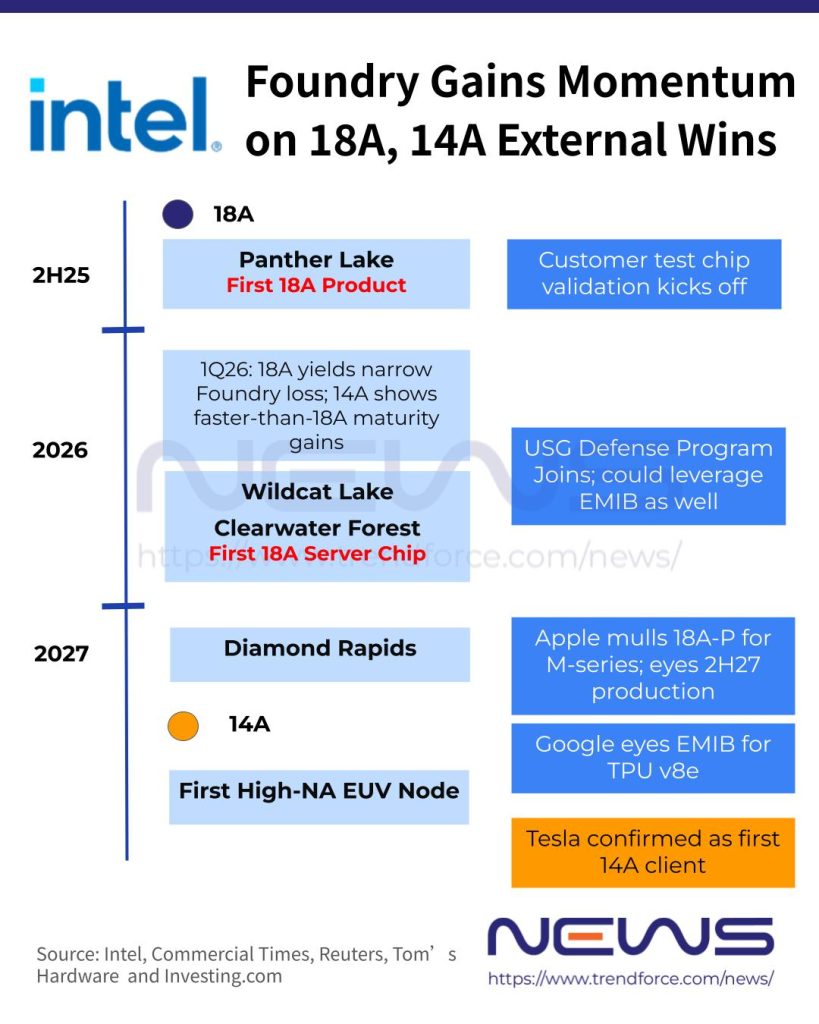
The report suggests that Apple’s M-series chips are evaluating Intel’s 18A-P node, while Google’s TPU v8e could tap its EMIB (Embedded Multi-die Interconnect Bridge) advanced packaging.
With the rise of agentic AI, physical AI, and edge AI, the CPU is re-emerging as the orchestration and control hub of AI systems. As noted by Commercial Times, this momentum is also feeding into Intel’s foundry ambitions: beyond internal needs absorbing capacity, the global surge in AI chips is pushing customers to seek second sources—significantly elevating the strategic importance of Intel Foundry.
18A Gains Traction as Test Chip Validation Expands
The company has already seen its 18A ramping up with yields improving. CFO David Zinsner, citing the earnings call transcript from Investing.com, noted that Intel Foundry’s operating loss narrowed to $2.4 billion in Q1, improving by $72 million quarter over quarter, supported by better yields across Intel 4, 3, and 18A.
Internally, Intel’s flagship mobile processor Panther Lake and the Clearwater Forest server CPU are both built on its 18A process. As previously reported by Tom’s Hardware, Intel made notable progress on 18A yields in late 2025, just in time to initiate low-volume production of its Core Ultra 300-series “Panther Lake” CPU tiles at a development facility in Oregon, while simultaneously ramping high-volume manufacturing at Fab 52 in Arizona.
Beyond internal adoption, Commercial Times, citing supply chain sources, reports that customers have also begun validating test chips on Intel’s 18A node. Core design flows are largely completed, while development of the enhanced 18A-P process is advancing in parallel, the report adds.
Market observers cited by the report noted that, alongside a rebound in AI-driven CPU demand, stronger-than-expected progress in 18A yields and PDK readiness is steadily rebuilding confidence in Intel’s foundry business.
Meanwhile, Intel has also landed its first customer for its 14A process. Reuters, citing Elon Musk, reports that Tesla plans to adopt Intel’s next-generation 14A node for chips used in its Terafab AI complex in Austin.
Read more
[News] Intel Reportedly Sells Chips Typically Scrapped as CPU Demand Surges; 1Q26 Server CPU ASPs Up 27%- [News] Intel Says AI Inference Pushes CPU Ratio From 1:8 Toward 1:1; 18A Yield Target Advanced to Mid-Year
(Photo credit: Intel)