[News] From Annual Deals to 3–5 Year LTAs: Samsung and SK hynix Reportedly Reset Big Tech Memory Contracts

As memory emerges as a critical bottleneck in hyperscalers’ in-house AI chip development and large-scale infrastructure buildouts, long-term supply agreements are rapidly becoming the new industry standard—on time horizons longer than previously anticipated. According to Aju News, Samsung and SK hynix are moving away from one-year, short-term contracts with global big techs, transitioning instead to an LTA-only model spanning three to five years.
Newsis suggests that for custom AI chips in particular, key specifications and volumes—including memory and advanced packaging—are often locked in early at the design stage. This design-linked procurement structure is, therefore, accelerating the broader shift toward long-term contracting across the global memory supply chain.
Samsung and SK hynix Move to Multi-year Contracts
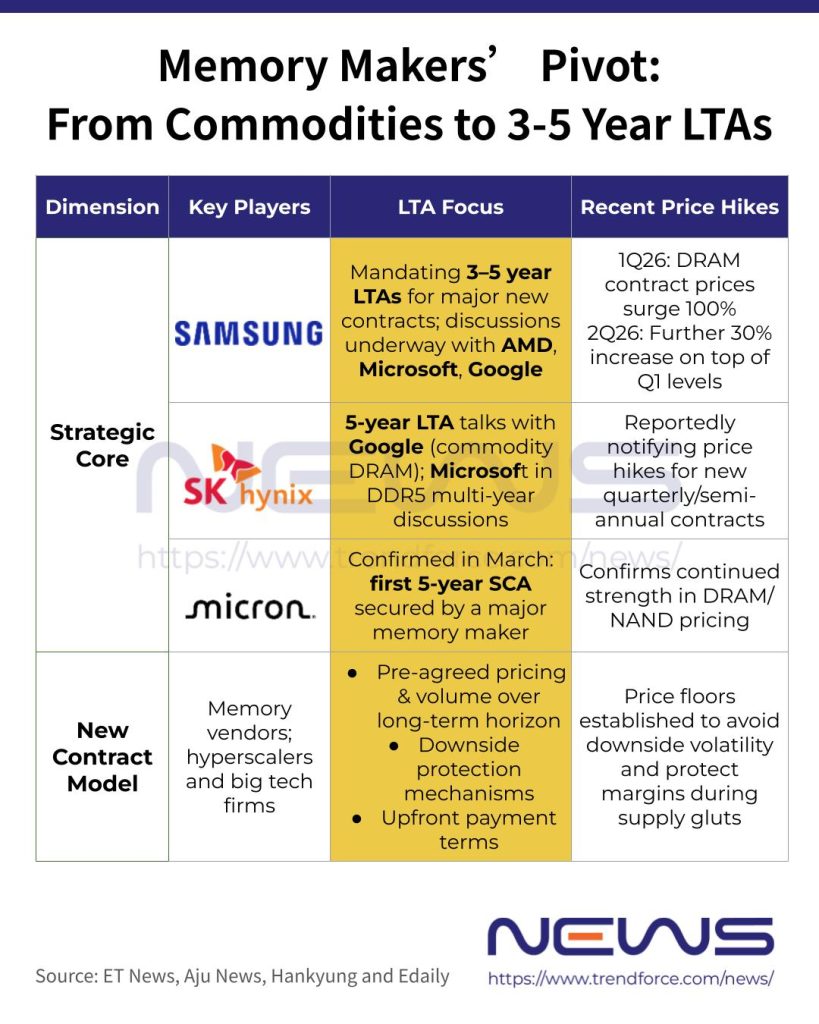
Prior to its South Korean peers, Micron had already indicated during its March earnings call that it had secured its first five-year strategic customer agreement (SCA) and was in active discussions with multiple clients. Now, according to Aju News, Samsung Electronics has adopted a policy to apply long-term agreements (LTAs) of at least three years to all new contracts starting this year.
Notably, Aju News suggests Samsung is expected to secure stable three-year memory supply commitments with key customers currently in late-stage negotiations, including AMD, Microsoft, and Google. While the company had previously accepted ultra-short-term deals—even on a quarterly basis—through last year, it has now decided to transition its supply framework to an LTA-based model, Aju News notes.
SK hynix, meanwhile, is also understood to be pursuing a five-year long-term supply agreement with Google for commodity DRAM. According to Aju News, discussions also include extending the deal by an additional two years, contingent on next-generation HBM supply, as SK hynix is currently the primary supplier of HBM3E to Google. Negotiations, initially expected to conclude later this year, are now likely to be finalized within the first half, the report adds.
According to Hankyung, SK hynix is also in the final stages of coordination with Microsoft over a multi-year DDR5 long-term supply agreement. The deal, valued at tens of trillions of won, is expected to run for three years starting this year, the report notes.
The New LTA Model Defining Memory Supply
In terms of how the new model is expected to operate, Aju News reports that Samsung is reviewing a set of supporting mechanisms alongside its shift toward an LTA framework, including pricing policies designed to cushion DRAM volatility and safeguards to secure minimum annual supply volumes.
Hankyung further notes that long-term supply agreements are structured around pre-agreed pricing and volume commitments over an extended period, typically deployed during periods of sharp price spikes or supply shortages. In SK hynix’s case, negotiations are also said to include downside protection mechanisms against potential DRAM price declines, such as a minimum price floor, alongside upfront payment terms amounting to roughly 10–30% of the total contract value, according to Hankyung.
It is also worth noting that multi-year contracts, while offering memory suppliers greater assurance on margins, future capex planning, and expansion support, are not extended across the entire customer base. Industry sources observe that such agreements are primarily reserved for major cloud service providers (CSPs), including Microsoft, Google, Amazon, Meta, Alibaba, and ByteDance.
Read more
- [News] Samsung Reportedly Eyes Long-Term Memory Deals with Google, Microsoft; May Include $10B+ Prepayments
- [News] Samsung, SK hynix Reportedly Lift Memory Prices Up to 30%; Long-Term Supply Deals in Play
(Photo credit: SK hynix)