[News] Samsung Reportedly Advances Xi’an to 236-Layer NAND; SK hynix Eyes Dalian Upgrade Amid Tight Supply
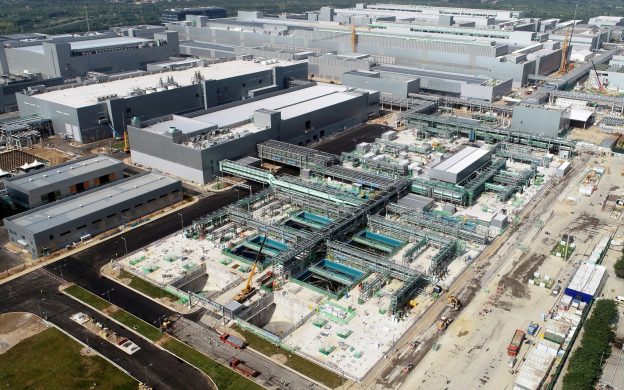
As Samsung and SK hynix continue expanding investment in China amid tightening memory supply, the ongoing NAND process upgrades at their key local fabs are drawing growing attention. According to ETNews, Samsung has completed the first phase of its process transition at the Xi’an plant, phasing out legacy 128-layer (V6) NAND while already ramping mass production of 236-layer (V8) products.
Notably, the report indicates Samsung is lining up further upgrades, with its Xi’an Phase 2 (X2) facility also set to transition to 286-layer (V9) NAND. The shift is expected to be completed by 2026, paving the way for full-scale mass production of the latest V9 nodes, the report notes.
According to TrendForce, China accounted for roughly 30–35% of Samsung’s total NAND output in 2025. Thus, with this process upgrade, the Xi’an facility is expected to significantly expand its output of advanced V8 and V9 NAND products, ET News suggests.
The report highlights weakening demand for older-generation products as a key driver, while the rapid advance of Chinese rivals with cutting-edge offerings is further accelerating the transition. According to ETNews, China’s leading NAND maker has already moved into mass production of 294-layer, making it increasingly difficult to maintain a competitive edge with 100-layer-class solutions.
For context, Samsung is currently mass-producing V9 at its Pyeongtaek plant while also preparing for V10 (over-400 layers) production, according to ETNews.
Meanwhile, ETNews suggests that tighter restrictions on advanced NAND equipment imports into China, amid escalating U.S.–China tensions, may have further pushed Samsung Electronics to speed up its process transition. Although Samsung retains “Validated End User (VEU)” status as an exemption, the report adds that since late 2025 it has been required to secure annual approval from the U.S. government.
SK hynix Moves to Restart Dalian NAND Investment
On the other hand, expansion at SK hynix’s Dalian NAND fab is increasingly taking shape. According to The Bell, talks to restart investment picked up in the second half of 2025 as NAND prices recovered alongside the DRAM upcycle.
The report adds that SK hynix’s overall NAND capacity had been reduced after its Cheongju M15 fab was converted to DRAM during the downturn; other facilities, such as M15X and the Yongin Phase 1 fab, are expected to be dedicated to DRAM production, leaving limited room for additional NAND allocation.
In this context, the Dalian Phase 2 plant is effectively the only available site for expanding NAND capacity, The Bell notes, adding that SK hynix now plans to begin equipment installation at its Dalian Phase 2 plant in the second half of 2026.
Meanwhile, the need to convert the Dalian Phase 1 plant has also been consistently raised. As The Bell notes, the Dalian fab is still operating on 192-layer NAND technology—clearly trailing SK hynix’s latest 321-layer ramp by more than two full generations. Thus, SK hynix is reportedly weighing the production of mid-200-layer NAND at its Dalian fab.
Notably, SK hynix may also be facing expansion pressure in China. According to The Bell, regulatory conditions imposed by China’s State Administration for Market Regulation (SAMR) during its acquisition of Intel’s NAND business continue to influence strategic decisions, requiring sustained output of PCIe- and SATA-based eSSD products and effectively shaping production priorities at the asset level.
According to TrendForce, China accounted for roughly 40–45% of SK hynix’s total NAND output in 2025.
Read more
(Photo credit: Samsung)