[News] Acer and ASUS Reportedly to Pass Surging Memory Costs to PCs in 1Q26, Hot on Dell’s Heels

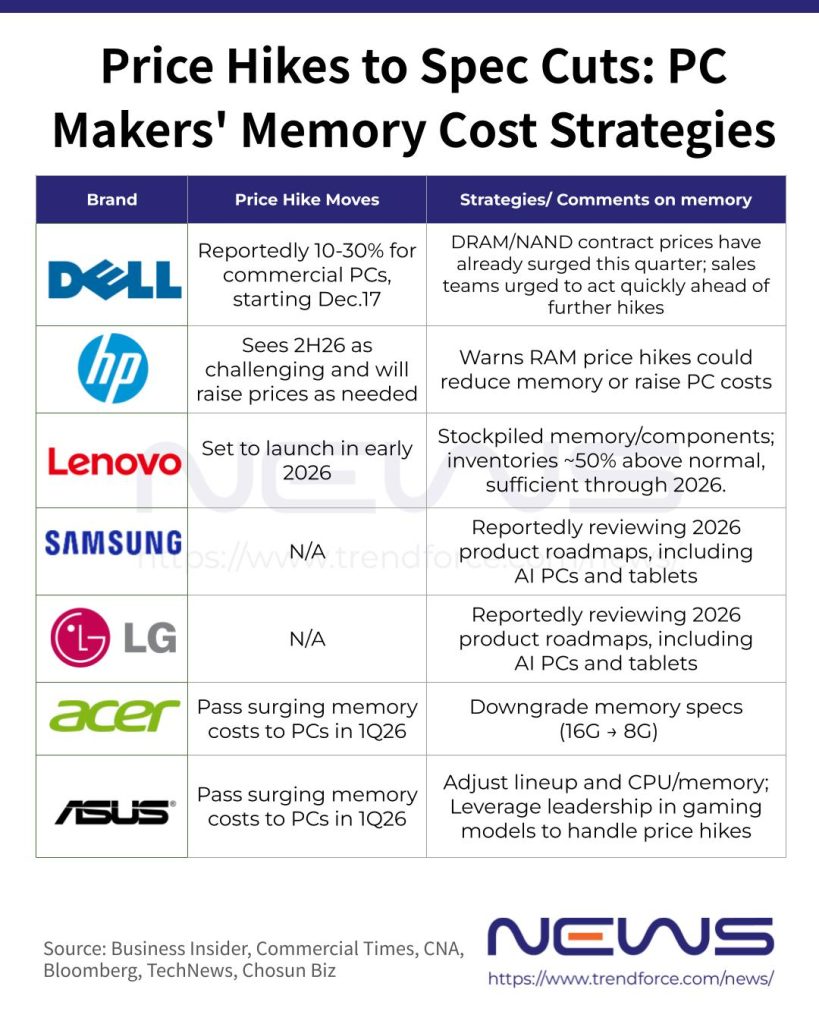
As memory prices soar, Dell is reportedly set to lead the wave of PC price hikes, raising prices across its commercial lines starting December 17. Commercial Times reports that Taiwan’s Acer and ASUS both acknowledged that passing on soaring memory costs has become an industry-wide consensus, and the market now widely expects that starting January, 2026, MSRP (Manufacturer’s Suggested Retail Price) for both consumer and business PCs will fully reflect the rising expenses.
According to Business Insider, Dell is set to hike prices across its commercial product lines, with increases ranging from 10% to 30%. Commercial Times now suggests that in mainland China, spot markets are also seeing higher prices for models with premium memory and storage, though Acer and ASUS have yet to officially adjust their MSRPs.
The Memory Price Frenzy
Notably, a Mirror Daily report, citing a senior PC industry executive, highlights the memory price frenzy, driven by aggressive buying from top-tier CSPs: DDR5 16GB modules jumped from $40 in July to $105 in October, and by November, contract pricing stopped while spot prices spiked multiple times a day, reaching $180 per module.
The report also identifies HP as a key driver behind the price spike. After failing to negotiate in South Korea, the company reportedly turned to Chinese DRAM suppliers, snapping up modules at $200 each. Thus, spot prices for DDR5 16GB modules surged again last week, climbing to $200–220, the report adds.
The surge is hitting PC brands hard. Commercial Times reports Acer CEO Jason Chen saying that memory typically makes up 8%–10% of the BOM (Bill of Materials). Between Q3 and mid-Q4, memory prices reportedly jumped 30%–50%, translating to a 2%–3% impact on overall BOM costs. Still, PC makers are feeling the pressure, with some cutting configurations, such as dropping 16GB RAM down to 8GB, Chen added.
Asus Co-CEO Samson Hu told Commercial Times that memory prices are unlikely to ease until the first half of next year. Acer CEO Jason Chen also sees no short-term relief either but hopes Chinese memory makers’ ramp-up could ease the pressure next year, the report adds.
Demand under Pressure
TrendForce observes that in the consumer notebook market, demand remains quite responsive to shifts in specifications and pricing. However, current stock levels of finished goods and inexpensive memory help safeguard short-term profits. While prices may stay stable for now, medium- and long-term adjustments, such as lowering specifications or raising prices, are inevitable. TrendForce forecasts more significant price fluctuations in the PC market by the second quarter of 2026.
The Mirror Daily report also highlights the potential impact of PC brands’ price hike to reflect memory costs, as even a modest 20% price hike affects demand for such a mature consumer product. The industry consensus, as per the report, is that Q1 2026 laptop sales will drop at least 10% YoY, with Q2 likely to fall another 10–20%.
A senior PC industry executive cited by the report warned DDR5 16GB modules could reach $300 in Q1, with Q2 prices even more unpredictable. Laptop SSDs are also soaring—1TB units now fetch $400, pricier than a Chromebook, while 512GB models jump from $40 to over $140 in just three months, nearly tripling, the report says.
Read more
- [News] Dell Reportedly Plans 10–30% Hikes on Commercial PCs From Dec. 17 as Memory Prices Surge
- [Exclusive] Memory Crunch Hits PCs: Dell Hikes Prices 15-20% Mid-December, Lenovo from January 2026
(Photo credit: Acer)
Please note that this article cites information from Commercial Times, Mirror Daily and Business Insider.