[News] SanDisk Reportedly Sees NAND Shortage Until 2026; Ongoing Price Opportunities Across Board
As data center expansion surges, cloud leaders are moving from AI training to inference workloads, driving strong demand for high-capacity memory. This surge is fueling a wave of NAND price hikes across major players lately, including SanDisk, Micron, and Western Digital. Speaking at last week’s Goldman Sachs Communacopia + Technology Conference, SanDisk highlighted the company’s bullish outlook, noting that the market is expected to remain undersupplied through 2026, according to Seeking Alpha.
As per the transcript from Seeking Alpha, while the company identifies data centers as a primary growth driver, with momentum continuing to accelerate, CEO David Goeckeler reportedly emphasized SanDisk’s strategic approach of balancing supply-demand alignment with controlled capacity expansion. “We don’t see a good market going into ’26,” he noted, warning that undersupply conditions could persist throughout the period.
More Upside for Future Price Hikes
SanDisk’s bullish market view is reflected in its latest price move. TechPowerUp reported that the NAND giant is hiking prices by 10% for all channel partners and consumer products, effective on new orders placed after September 5. The company said the increase responds to surging demand from AI applications, data centers, and mobile devices, as per the report.
SanDisk, according to Seeking Alpha, sees more room for NAND price hikes as the market stays tight. Executive VP & CFO Luis Visoso said the company expects ongoing opportunities to raise prices across client, data center, and cloud segments, noting that pricing and volumes are negotiated quarterly with each customer.
Updates on BIC 8 and HBF
According to Seeking Alpha, SanDisk will sharply ramp up its NAND transition this year, with BICS 8 expected to grow from today’s single-digit share to 40–50% of its portfolio by fiscal year-end. It is worth noting that SanDisk is accelerating its NAND roadmap, moving from the BICS 5 to BICS 6 for QLC, and now reportedly targeting full deployment of BICS 8 across its portfolio over the next couple of years.
It is worth noting that SanDisk disclosed earlier this year that it is developing HBF (High Bandwidth Flash) technology and has signed a landmark MoU with SK hynix to jointly define specifications, according to its press release. As Sisa Journal reported, while HBM stacks DRAM chips to maximize memory bandwidth, HBF stacks 3D NAND arrays to dramatically increase parallel I/O operations.
The company said at the Goldman Sachs conference that HBF is expected to be ready by late 2026, with complete systems—including controllers and ASICs—available in early 2027, as noted by Seeking Alpha. Its first-generation HBF will reportedly feature 16-layer memory, offering up to 512GB per stack—matching HBM’s bandwidth while increasing capacity by 8 to 16 times.
Read more
- [News] Western Digital Raises HDD Prices Amid Soaring Demand, Shipping Delays of Up to 10 Weeks
- [News] Micron Freezes Prices as Inference AI Fuels Surge in SSD Demand and Supply Shortages
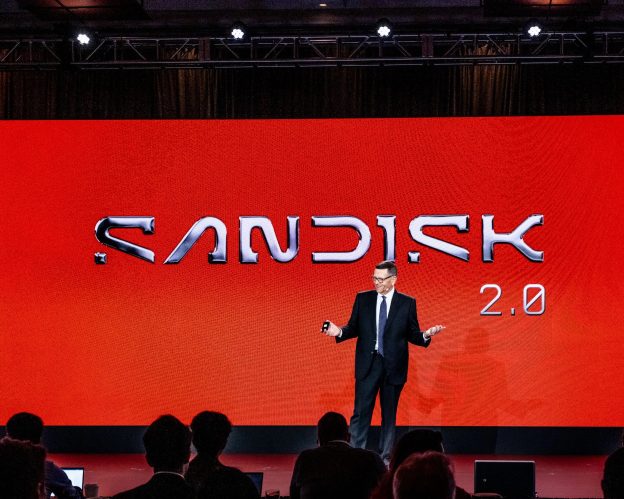
(Photo credit: SanDisk’s LinkedIn)
Please note that this article cites information from Seeking Alpha, TechPowerUp, Sisa Journal and SanDisk.