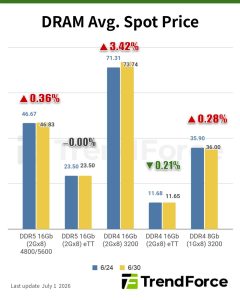
[News] Micron Freezes Prices as Inference AI Fuels Surge in SSD Demand and Supply Shortages
As global data center deployments accelerate, cloud giants are shifting their demand from training AI to inference AI, driving sustained growth in high-capacity memory requirements and causing memory supply constraints to migrate from DRAM to NAND. Supply chain sources reveal that following SanDisk’s 10% NAND price hike last week, Micron has also notified customers it will suspend pricing on all products for one week.
Industry insiders report that Micron will halt quotations to distributors and OEM/ODM manufacturers starting today, covering both DRAM and NAND products, and is even unwilling to discuss long-term contracts for next year.
Supply chain sources indicate that after reviewing customer FCST (demand forecasts), Micron discovered they would face severe supply shortages, prompting an emergency suspension of all product pricing while the company recalibrates its pricing strategy.
According to EE Times China, Micron had initially notified channel partners of impending 20%-30% price increases for DRAM products, with hikes extending beyond consumer and industrial-grade storage to include automotive electronics, where increases could reach 70%.
Implications of Micron’s Move
Sources suggest Micron’s moves reflect structural shifts in high-capacity storage products amid the rapid rise of inference AI services. As global CSPs continue posting record revenues, tech giants like Google and Oracle are aggressively expanding AI infrastructure and pivoting toward high-performance inference applications, driving substantial growth in demand for high-capacity storage products.
Industry sources indicate that lead times for high-capacity HDDs have now extended to nearly one year. In response, memory suppliers are actively developing Nearline SSD products, aiming to narrow the current price gap with HDDs—from the current 4–5x down to around 3x—to encourage customer adoption.
In line with Micron’s move, a recent report from a major U.S. investment firm expressed a positive outlook on the NAND industry, highlighting the strengthening role of both enterprise SSDs (eSSDs) and NL SSDs in the AI era. The report noted that eSSDs are expected to become the core storage devices for AI training and inference servers, while NL SSDs may emerge as viable HDD replacements by 2026–2027.
The report further forecasts that the rapid build-out of AI infrastructure could result in a 2% NAND supply shortage by 2026. Moreover, if NL SSDs continue to gain share from NL HDDs, the NAND supply gap could widen to as much as 8%.
Read more
- [News] Micron Reportedly Cuts Over 300 Jobs in China Amid Mobile NAND Retreat
- [News] HBM Battle Heats Up: Micron Reportedly Hints 2026 Sell-Out, SK hynix Yet to Confirm
(Photo credit: Micron)
Please note that this article cites information from EE Times China.