[News] UltraRAM Reportedly Nears Commercialization: DRAM Speed, NAND Durability, 1K-Year Data Life
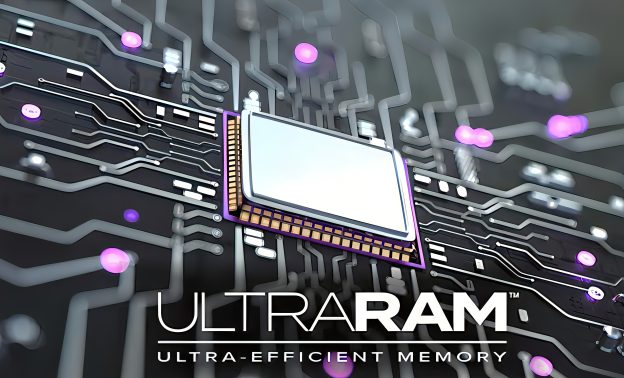
According to TechNews, citing Tom’s Hardware and Blocks & Files, the new memory technology “UltraRAM,” which combines the advantages of DRAM and NAND, has made significant progress toward commercialization. UK-based semiconductor startup Quinas Technology, the developer of UltraRAM, has partnered with IQE to advance its fabrication to an industrial scale.
UltraRAM is regarded as a new type of memory that merges the strengths of DRAM and NAND. As Tom’s Hardware reports, it delivers DRAM-like high-speed performance, durability 4,000 times greater than NAND, ultra-low energy consumption, and data retention of up to 1,000 years. The next step toward commercialization will reportedly see Quinas and IQE explore pilot production with multiple foundries and industry partners, as the report points out.
The Significant Role of Epitaxy in UltraRAM
As Tom’s Hardware highlights, the design leverages a newly developed advanced epitaxy process using gallium antimonide and aluminum antimonide — claimed to be a world first — that will pave the way for UltraRAM volume production.
The report further indicates that UltraRAM is built on epitaxy as its critical first step, where compound semiconductor layers are grown on a crystalline substrate, followed by standard methods such as photolithography and etching.
Challenges Ahead for UltraRAM Commercialization
Quinas’s UltraRAM is seen as a transformative technology with the potential to replace both DRAM and NAND. However, as Blocks & Files notes, it must first be integrated into the existing memory supply chain.
As the report points out, DRAM makers such as Micron, Nanya, SK hynix, and Samsung, along with NAND producers including Kioxia, Micron, SK hynix/Solidigm, Samsung, and SanDisk, supply memory and SSDs to device manufacturers. For UltraRAM to gain adoption, Quinas would need to enter this supply chain so that end-device suppliers could use its memory instead of DRAM and NAND — a shift that would require changes at the hardware, operating system, and system software levels, the report highlights.
Blocks & Files further states that if Quinas can demonstrate industrial-scale manufacturing with viable yields and deliver system-level performance well above DRAM and NAND at lower energy cost, UltraRAM could gain real traction. However, it emphasizes that the most critical factor is proving a clear path to profitable large-scale production.
Read more
- [News] SK hynix Launches Industry-First High-K EMC Mobile DRAM with 3.5x Higher Thermal Conductivity
- [News] Micron Launches G9 NAND SSDs for AI, Ships Samples of World’s First PCIe Gen6 NVMe
(Photo credit: Quinas Technology)
Please note that this article cites information from TechNews, Tom’s Hardware, and Blocks & Files.