[News] Samsung’s 4nm GAIA Could Mark First PIM Commercialization in AI PCs, Mass Production as Early as 2027
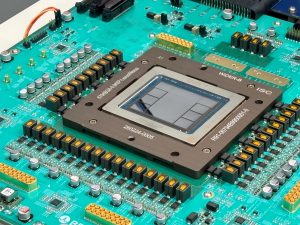
Samsung is exploring a new approach to boost AI performance and efficiency on PCs. According to ZDNet, Samsung showcased its LPDDR5X-PIM paired with an edge AI accelerator SoC at Hot Chips. The company’s AI PC chipset under development, known as “GAIA,” is expected to incorporate LPDDR5X-PIM, which integrates computing capabilities directly into memory. This would mark the first integration of Processing-in-Memory (PIM) into an actual AI PC chipset. If GAIA reaches mass production, it could also become the first commercial application of PIM beyond the research and validation stage, the report notes.
GAIA is an AI accelerator for AI PCs being developed by Samsung Electronics’ System LSI division. Built on Samsung Foundry’s 4nm process, the chip is optimized for AI workloads. ZDNet adds that Samsung has reportedly provided GAIA prototypes to major PC makers, including Lenovo and HP, for performance validation, with mass production potentially beginning as early as next year.
LPDDR5X-PIM Delivers Up to 3.01x Higher Output in Testing
The key to the approach is reducing data movement. As the report explains, LPDDR5X-PIM adds computing capabilities directly to low-power LPDDR5X memory, allowing some data to be processed where it is stored rather than repeatedly transferred between memory and CPUs or GPUs. This can ease AI computing bottlenecks while reducing power consumption.
Samsung validated the SoC with both LPDDR5X and LPDDR5X-PIM, with PIM showing clear performance gains. LPDDR5X-PIM completed the test workload in 5.4 seconds versus 12.3 seconds for conventional LPDDR5X, a 2.28x improvement, while output jumped 3.01x from 27.0 to 81.3 per second, the report notes. ZDNet adds that Samsung previously said simulations showed up to 6.2x higher AI matrix-computation performance than conventional memory. These characteristics make LPDDR5X-PIM particularly suited to on-device AI, where laptops and smartphones face tight power and thermal limits.
GAIA Could Put PIM Commercialization to the Test
Samsung has been extending PIM technology across its memory portfolio, according to ZDNet. The company has introduced HBM-PIM for servers and integrated PIM with LPDDR for mobile applications. However, technical and ecosystem challenges have continued to limit its adoption in commercial products, the report adds. GAIA could therefore serve as a key test of PIM’s commercial potential. Sources cited by ZDNet note that if GAIA moves into mass production after customer validation in the AI PC market, PIM could evolve from a next-generation memory technology into a key solution for on-device AI.
Samsung is also lowering barriers to PIM commercialization. As noted by Seoul Economic Daily, its Address Alignment Mode (AAM) allows LPDDR5X-PIM to work with existing DRAM memory controllers, reducing the need for major system changes. The report adds that the first JEDEC specification for next-generation LPDDR6-PIM is nearing finalization, as Samsung looks to expand PIM from a proprietary solution into a standardized memory technology.
Meanwhile, SK hynix is also advancing PIM-based AI solutions. At CES 2026, the company showcased AiMX, an AI accelerator prototype built around its GDDR6-AiM PIM chip and designed for LLM workloads. The company also demonstrated other computational-memory technologies, including Compute-using-DRAM (CuD) and CMM-Ax.
Read more
- [News] Hot Chips 2026: Samsung’s zHBM Claims 70% Power-Efficiency Gain; SK hynix Evaluates Intel EMIB
- [News] Intel Unveils Three AI Architectures at Hot Chips 2026, Diamond Rapids Taps In-House 18A-P and Packaging
(Photo credit: Samsung)