[News] Micron Meets Less Than Half of Data Center Demand as Customers Rush to Secure Memory at “Very High” Prices
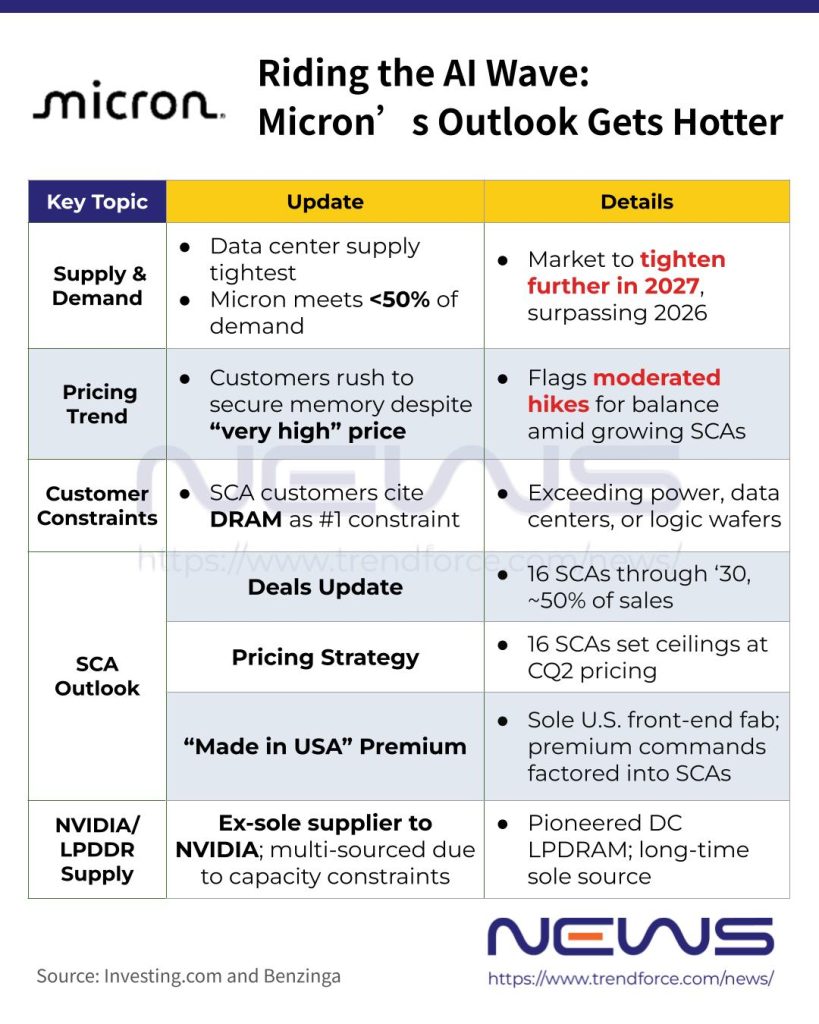
Nearly six weeks after reporting an 81% quarterly operating margin, Micron struck an even more bullish tone at the KeyBanc Technology Leadership Forum 2026 on August 10. The company said customers remain eager to secure memory despite “very high” prices, with the tightest supply in data centers, where Micron can often fulfill no more than half of customer demand, according to Investing.com.
Benzinga, citing Sumit Sadana, Micron’s executive vice president and chief business officer, notes that the U.S. memory giant now expects the supply-demand balance to tighten further in 2027, potentially making it even more constrained than 2026 as AI continues to fuel demand for DRAM capacity and memory bandwidth.
According to Investing.com, Micron said its customers consistently point to DRAM — not power, real estate, data center capacity, or logic wafers — as their number one constraint they are facing today.
SCAs Lock In Demand as Price Gains Cool
Micron reiterated at the forum that it has signed 16 Strategic Customer Agreements (SCAs), which are expected to account for roughly half of revenue, carry binding take-or-pay terms, and run mostly through 2030. Yet even as these contracts lock in years of demand at prices well above prior cycle peaks, Micron also flagged that it is starting to moderate its price increases to some extent, according to Investing.com — a detail that, on its face, seems at odds with a company describing 2027 as tighter than 2026.
As noted in the Investing.com transcript, Sadana explained that Micron is managing multiple levers in parallel rather than relying on price alone. He said the company is balancing improvements in its portfolio mix, gains in overall shipment volumes, and pricing opportunities to strike what he called “a very balanced outcome that is in the best long-term interest of our customers and ourselves.”
Sadana also detailed how pricing is structured within these agreements. Most SCA volume carries a price band with a ceiling, he said, and for the 16 agreements announced at earnings, that ceiling was set using CQ2 pricing. Future SCAs, however, won’t be anchored to that same benchmark — Sadana said any new agreements going forward will have ceiling prices “consistent with whatever the market price is at the time the SCAs are signed.”
Micron’s statement mirrors TrendForce’s price projections. According to TrendForce, multiple memory suppliers have already factored in expected price hikes into their prices for the second quarter of 2026. Additionally, several U.S.-based CSPs have entered into multi-year long-term agreements (LTAs), which restrict suppliers from raising prices for these clients. Consequently, TrendForce predicts that server DRAM contract prices will rise by 13–18% quarter-over-quarter in 3Q26.
Made in USA’ Premium Baked Into SCA Pricing
Interestingly, Micron also pointed to its position as the only company investing in front-end memory fab manufacturing in the U.S. as a key differentiator. As noted in the Investing.com transcript, Sadana said Samsung’s U.S. investments are focused on logic foundry work rather than memory, while SK Hynix’s Indiana project is limited to back-end manufacturing, assembly, and packaging — leaving Micron alone in front-end fab production on U.S. soil.
According to Sadana, customers recognize and value that distinction, and Micron believes it can command a pricing premium for its U.S.-made supply as a result. That premium, he said, has already been factored into the company’s SCAs.
Read more
- [News] Musk Says Micron Is “Making Room” for Tesla in the Years to Come, Hinting at Long-Term Memory Supply
- [News] SK hynix Reportedly Removes Price Cap in Memory Long-Term Agreements, Diverging from Micron
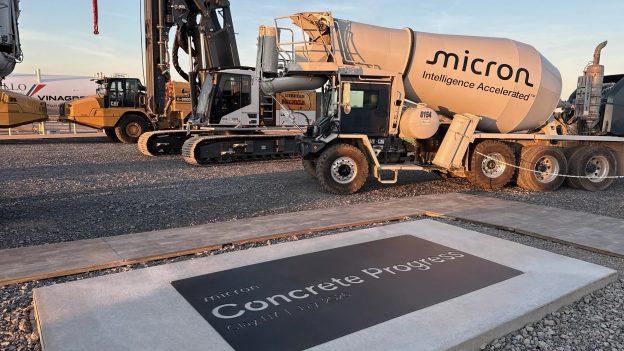
(Photo credit: Micron)