[News] SK hynix Advances DRAM and NAND Roadmap, Targets 3x Wafer Output by 2034, 375-Layer NAND at Year-End
While SK hynix had only last week outlined plans to double capacity over the next five years, the memory giant is now signaling an even more aggressive expansion across both DRAM and NAND. According to Nikkei, citing Chairman Chey Tae-won, the company is targeting a threefold increase in wafer output by 2034. Separately, The Elec reports that SK hynix is preparing to begin mass production of its 375-layer NAND by year-end.
DRAM Capacity Expansion Accelerated by a Decade
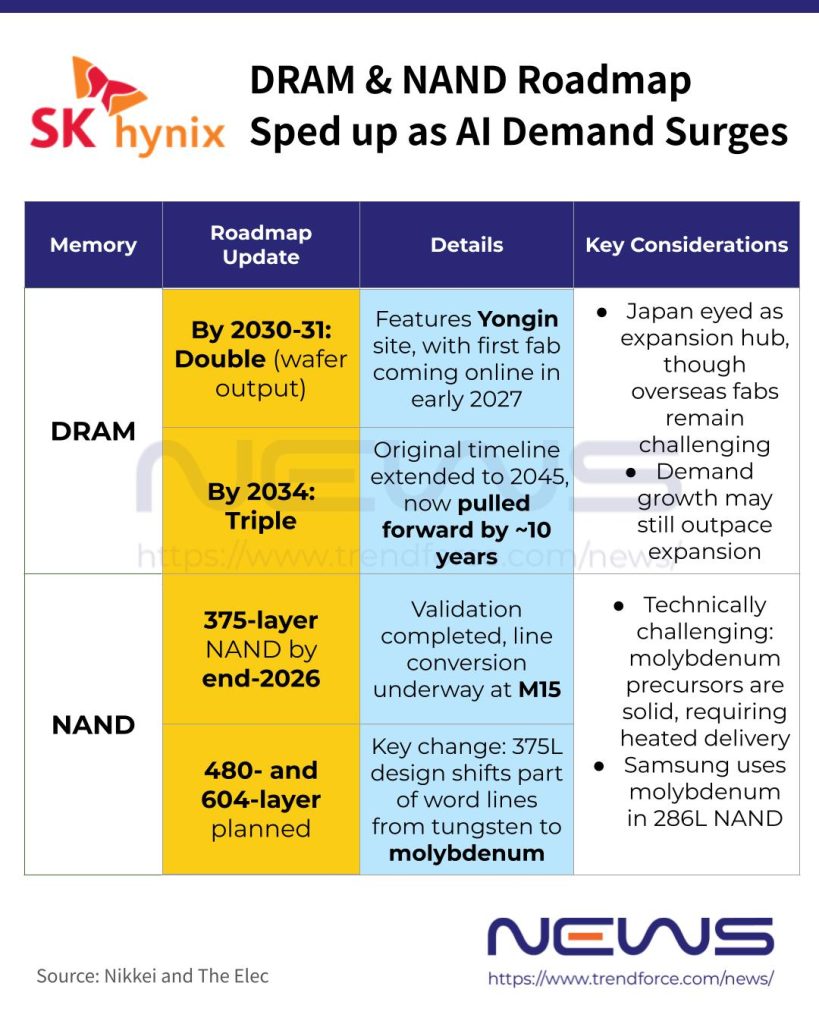
Nikkei reports that SK hynix is building four semiconductor fabs in Yongin, with the first facility expected to begin operations in early 2027. The original schedule had stretched to 2045, but the timeline has been pulled forward by roughly a decade, according to the report. Chairman Chey Tae-won added that demand is rising so rapidly that even the accelerated expansion may still fall short.
As previously reported by The Elec, SK hynix is targeting a significant ramp in DRAM output, lifting monthly wafer capacity from around 550,000 wafers today to roughly 1 million wafers by 2030. Much of the expansion is centered on the Yongin Semiconductor Cluster, where the first fab alone is expected to add about 360,000 wafers per month of DRAM capacity in the first half of 2030, according to the report.
Notably, Nikkei, citing Chey, adds that once its planned domestic fab expansion is completed, SK hynix will evaluate opportunities to build additional manufacturing facilities overseas, with Japan emerging as a leading contender.
Japan is home to a broad base of semiconductor equipment and materials suppliers, including Tokyo Electron and JSR, strengthening its appeal for SK hynix, Nikkei suggests.
375-Layer NAND Progresses
As market attention remains on Kioxia’s NAND expansion and its 332-layer BiCS10, which is expected to enter mass production in FY2027, The Elec reports that SK hynix has completed validation of its 375-layer NAND and is preparing to transition it into mass production by the end of 2026.
An industry source cited in the report said that what was previously referred to as a 400-layer-class device has been revised to 375 layers due to increasing manufacturing complexity at higher stack levels, with a longer-term roadmap extending to 480- and 604-layer nodes.
It is worth noting that SK hynix has also made a key design change in the 375-layer structure, with part of the metal gate electrodes (word lines) controlling each cell layer reportedly shifting from tungsten to molybdenum, the report points out.
As explained by The Elec, as stacking increases, interconnects become thinner and tungsten’s resistance rises with shrinking dimensions, slowing signal transmission. Molybdenum, by contrast, offers lower resistance in fine word-line structures, enabling faster signal transfer and improved read/write performance. It can also be deposited directly, supporting higher-density stacking and greater efficiency.
Kioxia Investment in Focus
SK hynix’s dual role as both competitor and investor in Kioxia is drawing renewed market attention, as the NAND rival’s share price continues to surge.
According to Newsis, SK hynix’s 2018 investment has been reappraised amid the NAND upcycle, with the KRW 4 trillion stake at times surging sharply in value. Kioxia briefly became the second-largest listed company in Japan after SoftBank Group and even surpassed Toyota in market capitalization, the report notes, adding that at its peak, SK hynix’s holding was estimated at around KRW 60 trillion.
Beyond valuation gains, SK Group Chairman Chey Tae-won also addressed the company’s relationship with Kioxia. According to Hankyung, Chey said discussions between management teams are ongoing to explore possible areas of cooperation. He emphasized that while governance remains independent, collaboration in non-competitive areas remains fully possible.
Separately, Global Economic notes that SK hynix is constrained by a trust structure that prevents direct management participation in Kioxia. Chey, cited by the report, added that although Kioxia is an investment asset, it also competes directly with SK hynix, requiring clear competitive boundaries to be maintained.
Read more
- [News] SK hynix Reportedly to Double DRAM Capacity to 1M Monthly Wafers by 2030, Speeds Yongin Expansion
- [News] Memory 1Q26 Price Surge: Samsung Flags 146% ASP Jump, SK hynix Sees Mid-60% DRAM Gains
(Photo credit: SK hynix)