[News] Samsung, NVIDIA Deepen Ties as Talks Reportedly Expand to HBM5 Next Year and Next-Gen Groq Chips
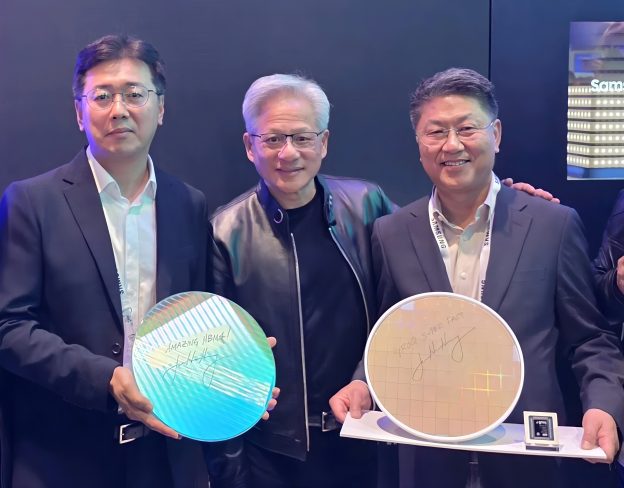
Following Jensen Huang’s high-profile meetings with SK hynix during his South Korea visit, Samsung Electronics Vice Chairman Jun Young-hyun met with the NVIDIA CEO on June 8 to discuss potential cooperation in HBM and foundry services. According to The Chosun Daily, Jun said the discussions focused on collaboration in HBM and foundry. He added that the near-term priority is to ensure stable supplies of HBM4 and SOCAMM this year, while the two companies also discussed longer-term collaboration beginning next year, including HBM4E, foundry services, and HBM5.
Samsung, NVIDIA Expand Foundry Cooperation
On the foundry front, Samsung Electronics is in discussions with NVIDIA on next-generation chip production using its advanced process technologies, including the Drive AGX Thor autonomous driving chip and the Groq language processing unit (LPU), according to Seoul Economic Daily.
Jun said Samsung is manufacturing NVIDIA’s autonomous driving and Groq chips using 4nm and 8nm nodes, according to ZDNet. He added that the partnership also extends to next-generation Groq chips.
As highlighted by Seoul Economic Daily, Samsung currently manufactures the third-generation Groq LPU (LP30) on its 4nm process. Jun’s remarks suggest the company is also in position to produce the next-generation LP40, despite industry expectations that TSMC could secure the order through its advanced packaging strengths.
Samsung Details Memory Portfolio for NVIDIA
On the memory front, Samsung Electronics is supplying HBM4 (6th-generation) memory with data transfer speeds exceeding 11.7 Gbps per pin for NVIDIA’s Vera Rubin platform, according to Yonhap News. The company is also providing LPDDR5X-based SOCAMM2 modules for the Vera CPU, as well as its PCIe Gen6-based PM1763 storage solution.
Yonhap News adds that Samsung’s HBM4E combines DRAM core dies with a proprietary 4nm foundry base die, enabling operating speeds of 14 Gbps per pin and achieving up to 16 Gbps in testing.
Meanwhile, Vice Chairman Jeon stopped short of confirming whether Samsung Electronics and NVIDIA would sign a long-term memory supply agreement, saying Samsung would do its utmost as a key partner to support NVIDIA’s success, according to Newspim.
NVIDIA CEO Jensen Huang also discussed the company’s partnership with Samsung during a Q&A session following the NVIDIA Korea AI Ecosystem Reception. According to Dealsite, Huang said NVIDIA and Samsung have long collaborated in the Application-Specific Integrated Circuit (ASIC) sector and are jointly developing new ASIC products. He added that the two companies also share a long history of cooperation in memory technologies.
Read more
- [News] SK hynix to Supply Memory for NVIDIA Vera CPU as Partnership Deepens; Samsung Meeting in Spotlight
- [News] Samsung Groq Orders May Jump ~70% to 15K Wafers; Tesla Reportedly Delays Other Foundry Clients
(Photo credit: Samsung)