Popular Keywords



About TrendForce News
TrendForce News operates independently from our research team, curating key semiconductor and tech updates to support timely, informed decisions.
[News] China’s No.3 Foundry Nexchip to Hike Prices 10% from June, Following SMIC, Hua Hong
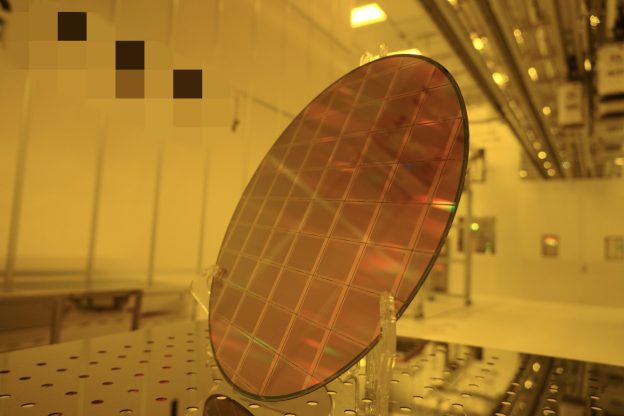
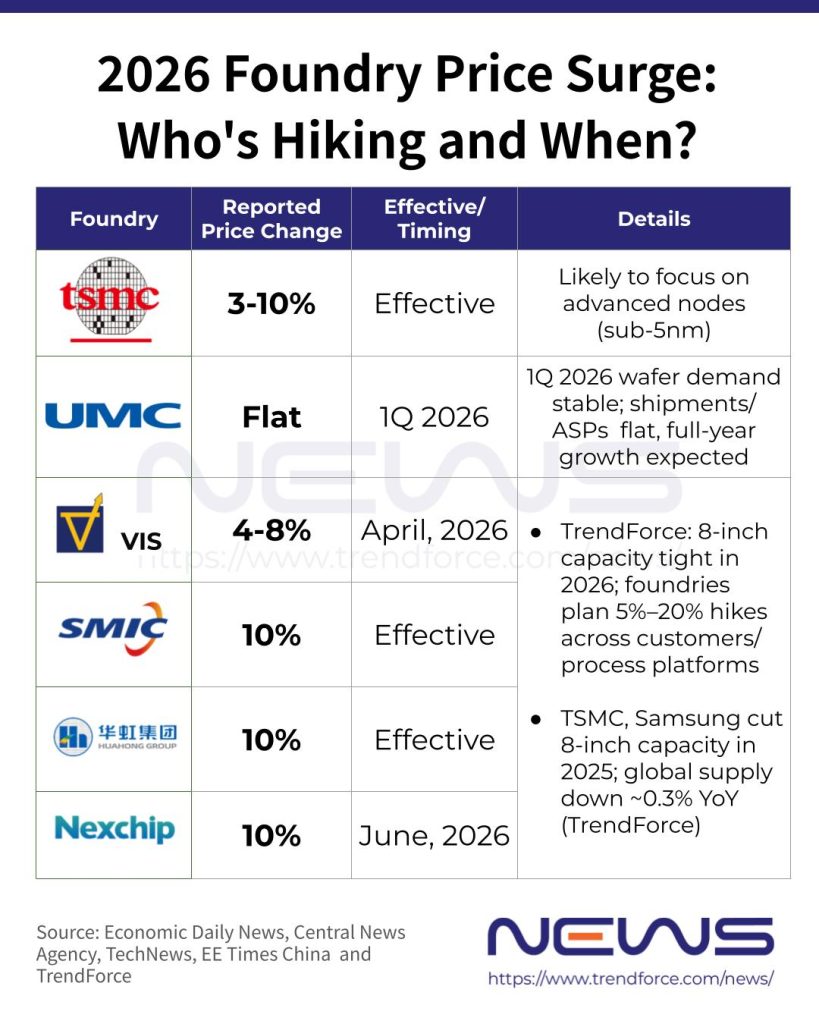
As 8-inch capacity tightens and operating costs climb, foundries are bracing for a new wave of price hikes. Following Chinese peers led by SMIC, Nexchip, the country’s third-largest foundry, announced on March 12 a 10% increase in foundry fees starting June 2026, TechNews reports.
According to TechNews, Nexchip, in its client notice, cited geopolitical instability, supply chain volatility, and higher raw material costs as key factors driving the adjustment. With more than two months before the new rates take effect, industry observers reportedly expect some customers may accelerate shipments or adjust orders to mitigate upcoming cost pressures.
Though the notice suggests that all wafers produced from 0:00 on June 1, 2026, will see a 10% increase in foundry fees, industry sources say the adjustment may not apply uniformly across all products.
It is worth noting that Nexchip also speeds up capacity expansion amid rising demand. In January 2026, Nexchip’s Phase IV project, with a total investment of CNY 35.5 billion, was launched. According to its press release, the project will establish a 12-inch wafer foundry line with a monthly capacity of 55,000 wafers, supporting 40nm and 28nm logic, CIS, and OLED processes.
As previously reported by Commercial Times, the rapid expansion of AI applications is fueling strong demand for power management chips. Notably, major Chinese foundries SMIC and Hua Hong continue to run at full capacity, with prices for some process nodes already rising by roughly 10%, the report added.
On the other hand, TSMC affiliate Vanguard International Semiconductor, known for its focus on 8-inch fabs, could introduce price increases as early as the first quarter, with hikes estimated at around 4%–8%, according to Commercial Times.
Market Chatter on TSMC’s Potential 22–28nm Capacity Cuts
Amid rising mature-node prices, supply is expected to tighten further as TSMC scales back legacy capacity. The foundry has reportedly informed customers that its Fab 2 (6-inch) and Fab 5 (8-inch) will shut down by the end of 2027, a move that could further constrain 8-inch supply and add upward pressure on mature-node pricing.
Meanwhile, market rumors have also emerged suggesting TSMC could reduce 22–28nm capacity in the second half of 2026. However, industry sources caution that while the long-term trend of shifting resources toward advanced nodes such as 3nm and 2nm is clear, the rumored timeline is unlikely to materialize this year.
According to TrendForce, TSMC maintained its dominance in 2025, with market share climbing to 69.9% from 64.4% a year earlier. Samsung remained in second place but saw its share slide to 7.2%, down from 9.4% in 2024.
China’s foundries remained broadly stable in 2025, with SMIC (5.32%), Hua Hong (2.6%), and Nexchip (0.8%) ranking third, sixth, and ninth globally, respectively, TrendForce notes.
Read more
- [News] AI Drives Mature-Node Prices: SMIC Reportedly Up 10%, Vanguard Estimated Up 4–8% From Q1
- [News] China Reportedly Aims to Boost 7nm, 5nm Output Fivefold in Two Years, Driven by SMIC, Hua Hong
(Photo credit: Nexchip)
Please note that this article cites information from TechNews, Commercial Times and Nexchip.