Popular Keywords



About TrendForce News
TrendForce News operates independently from our research team, curating key semiconductor and tech updates to support timely, informed decisions.
[News] China Reportedly Builds EUV Prototype Using Older ASML Components, Eyes 2028 Chipmaking
China’s long journey toward domestic EUV lithography capability appears to be narrowing, as recent developments point to faster-than-expected progress. According to Reuters, sources say China has assembled a prototype EUV machine using components sourced from older ASML systems.
As the report indicates, sources say the Chinese government aims to produce functional chips using the prototype by 2028, though 2030 is viewed as a more realistic target. The existence of the prototype suggests China could be years closer to semiconductor self-sufficiency than previously expected.
Citing sources, the report notes that the prototype was completed in early 2025 and is now undergoing testing. It adds that while the machine is operational and capable of generating extreme ultraviolet light, it has not yet produced working chips.
Former ASML Engineers Reportedly Part of EUV Effort
The report, citing sources, says the prototype was developed by former ASML engineers who reverse-engineered EUV machines while working under aliases to maintain secrecy, adding that without their deep, first-hand expertise, the effort would have been nearly impossible.
The recruitment of these ex-ASML veterans was part of an aggressive talent drive launched in 2019 to attract overseas semiconductor experts, offering signing bonuses of 3 million to 5 million yuan ($420,000 to $700,000) along with housing purchase subsidies, the report adds. Notably, the report mentions that the recruits included Lin Nan, ASML’s former head of light-source technology, whose team at the Chinese Academy of Sciences’ Shanghai Institute of Optics has filed eight EUV light-source patents over the past 18 months.
Huawei Reportedly at the Center of the EUV Program
Beyond former ASML engineers, the report, citing sources, says that although the EUV project is led by the Chinese government, Huawei plays a central role in coordinating a nationwide network of companies and state research institutes involving thousands of engineers.
Huawei has deployed staff to offices, fabs, and research centers nationwide to support the effort, the report states. According to sources cited by the report, employees assigned to the project often stay on-site during the work week and face restrictions on returning home, with phone access limited due to the sensitive nature of their work.
Limits of the Current Prototype
While China has developed an EUV prototype, the report points out that it remains far less sophisticated than ASML’s systems. The prototype is functional enough for testing, but China still faces significant technical hurdles—particularly in matching the ultra-precision optical systems produced by Western suppliers.
China’s prototype trails ASML’s machines largely because researchers have struggled to secure ultra-precision optical systems such as those supplied by Germany’s Carl Zeiss AG, a key ASML partner, according to sources cited in the report. Meanwhile, export-restricted components from Japan’s Nikon and Canon are said to be used in the prototype.
Read more
- [News] Decoding China’s Lithography Push to Challenge ASML: From SiCarrier to Alternative EUV Paths
- [News] China Reportedly Damaged DUV Machine in Reverse-Engineering, Called ASML for Help
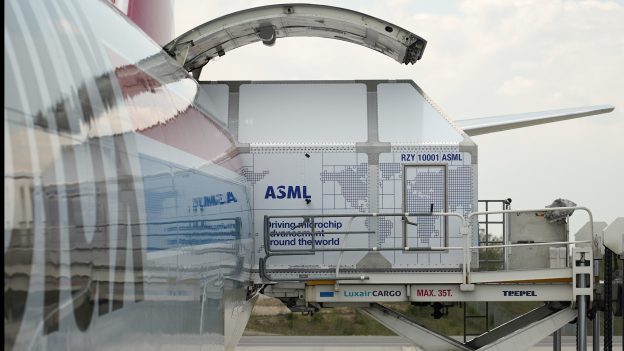
(Photo credit: ASML)
Please note that this article cites information from Reuters.