Popular Keywords



About TrendForce News
TrendForce News operates independently from our research team, curating key semiconductor and tech updates to support timely, informed decisions.
[News] Samsung LPDDR6 Memory Specs Unveiled: 10.7Gbps Speed on 12nm; Reportedly Eyes 14 Gbps
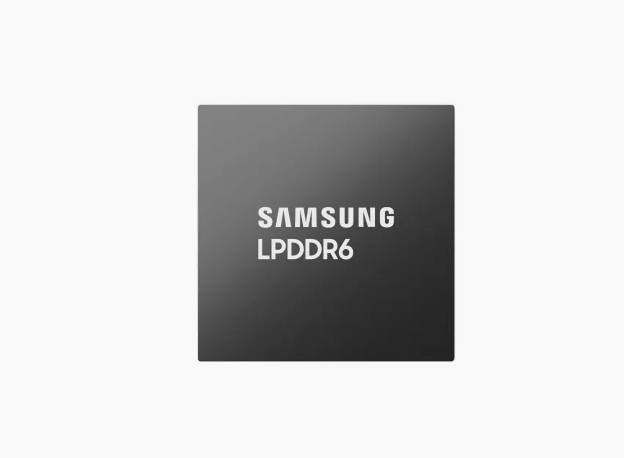
As Samsung pushes forward with its HBM4 timeline, it’s also making strides in next-gen DRAM. CES and Samsung’s press release show that its LPDDR6 has been named a 2026 Innovation Award Honoree in the Mobile Devices, Accessories & Apps category. The newly revealed specs, notably, point to a 12 nm design delivering 10.7Gbps data rates with expanded I/O for higher bandwidth—built for data-heavy mobile, edge, and on-device AI workloads.
TechPowerUp, citing Samsung, reports that LPDDR6 delivers a 21% jump in energy efficiency over LPDDR5X—matching its bandwidth and speeds while using about one-fifth less power. The outlet also notes that future LPDDR6 revisions could climb to 14 Gbps, surpassing even the fastest overclocked LPDDR5X. As the report highlights, Samsung’s tuned LPDDR5X already hits 10.7 Gbps, effectively setting the starting line for LPDDR6.
More specifics should land at the upcoming 2026 CES, where Samsung plans to demo devices running the new memory and detail its key features, the report adds.
According to Samsung, LPDDR6 also brings stronger security features to protect data integrity, pushing its use cases beyond mobile and into industrial and mission-critical AI applications.
LPDDR6 Roadmap for Memory Giants
Samsung isn’t the only one gearing up for LPDDR6. Wccftech, citing SK hynix’s roadmap, reports the company is rolling out a wide range of DRAM—from standard LPDDR6 to AI-focused “AI-D” solutions like LPDDR5X SOCAMM2, MRDIMM Gen2, LPDDR5R, and second-generation CXL LPDDR6-PIM. SK hynix’s LPDDR6 is expected in 2026, while DDR6 may arrive between 2029 and 2031, the report suggests.
Micron has not provided detailed timing for LPDDR6, but in its June earnings call, the company reportedly marked a key milestone: first qualification sample shipments of 1γ-based LPDDR5 DRAM, according to Tom’s Hardware. The 1γ process—Micron’s 6th-generation 10nm-class node—offers 20% lower power, 15% higher performance, and 30% greater bit density than 1β, potentially reducing production costs once yields stabilize, the report adds.
Read more
(Photo credit: CES’s website)
Please note that this article cites information from CES, TechPowerUp, Wccftech, Tom’s Hardware, and Samsung.