


Apple’s Across-the-Board Price Increases Add Uncertainty to Consumer Demand; Global Notebook Shipments Forecast to Decline 13.6% in 2026, Says TrendForce
Apple's decision to raise prices across the entire MacBook lineup has reshaped market expectations, according to TrendForce’s latest notebook market research. Even premium brands are now being forced to pass part of their rising costs on to consumers, reinforcing expectations of higher notebook prices and making consumers more cautious about upgrading their devices.
TrendForce forecasts Apple will ship approximately 23.1 million notebooks in 2026 as MacBook price increases begin to reach end markets in the third quarter and consumer demand softens. First-half shipments exceeded expectations, supported by stable pricing and the strong launch of the MacBook Neo. Although momentum is expected to moderate in the second half, full-year shipments are still projected to achieve double-digit year-over-year growth.
TrendForce notes that higher MacBook prices may narrow the price overlap between MacBooks and certain premium Windows notebooks, encouraging some price-sensitive consumers to switch to Windows devices. Nevertheless, with notebook prices rising across the board and overall consumer demand weakening, this spillover effect is expected to be limited and is unlikely to become a meaningful driver of broader market recovery.
Compared to the overall notebook market, Apple’s performance is projected to stay relatively stable throughout the year. The ongoing adoption of Apple Silicon is encouraging existing users to upgrade, and the robust macOS ecosystem—along with Apple’s seamless cross-device integration—helps maintain underlying demand. However, if retail prices increase more than anticipated and significantly reduce consumer demand, Apple’s shipment forecast might need further downward adjustment.
TrendForce observes that strong demand for AI servers continues to divert semiconductor supply chain resources away from consumer electronics. Prices for memory, power management ICs, and key raw materials such as gold and copper remain elevated, keeping pressure on notebook manufacturing costs.
CPU supply in mainstream price segments did improve steadily during the second quarter when compared with conditions at the beginning of 2026. This enabled notebook brands to accelerate procurement and bring shipments forward. As a result, first-half notebook shipments exceeded earlier expectations.
Stronger-than-expected first-half demand also means that a portion of second-half demand has effectively been pulled forward, leaving less demand to support the market later in the year. As rising component costs are gradually passed through to retail prices, signs of weakening consumer demand have begun to emerge. TrendForce notes that several notebook brands have already experienced softer consumer demand. This is particularly noticeable in the entry-level and mainstream segments, where price sensitivity has become increasingly evident.
Consumers are also beginning to extend their notebook replacement cycles. Despite demand from commercial PC upgrades and education-sector procurement projects remaining relatively stable and continuing to provide an important source of support, it is insufficient to fully offset the slowdown in the consumer market.
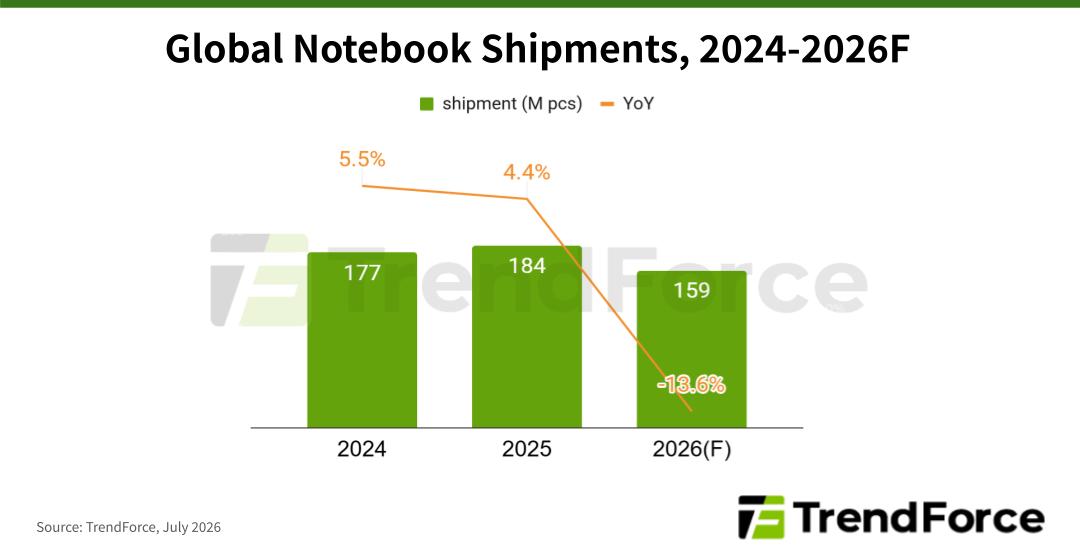
TrendForce forecasts that global notebook shipments will decline by 13.6% in 2026 after taking into account the stronger-than-expected first-half shipments driven by improved component supply, weaker second-half demand, and rising end-market prices.
The industry continues to face two major challenges: First, sustained AI server demand is consuming memory capacity and advanced semiconductor manufacturing resources, making supply shortages and cost inflation difficult to ease in the near term.
Second, consumers are becoming increasingly resistant to higher notebook prices. Against a backdrop of constrained supply and slowing demand, notebook brands will face their greatest challenge in balancing cost pass-through with maintaining end-market demand.
For more on the latest technology industry news and trends, please visit News.